Lucrative themes
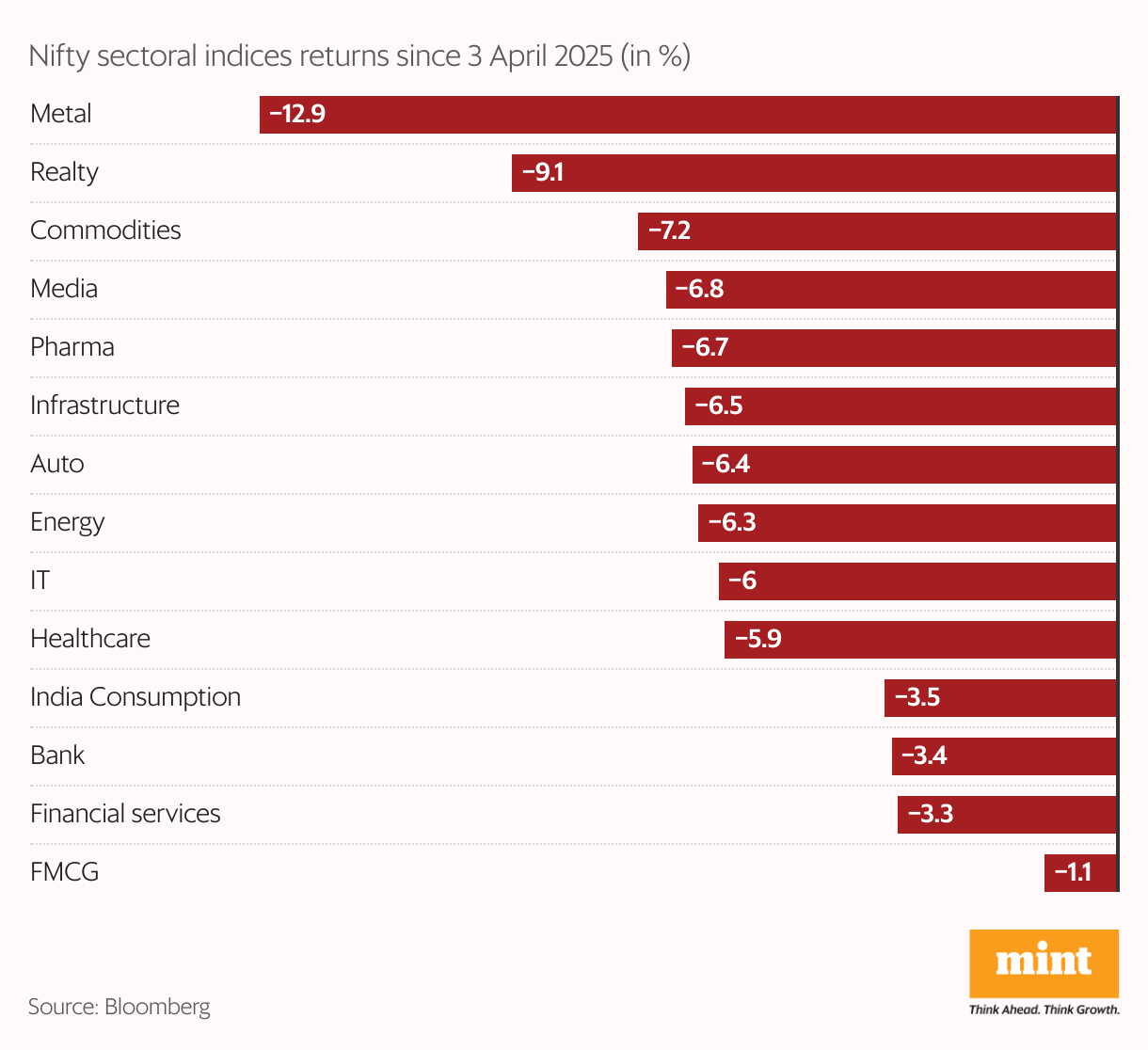
Following the market volatility on Monday, all sectoral indices were awash in a sea of red, with the metals and real estate sectors bearing most of the brunt. But the broader market corrections have made consumption-oriented and domestic-facing sectors more lucrative for investors, according to experts.
“Domestic themes like cement, building materials and consumer discretionary looks attractive from a longer-term point of view,” Nilesh Shah, managing director at Kotak Mahindra AMC, said in a note.
Also read | Here are the sectoral winners and losers from Trump’s reciprocal tariffs
“The tax rebate announced in the budget, EMI burden coming down due to lower rates, likely drop in oil prices and eighth pay commission to be implemented next year will support (the) consumption theme,” Shah added.
In fact, the Nifty FMCG index has been the most resilient so far, losing only 1% in the last three days. The Nifty Consumption, Nifty Bank, and Nifty Financial Services indices lost only 3-3.5% in that period.
The rupee’s resilience
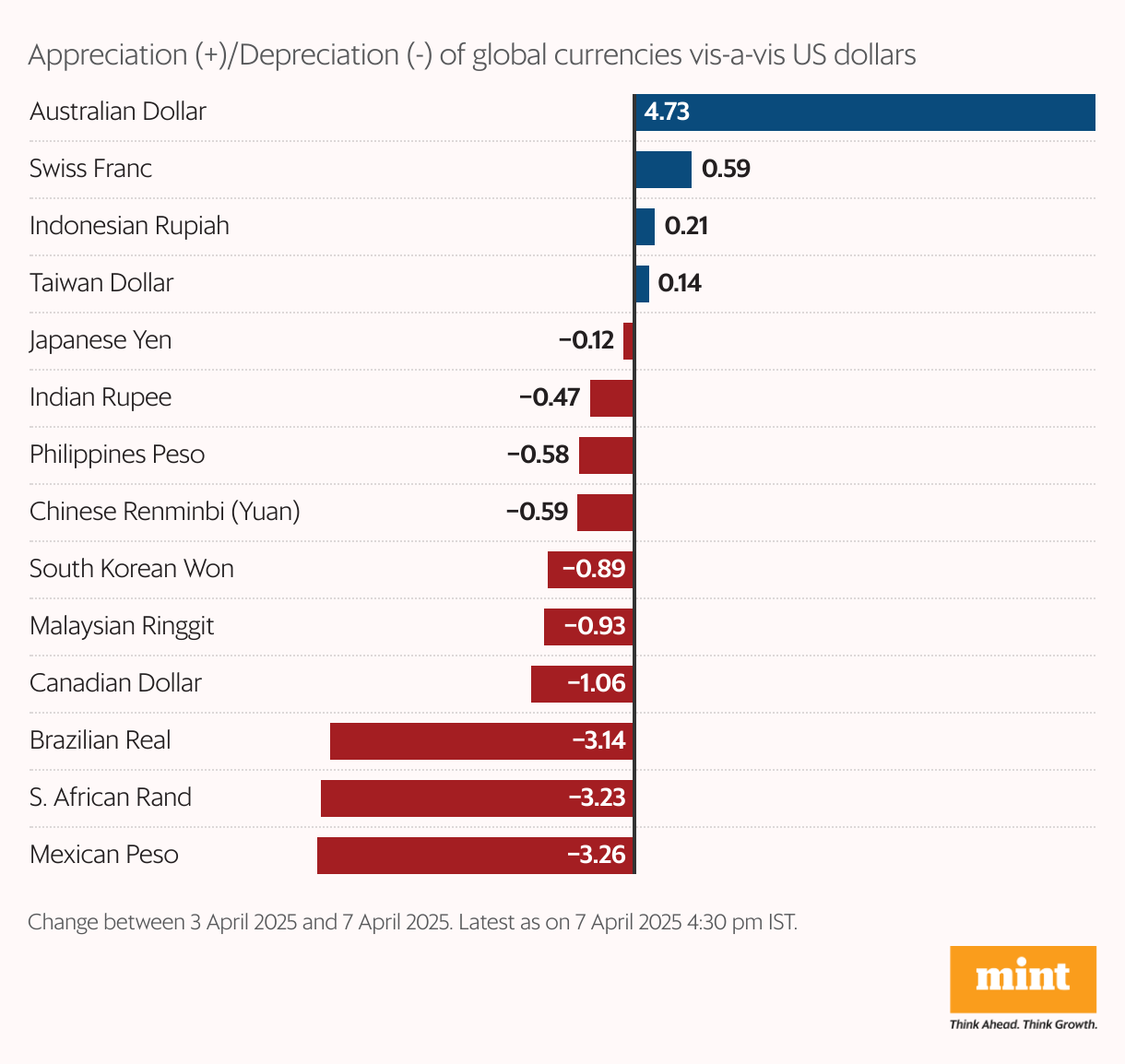
As global currencies adjust to Trump’s tariff measures, several emerging market currencies have depreciated against the US dollar—potentially boosting export competitiveness. However, the Indian rupee has shown relative firmness, slipping just 0.47% between 3 April and 7 April.
The South African rand and Mexican peso have posted heavy corrections, depreciating by 3.23% and 3.26%, respectively, while the Brazilian real has weakened by 3.14%. The Chinese renminbi has declined by 0.59%.
On the flip side, some major currencies have moved against the broader trend. The Australian dollar appreciated sharply against the US dollar by 4.73%, followed by the British pound at 2.11%. The Swiss franc and the euro also strengthened by 0.59% and 0.80%, respectively—an outcome that could weigh on their export competitiveness in the short term.
Even so, the “intensifying trade war triggered by Trump’s tariff policy weighs on the INR”, said Kunal Sodhani, assistant general manager (vice president), global trading centre, FX & rates treasury, Shinhan Bank India.
“The heightened uncertainty has triggered risk-off sentiment, leading to outflows from emerging markets. DXY (US dollar index) also sharply bounced back above 103 levels, pushing USD higher against the majors,” Sodhani added.
“China also had retaliatory tariffs on the US. Thus, all eyes also remain on the USD-CNH (Chinese Yuan) pair. Any major weakening in the Chinese yuan can have its negative impact on rupee. For USD-INR, 85.20 acts as a good base while 86.50 levels may be tested.”
About The Author