The Bank of Japan (BoJ) meets on Thursday and is expected to keep its benchmark interest rate unchanged at 0.5%, awaiting the first moves of Prime Minister Sanae Takaichi’s new cabinet.
Market hopes that the BoJ will continue normalising its monetary policy remain intact, and some central bank policymakers have confirmed that theory. Expectations of an interest rate hike in October, nevertheless, have receded, following the election of the fiscal dove Takaichi as Japan’s Prime Minister in mid-October.
In this context, investors will keep their focus on the vote split, expecting to see some dissenting voices, and on the tone of BoJ Governor Kazuo Ueda’s press conference, seeking validation of a rate hike in December or, at the latest, in January.
What to expect from the BoJ interest rate decision?
As it stands, the BoJ is expected to maintain its monetary policy unchanged for the sixth consecutive meeting in October and reiterate its commitment to gradual monetary tightening.
A recent Reuters poll showed that 60% of analysts expect the Bank of Japan to raise its benchmark interest rate to 0.75% from the current 0.5% before the year-end. Data from the overnight swaps market, however, revealed that the chances of an October hike have dropped to about 24%, from 68% last month.
The new Prime Minister Takaichi, an assistant of former Prime Minister Shinzo Abe, has defended a looser fiscal policy and pledged to reassert the government’s authority over the Bank of Japan and its monetary policy. This has raised concerns about the central bank’s independence, dampening market expectations of immediate rate hikes.
With this in mind, the stubbornly strong inflation is likely to pose a serious challenge to Takaichi’s aim of an expansive monetary policy. Data released last week revealed that the National Consumer Price Index (CPI) accelerated to 2.9% in September, from the previous 2.7%, remaining above the central bank’s target for price stability.
Beyond that, service-sector inflation has picked up for the second consecutive time in September, endorsing the BoJ’s view that rising labour costs will keep price pressures sustainably above the central bank’s 2.0% target in the coming months.
Against this background, some BoJ policymakers have called for immediate rate hikes. Board Member Hajime Takata said last week that now is the appropriate time to raise interest rates, noting that inflation has remained above the bank’s target for three and a half years already, and the economic risks stemming from US tariffs have eased. BoJ Governor Ueda, however, has been showing a more cautious view.
How could the Bank of Japan’s monetary policy decision affect USD/JPY?
In this context, investors have already assumed a delay of the next rate hike, but they are likely to look for confirmation that the plan to keep normalising the monetary policy remains in play. A dovish hold, with no mention of upcoming rate hikes, might disappoint markets and send the Japanese Yen (JPY) on a tailspin.
The Yen lost more than 2% against the US Dollar (USD) in the week after Takaichi secured support to form a cabinet in mid-October. This week, USD/JPY has whipsawed, pulling back following the agreement between the US and Japan, and higher hopes of a China-US trade deal, to bounce up again following Chairman Jerome Powell’s hawkish comments after the Fed’s monetary policy decision on Wednesday.
USD/JPY 4-Hour Chart
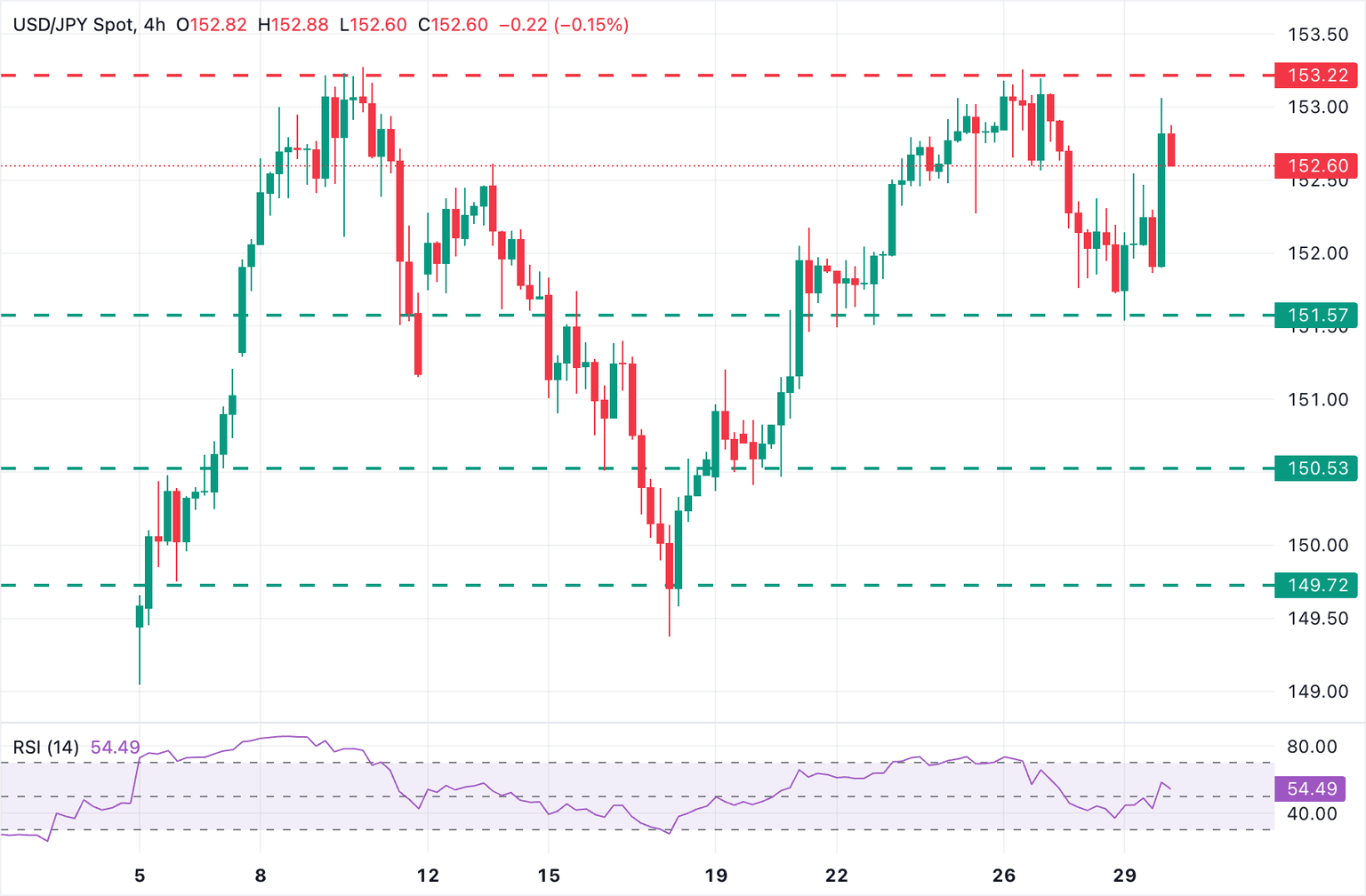
From a technical perspective, Guillermo Alcalá, FX analyst atFXStreetsees the USD/JPY pair looking for direction with key resistance below the 153.20 area: “The risk is on a too dovish BoJ statement, which might disappoint investors and send the pair back beyond the eight-month highs, at the 153.25 area, aiming for mid-February highs, at 154.80.”
“On the other hand, clear signals hinting at a rate cut in December or a high number of dissenters would give fresh hopes for Yen bulls to retest the October 21 and 22 lows, at the 151.50 area,” says Alcala.
Japanese Yen FAQs
The Japanese Yen (JPY) is one of the world’s most traded currencies. Its value is broadly determined by the performance of the Japanese economy, but more specifically by the Bank of Japan’s policy, the differential between Japanese and US bond yields, or risk sentiment among traders, among other factors.
One of the Bank of Japan’s mandates is currency control, so its moves are key for the Yen. The BoJ has directly intervened in currency markets sometimes, generally to lower the value of the Yen, although it refrains from doing it often due to political concerns of its main trading partners. The BoJ ultra-loose monetary policy between 2013 and 2024 caused the Yen to depreciate against its main currency peers due to an increasing policy divergence between the Bank of Japan and other main central banks. More recently, the gradually unwinding of this ultra-loose policy has given some support to the Yen.
Over the last decade, the BoJ’s stance of sticking to ultra-loose monetary policy has led to a widening policy divergence with other central banks, particularly with the US Federal Reserve. This supported a widening of the differential between the 10-year US and Japanese bonds, which favored the US Dollar against the Japanese Yen. The BoJ decision in 2024 to gradually abandon the ultra-loose policy, coupled with interest-rate cuts in other major central banks, is narrowing this differential.
The Japanese Yen is often seen as a safe-haven investment. This means that in times of market stress, investors are more likely to put their money in the Japanese currency due to its supposed reliability and stability. Turbulent times are likely to strengthen the Yen’s value against other currencies seen as more risky to invest in.
Economic Indicator
BoJ Press Conference
The Bank of Japan (BoJ) holds a press conference at the end of each one of its eight scheduled policy meetings. At the press conference the Governor of the BoJ communicates with media representatives and investors regarding monetary policy. The Governor talks about the factors that affect the most recent interest rate decision, the overall economic outlook, inflation, and clues regarding future monetary policy. Hawkish comments tend to boost the Japanese Yen (JPY), while a dovish message tends to weaken it.
Read more.
Next release:
Thu Oct 30, 2025 06:30
Frequency:
Irregular
Consensus:
–
Previous:
–
Source:
Bank of Japan
About The Author