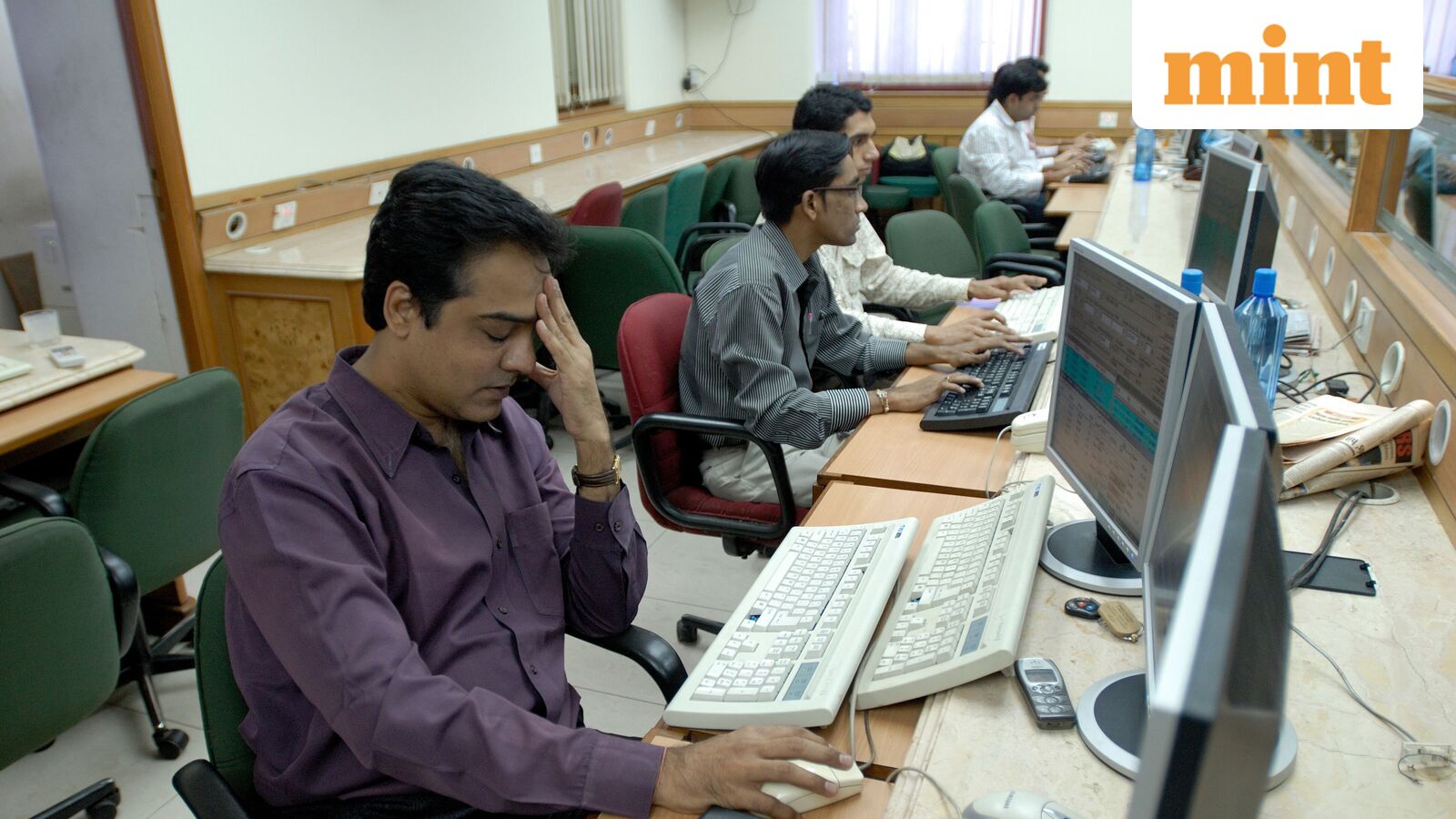
The domestic stock market barometer- the Sensex and the Nifty 50- suffered strong losses in intraday trade on Friday, November 7, extending their losing run to the third consecutive session.
In these sessions, the Sensex has crashed over 1,300 points, or 1.6 per cent, while the Nifty 50 has dropped by more than 440 points, or 1.7 per cent.
On Friday, the Sensex plunged over 600 points, or nearly 1 per cent, to an intraday low of 82,670.95, while the Nifty 50, too, dropped by nearly a per cent to an intraday low of 25,318.45. The selloff was broad-based as the Nifty Midcap 100 and the Nifty Smallcap 100 indices also dropped by up to a per cent.
Why is the Indian stock market falling?
Let’s take a look at five key factors that are driving the Indian stock market down:
1. Weak global cues
Weakness in global markets is one of the primary triggers behind the recent selloff in the Indian stock market.
Globally, sentiment has turned cautious over stretched valuations of the “mother market”, Wall Street.
On November 7, major Asian stock markets suffered strong losses, with Japan’s Nikkei and Korea’s Kospi crashing 2 per cent each, following an up to 2 per cent fall on Wall Street overnight.
While investors are now looking for fresh triggers amid dimming prospects for another rate cut by the US Federal Reserve, the ongoing US government shutdown, which began on October 1 and is now the longest in history, has created a dearth of economic data and is creating a sense of uncertainty in the market.
2. Indian market lacks dominance of tech, commodities players
The rally in global markets this year has been largely driven by tech companies, fueled by strong optimism surrounding artificial intelligence (AI). India lacks strong global players in the segment. Experts say this is one of the reasons why Indian stock markets have underperformed this year so far.
“Globally, two sectors- tech and commodities- are driving the rally. India does not have many strong names in these segments. This is one of the reasons why we are underperforming,” said Shankar Sharma, ace investor and the founder of GQuant, an AI-tech company.
3. The “macro” element
India’s gross domestic product (GDP) grew by an impressive 7.8 per cent in the first quarter of the current financial year (Q1FY26), thanks to low inflation.
However, the growth in nominal GDP (economic expansion before adjusting for inflation) declined to 8.8 per cent in Q1FY26 as against 9.6 per cent in the same period last fiscal. This indicates that there is still some weakness in the economy. Concerns over the Indian economy are limiting the gains of the market.
Meanwhile, India’s services sector eased to a five-month low in October after hitting a 15-year peak in August.
“The Indian market is an ageing bull market. Economic growth is deceptive: real GDP growth looks good, but the problem lies in the very low nominal GDP growth figure. Nominal GDP growth is what really drives earnings. Stretched valuations are also keeping the risk appetite low,” said Sharma.
The Q2FY26 GDP data is due on November 28.
4. Relentless foreign capital outflow
Foreign institutional investors (FIIs) continue selling Indian stocks amid mixed earnings, volatility in the Indian rupee, and fading expectations of further US Fed rate cuts.
So far in November, FIIs have offloaded Indian stocks worth ₹6,214 crore. They have been selling Indian equities since July this year, cumulatively offloading around ₹1.4 lakh crore in the cash segment.
“The huge shorting by FIIs is overpowering the DII and investor buying in the market. The success of the FII strategy of sustained selling in India and moving money to cheaper markets has emboldened them to continue the strategy and continue shorting the market,” said VK Vijayakumar, Chief Investment Strategist at Geojit Investments.
5. Persisting uncertainty over India-US trade deal
Despite many positive signals and the apparent bonhomie between Prime Minister Narendra Modi and US President Donald Trump, the persisting uncertainty over a potential India–US trade deal remains a major headwind for the Indian stock market.
On Thursday, Trump said that talks with Prime Minister Modi on the India-US trade deal were progressing well, and he could visit the country next year.
Read all market-related news here
Read more stories by Nishant Kumar
Disclaimer: This story is for educational purposes only. The views and recommendations expressed are those of individual analysts or broking firms, not Mint. We advise investors to consult with certified experts before making any investment decisions, as market conditions can change rapidly and circumstances may vary.
About The Author