Gold (XAU/USD) turns lower for the third straight day on Monday following a modest Asian session uptick to levels just above the $4,100 mark and remains close to a one-week low touched on Friday. Traders scaled back their expectations for another interest rate hike by the US Federal Reserve (Fed) after a slew of influential FOMC members showed little conviction for reducing borrowing costs. This, in turn, assists the US Dollar (USD) to gain some positive traction at the start of a new week and turns out to be a key factor undermining the non-yielding yellow metal.
However, worries about the weakening economic momentum on the back of the longest-ever US government shutdown keep the door open for further policy easing by the US central bank, which might cap gains for the USD. This, along with a softer risk tone, could offer some support to the safe-haven Gold and help limit deeper losses. Traders might also refrain from placing fresh directional bets and opt to wait for the FOMC meeting Minutes on Wednesday. Moreover, the delayed US Nonfarm Payrolls (NFP) report for October on Thursday would influence the USD and drive the commodity.
Daily Digest Market Movers: Gold drifts lower as reduced Fed rate cut bets revive USD demand
- A growing number of Federal Reserve officials adopted a cautious stance and showed reluctance toward additional monetary policy easing. In fact, Kansas City Fed President Jeffrey Schmid said on Friday that inflation is too hot and that there is no room to be complacent on inflation expectations.
- Monetary policy is modestly restrictive, which is where it should be, and should lean against demand growth, Schmid added further. The probability for a 25 basis-point rate cut in December fell below 50% last week, which weighed on the non-yielding Gold for the second straight day on Friday.
- The US Dollar firmed slightly at the start of a new week as investors braced for the release of delayed US macro data for more clarity on the Fed’s interest rate outlook. This, in turn, is seen as another factor that keeps the XAU/USD bulls on the defensive through the Asian session on Monday.
- The closely-watched US Nonfarm Payrolls report for October will be published on Thursday, following the release of FOMC Minutes on Wednesday. This, in turn, will play a key role in influencing the near-term USD price dynamics and providing some meaningful impetus to the precious metal.
- Investors seem convinced that the US economic data would show some weakness and a slowdown in the economy on the back of a prolonged US government shutdown and prompt the Fed to ease policy further. This, along with a softer risk tone, helps limit the downside for the safe-haven commodity.
Gold could accelerate the downfall below Friday’s swing low, around the $4,032 region
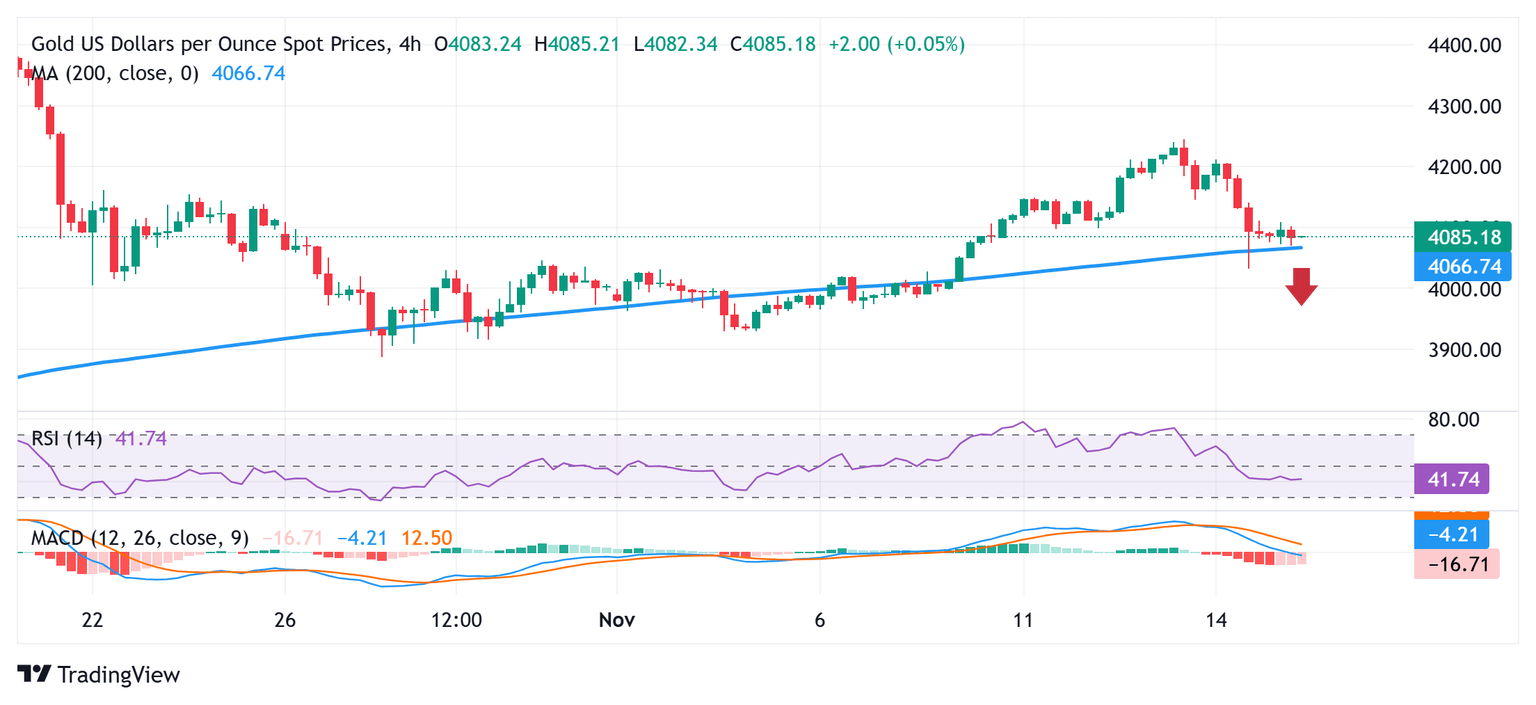
On Friday, the XAU/USD pair showed some resilience below the 20-period Simple Moving Average (SMA) on the 4-hour chart. The lack of any subsequent move up, however, warrants some caution for bullish traders. Moreover, negative oscillators on the said chart make it prudent to wait for sustained strength and acceptance above the $4,100 mark before positioning for further gains towards the $4,140-4,145 resistance. The momentum could extend further and allow the Gold price to make a fresh attempt towards conquering the $4,200 round figure.
On the flip side, weakness below the 200-period SMA on the 4-hour chart, currently around the $4,059 area, could find some support near Friday’s swing low, around the $4,032 region. This is followed by the $4,000 psychological mark, which, if broken decisively, could make the Gold price vulnerable to accelerate the fall towards the $3,931 intermediate support en route to the $3,900 mark and late October swing low, around the $3,886 region.
Fed FAQs
Monetary policy in the US is shaped by the Federal Reserve (Fed). The Fed has two mandates: to achieve price stability and foster full employment. Its primary tool to achieve these goals is by adjusting interest rates.
When prices are rising too quickly and inflation is above the Fed’s 2% target, it raises interest rates, increasing borrowing costs throughout the economy. This results in a stronger US Dollar (USD) as it makes the US a more attractive place for international investors to park their money.
When inflation falls below 2% or the Unemployment Rate is too high, the Fed may lower interest rates to encourage borrowing, which weighs on the Greenback.
The Federal Reserve (Fed) holds eight policy meetings a year, where the Federal Open Market Committee (FOMC) assesses economic conditions and makes monetary policy decisions.
The FOMC is attended by twelve Fed officials – the seven members of the Board of Governors, the president of the Federal Reserve Bank of New York, and four of the remaining eleven regional Reserve Bank presidents, who serve one-year terms on a rotating basis.
In extreme situations, the Federal Reserve may resort to a policy named Quantitative Easing (QE). QE is the process by which the Fed substantially increases the flow of credit in a stuck financial system.
It is a non-standard policy measure used during crises or when inflation is extremely low. It was the Fed’s weapon of choice during the Great Financial Crisis in 2008. It involves the Fed printing more Dollars and using them to buy high grade bonds from financial institutions. QE usually weakens the US Dollar.
Quantitative tightening (QT) is the reverse process of QE, whereby the Federal Reserve stops buying bonds from financial institutions and does not reinvest the principal from the bonds it holds maturing, to purchase new bonds. It is usually positive for the value of the US Dollar.
About The Author