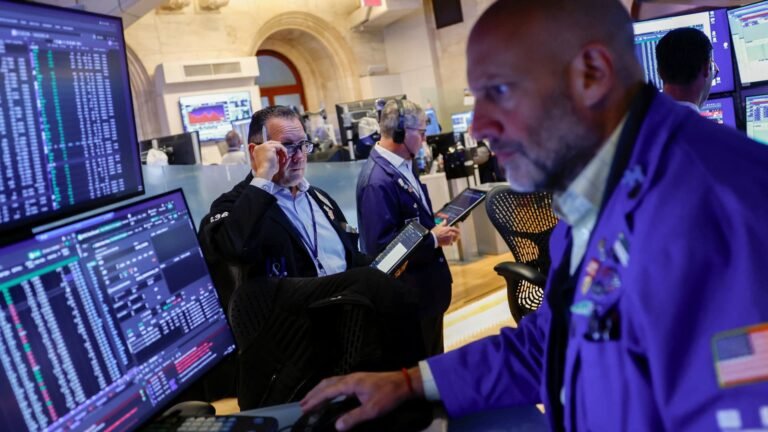
The Indian stock market witnessed an across-segment selloff on Monday, January 19, on profit booking amid weak global cues. Benchmarks, the Sensex and the Nifty 50 fell by almost half a per cent, with heavyweights, including Reliance, ICICI Bank, and HDFC Bank, among the top drags after their Q3 results.
The Sensex dropped 324 points, or 0.39%, to end at 83,246.18, while the Nifty 50 closed at 25,585.50, losing 109 points, or 0.42%. The BSE Midcap index fell 0.43%, while the Smallcap index suffered a loss of 1.28%.
Investors lost ₹2 lakh crore in a day as the overall market capitalisation of BSE-listed firms dropped to slightly over ₹466 lakh crore from nearly ₹468 lakh crore in the previous session.
Why did the Indian stock market fall?
Let’s take a look at five key factors behind the fall in the Indian stock market:
1. Trump’s tariff threat
US President Donald Trump threatened tariffs against eight European nations, effective from February 1, over Greenland.
Trump said in a post on Truth Social that starting 1 February, Denmark, Norway, Sweden, France, Germany, the United Kingdom, the Netherlands, and Finland will be charged a 10% tariff on all goods they export to the United States. On 1 June, the tariffs will increase to 25% and remain at 25% until a deal regarding “the complete and total purchase of Greenland” is finalised, he said.
Trump’s tariff threat attracted sharp reactions from European Union leaders, with media reports suggesting several of them discussed possible retaliation, including bringing back last year’s plan to impose tariffs on US goods.
“We don’t know now how President Trump’s disruptive policies are going to impact international trade and global economic growth. How the European nations are going to react to President Trump’s latest Greenland tariffs remains to be seen,” said VK Vijayakumar, Chief Investment Strategist, Geojit Investments.
“If Trump walks his talk and imposes 10% tariffs on the eight European countries on February 1st and follows it up by raising the tariffs to 25% from June 1st onwards, retaliation by the European bloc is almost certain,” said Vijayakumar.
2. Unimpressive Q3 earnings
Indian corporates have reported mixed Q3 results so far. Unlike expectations of a healthy upside, the numbers for heavyweight sectors such as IT and banking have shown only mild improvements, which have failed to boost market sentiment, pressured by US tariffs and geopolitical tensions.
3. Relentless FII selling
Relentless selling by foreign institutional investors (FIIs) remains a key headwind for the market. FIIs have sold off Indian stocks worth over ₹22,000 crore in the cash segment in January so far. FIIs have been selling Indian stocks since July last year.
“The total FII selling for January up to 16th stood at ₹22,529 crore. This month, FIIs were sellers on all days except one. The underperformance of India vis-à-vis other major markets is continuing in early 2026, also. Year-to-date return from Nifty stands at -1.73%,” Vijayakumar noted.
“It appears that the FII selling trend may continue until some positive triggers for a market rally happen. The AI trade, which dominated the stock market trend in 2025, is also continuing in early 2026. A reversal of this trend might happen sometime in 2026,” said Vijayakumar.
4. Caution ahead of Union Budget 2026
Caution ahead of the mega policy event—the Union Budget 2026—is also contributing to the market downtrend. While the central government is likely to maintain a balance between growth and fiscal consolidation, speculation that an overemphasis on fiscal consolidation may curtail government capital expenditure, a key driver of economic growth, is keeping investors wary.
5. Technical factors
Ajit Mishra, SVP of Research at Religare Broking, observed that the Nifty continues to hover near its medium-term moving average, the 100 DEMA, indicating a tussle between bulls and bears.
“A decisive break below this level could trigger further downside toward 25,300, followed by the key long-term support near the 200 DEMA at 25,150. On the upside, any rebound is likely to face resistance in the 25,900–26,000 zone, with the next hurdle around 26,200,” said Mishra.
Amol Athawale, VP- Technical Research at Kotak Securities, said that the current market formation is non-directional, and the short-term activity indicating a non-directional trend is likely to continue in the near future.
“On the downside, 25,500 and 25,400 would act as key support zones, while the daily SMA (simple moving average) at 25,950 and the 20-day SMA at 26,000 would be crucial resistance levels for the bulls,” said Athawale.
Read all market-related news here
Read more stories by Nishant Kumar
Disclaimer: This story is for educational purposes only. The views and recommendations expressed are those of individual analysts or broking firms, not Mint. We advise investors to consult with certified experts before making any investment decisions, as market conditions can change rapidly and circumstances may vary.
About The Author