Apples iPhone sales surge gives analysts something to cheer, but memory concerns weigh on outlooks
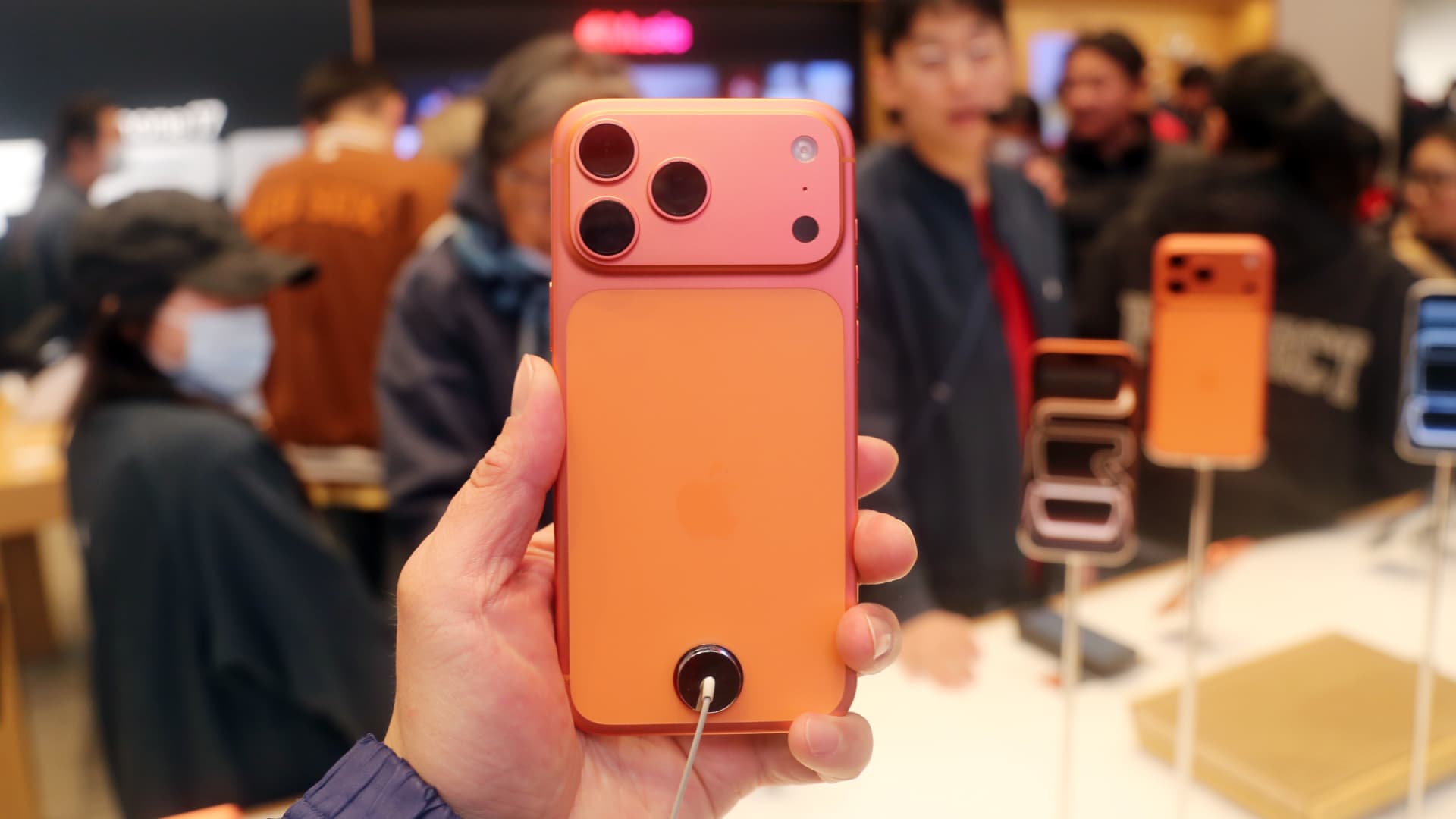
Apple posted a big earnings beat, yet analysts reacted much in the same way as the stock: with a muted response. The tech giant reported fiscal first-quarter earnings of $2.84 per share and $143.76 billion in revenue. Both of those figures beat LSEG consensus estimates of $2.67 in earnings per share and $138.48 billion in revenue. Driving the strong results were iPhone sales. Revenue for the product surged to $85.27 billion — up 23% annually — driven by robust sales for the iPhone 17, released in September. The growth is a shift from last year’s holiday season quarter, when iPhone sales fell. However, analysts were divided over the impact an AI-driven memory shortage — causing a surge in prices — will have on the company. While Apple gave a stronger-than-expected outlook for gross margins in the current quarter, it doesn’t give guidance looking further ahead. That lack of full-year guidance “likely explains stock’s after market reaction,” wrote Citi analyst Atif Mailk. Shares were down slightly despite the strong Q1 results. Initially, the stock popped in after-hours trading but was last 0.7% lower. UBS analyst David Voght believes that lack of visibility is concerning given the adverse impact of higher memory costs will increase as the year goes on. “Our checks suggest that Apple is likely to be less insulated from higher memory costs starting in the June qtr,” he wrote. “Therefore, with GM uncertainty in F2H:26 the debate, we don’t see the shares outperforming the S & P 500 despite a solid Dec qtr until investors gain greater clarity on potential offsets.” But Baird analyst William Power thinks Apple has “a strong track record of navigating supply chain challenges,” and thus will be able to overcome memory issues. Apple CEO Tim Cook noted Thursday that iPhone demand is “constrained,” a bullish sign for Melius Research analyst Ben Reitzes. He expects Apple won’t be able to meet the demand for quite some time, aiding the pricing power of the product. AI continues to be a weak spot for the “Magnificent Seven” member. But analysts were generally more bullish on the company’s ability to make inroads in the space. “AAPL guided F2Q26E opex of $18.4-$18.7 bn, which would mark the first time on record that AAPL opex increased qoq in F2Q reflecting AAPL’s investments to support AI and new products,” wrote Goldman Sachs analyst Michael Ng. Here’s are analysts from across the Street’s initial reactions: Barclays: underweight rating, $239 price target The bank’s target, up from $230, implies more than 7% downside from Apple’s Thursday close. “All geos saw growth in the Q, with Greater China’s 38% y/y growth a standout. It remains difficult for us to see the sustainability in demand in the geo, and expect China weakness could return to the business. Recall, the geo saw y/y losses in 8 of the past 9 Qs, and the December quarter looks like an anomaly to us.” DA Davidson: neutral, $270 “Given the strong demand for iPhone in F1Q26, management noted they exited the quarter with lean inventory and are currently constrained by the availability of advanced nodes. It was called out that supply chain flexibility is notably less given the demand. Furthermore, gross margin was guided to a range of 48-49% with management emphasizing that they expect the impact in F2Q26 to be more pronounced vs. F1Q26 levels, although mix should slightly offset.” UBS: neutral, $280 “Pulling the lens back a bit from the qtr, the direction of the stock over the next 6-12 mos will not be dictated by iPhone/Mac/iPad/AI innovation, but by the magnitude and impact of higher memory costs on iPhone pricing/demand and gross margin… Our checks suggest that Apple is likely to be less insulated from higher memory costs starting in the June qtr. Therefore, with GM uncertainty in F2H:26 the debate, we don’t see the shares outperforming the S & P 500 despite a solid Dec qtr until investors gain greater clarity on potential offsets.” Baird: outperform, $300 “Following years of slowing upgrade rates, iPhone sales have started to improve, aided by strong U.S. carrier trade-in subsidies, continued international penetration and a strong competitive position. We also believe AI (i.e., a revamped Siri) could help drive a stronger product upgrade cycle at some point in the future, with AAPL theoretically well-positioned to be the gateway to mainstream consumer AI adoption.” Wells Fargo: overweight, $300 “Apple highlighted its Google partnership to develop nextgen Apple foundation models and repeatedly emphasized the relationship as a collaboration w/ updated Siri launching in ’26. We see Apple’s hybrid approach (ondevice + cloud) and associated expenses accelerating.” Morgan Stanley: overweight, $315 “New model iPhones, and specifically the Pro/Pro Max, have the highest margins of all Apple Products, and given this is where demand is coming from, mix is acting as an important counterbalance to component cost headwinds. That said, Apple gave zero detail on how to model June quarter Product gross margins, leaving open the possibility that memory inflation could become a much bigger problem in June.” Citi: buy, $315 “Apple points to China as being a very product focused market. Consumers look at the capabilities of the products and the iPhone 17 has really resonated. The strong growth Apple saw in China is tied to that. Apple also believes to have gained share in China. They also benefit from some of the customer subsidies.” Loop Capital: buy, $325 “Margin and memory remain a big focus… and AAPL just guided GM to 48.0% – 49.0% in Mar Q AFTER seeing 100bps of Dec Q QoQ GM expansion to 48.2%. We’ll have more to say on this, but believe AAPL may have more mechanisms to prune out cost in the face of rising memory and processor ASPs than may be appreciated.” JPMorgan: overweight, $325 JPMorgan’s target, up from $315, implies nearly 26% upside for Apple. “Record Product gross margins in the Dec-Q and an implied Mar-Q record Product gross margin should help reassure investors around the materiality of the impact that investors have been concerned about in relation to rising memory costs, even though management acknowledged slightly higher impact in Mar-Q than the Dec-Q.” Bank of America: buy, $325 “We remain bullish on shares of Apple heading into 2026 given (1) iPhone upgrades are tracking better than expected (globally including China) with record upgraders, (2) gross margins continue to move higher despite commodity headwinds, (3) AI enabled Siri will be available in 2026, (4) a foldable iPhone is expected in Sep 2026 and (5) a new record installed base of 2.5bn devices to drive continued double-digit growth in Services.” Goldman Sachs: buy, $330 “AAPL’s outlook for gross margins, which anticipate the impact of rising memory costs, beat expectations (48-49% v. 47.6% consensus), which we believe reflects continued benefits from product premiumization and operating leverage.” Evercore ISI: outperform, $330 “Structurally we think AAPL is positioned to sustain high single digits sales and low teens EPS/FCF growth that could get magnified with share gains as competition likely struggles to get memory allocations. Apple Intelligence (powered by Gemini) will also be another catalyst.” Melius Research: buy, $350 Melius’ target, up from $345, implies more than 35% upside for Apple shares. “In addition, iPhone just crushed the estimates driven by China, which was the main concern in this stock. Perhaps investors think the China momentum isn’t sustainable, but going into a foldable cycle later this year, we are bullish longterm.”