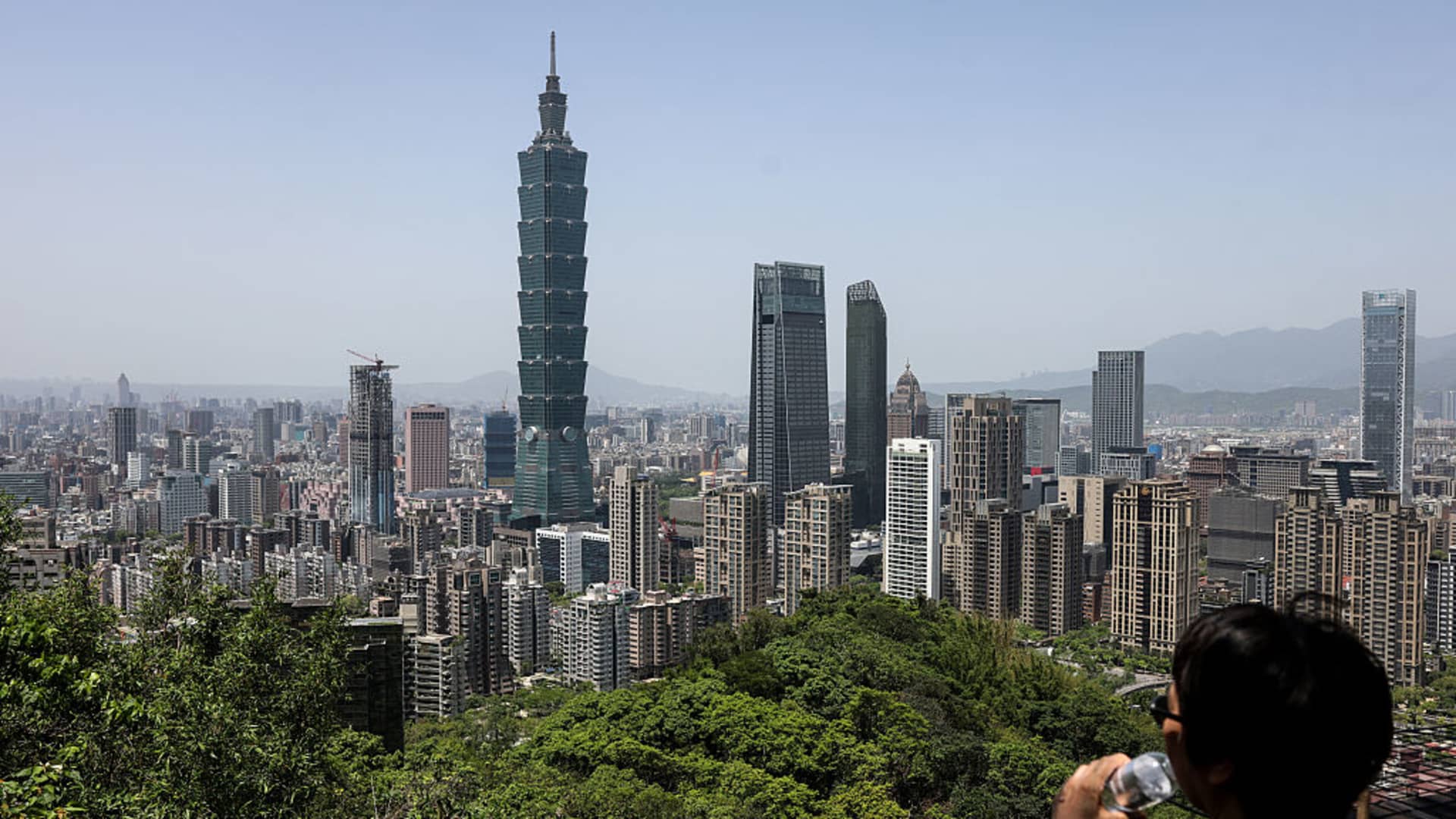
The city skyline is seen with the landmark Taipei 101 building from a lookout point on Elephant Mountain in Taipei on April 14, 2025. (Photo by I-Hwa Cheng / AFP) (Photo by I-HWA CHENG/AFP via Getty Images)
I-hwa Cheng | Afp | Getty Images
Trump administration officials signed a final reciprocal trade agreement that confirmed a 15% U.S. tariff rate for imports fromTaiwan, while committingTaiwanto a schedule for eliminating or lowering tariffs on nearly all U.S. goods.
The document released by the U.S. Trade Representative’s office on Thursday also commitsTaiwanto significantly boost purchases of U.S. goods from 2025 through 2029, including $44.4 billion of liquefied natural gas and crude oil, $15.2 billion of civil aircraft and engines, $25.2 billion of power grid equipment and generators, marine and steelmaking equipment.
The agreement addstechnical languageand specific details to a trade framework deal first reached in January that cut tariffs onTaiwanese goods, including from its powerhouse semiconductor industries, to 15% from the 20% initially imposed by Trump. That putsTaiwanon an equal footing with its closest Asian export competitors, South Korea and Japan.
TheJanuary agreementincluded a pledge byTaiwanthat its companies would invest $250 billion to boost production of semiconductors, energy and artificial intelligence in the U.S., including $100 billion already committed byTaiwanSemiconductor Manufacturing Corp2330.TW. TheTaiwangovernment would guarantee another $250 billion in U.S. investments, Commerce Secretary Howard Lutnick said.
The final language did not provide further details on those investments, but saidTaiwan’s representative office in the U.S. would collaborate with U.S. authorities to facilitate additional new greenfield and brownfield investments “in strategic high-technology manufacturing sectors, including AI, semiconductors, and advanced electronics.”
The deal will immediately eliminateTaiwan’s tariffs of up to 26% on many U.S. agricultural imports, including beef, dairy and corn. But some tariffs, including the current 40% tariff on pork belly and 32% on ham, will only fall to 10%, according to thetariff schedule.
The U.S. said under the deal,Taiwanwill remove non-tariff barriers on motor vehicles and accept U.S. auto safety standards as well as those on medical devices and pharmaceuticals.
U.S. Trade Representative Jamieson Greer said in a statement that the agreement will boost export opportunities for U.S. farmers, ranchers, fishermen, workers, and manufacturers.
“This agreement also builds on our longstanding economic and trade relationship withTaiwanand will significantly enhance the resilience of our supply chains, particularly in high-technology sectors,” Greer added.
For the first 11 months of 2025, the U.S. trade deficit withTaiwanballooned to $126.9 billion from $73.7 billion for all of 2024, largely due to the large increase in imports of high-end AI chips fromTaiwan, according to U.S. Census Bureau data.
About The Author