Unlock the White House Watch newsletter for free
Your guide to what Trump’s second term means for Washington, business and the world
The head of the International Energy Agency has warned that “fracturing in the global order” is leading to divisions over global energy policy, as America’s step back from climate commitments continues under President Donald Trump.
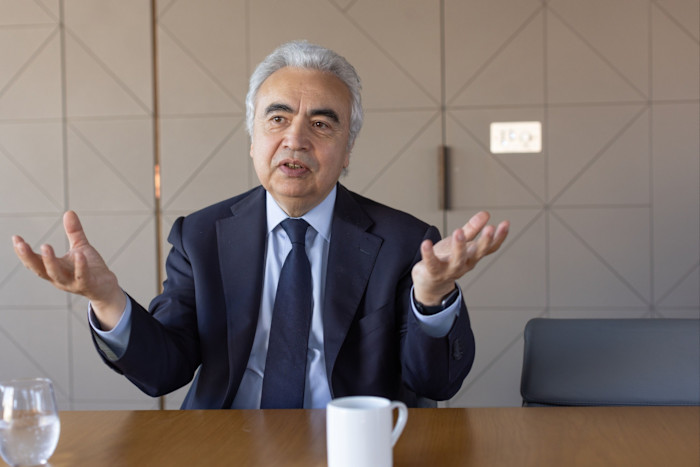
Fatih Birol, executive director of the global energy watchdog, said the gaps were increasingly stark, with the US rowing back climate pledges while China and Europe push forward with electrification.
“We see a fracturing in the global political order in general and there are of course reflections of that on the energy scene. Different countries are choosing different paths in terms of energy and climate change,” he said in an interview.
Last week, Trump repealed a key ruling underpinning the US Environmental Protection Agency’s authority to regulate emissions. He has already withdrawn from the Paris Agreement and the UN’s Framework Convention on Climate Change.
European countries have also softened climate ambitions, with the EU diluting its 2040 emissions reduction target last year and softening plans to phase out combustion engines by 2035. Canadian energy emissions have risen, as Prime Minister Mark Carney has backed the oil and gas sector in the face of trade threats from Trump.
Speaking as energy ministers gather in Paris for the biennial IEA ministerial meeting, Birol said climate change is “moving down the international policy agenda”.

US energy secretary Chris Wright will attend the meeting, where energy security, critical raw materials and climate measures will be discussed.
At an event in Paris on Tuesday organised by the French Institute of International Relations, Wright criticised the IEA’s 2050 net zero modelling as “ridiculous”, and said the IEA should focus on its role as an international data recording agency which is focused on energy security.
’’It does great quantitative work on energy, but it needs to focus on that mission and not . . . playing nice with European politicians or Americans,’’ he said.
Wright threatened to withdraw the US as an agency member if the organisation was ‘‘dominated and infused with climate stuff’’.
In November, the IEA issued new modelling saying that oil and gas demand would rise for 25 years under governments’ current policies.
Asked about the US pressure before the IEA reintroduced the outlook based on current government policies, Birol said the agency responded to what “our governments ask us to do”.
Despite scepticism from Washington about multilateral bodies, Birol said new countries were seeking to join.
A person familiar with the agency said Colombia would join the current 32-nation organisation as a full member. India is on track to become a full member, Brazil is set to start the process while Vietnam will become an associate member.
Sophie Hermans, Dutch energy minister and chair of this year’s IEA meeting, said in the same interview that there was a need for a “realistic and pragmatic approach” to tackling climate change.
Asked about ongoing EU debate over whether to continue with a planned phase out of CO₂ permits for energy intensive industries, she said companies should “know what way we are going” but added that “in an unstable geopolitical situation, then you must be flexible . . . to reshape your policies in order to make them fit to the situation”.
One area where the IEA is hoping to forge consensus is on diversifying supplies of critical raw materials vital to the green transition. Members will discuss strengthening supply chains and data gathering, with Birol and Hermans warning of the need to reduce dependence on China.
“We see one single country today has an oversized role in critical minerals . . . it is important to work with many countries that are like-minded to provide diversification,” Birol added.
Climate Capital

Where climate change meets business, markets and politics.Explore the FT’s coverage here.
Are you curious about the FT’s environmental sustainability commitments?Find out more about our science-based targets here
About The Author