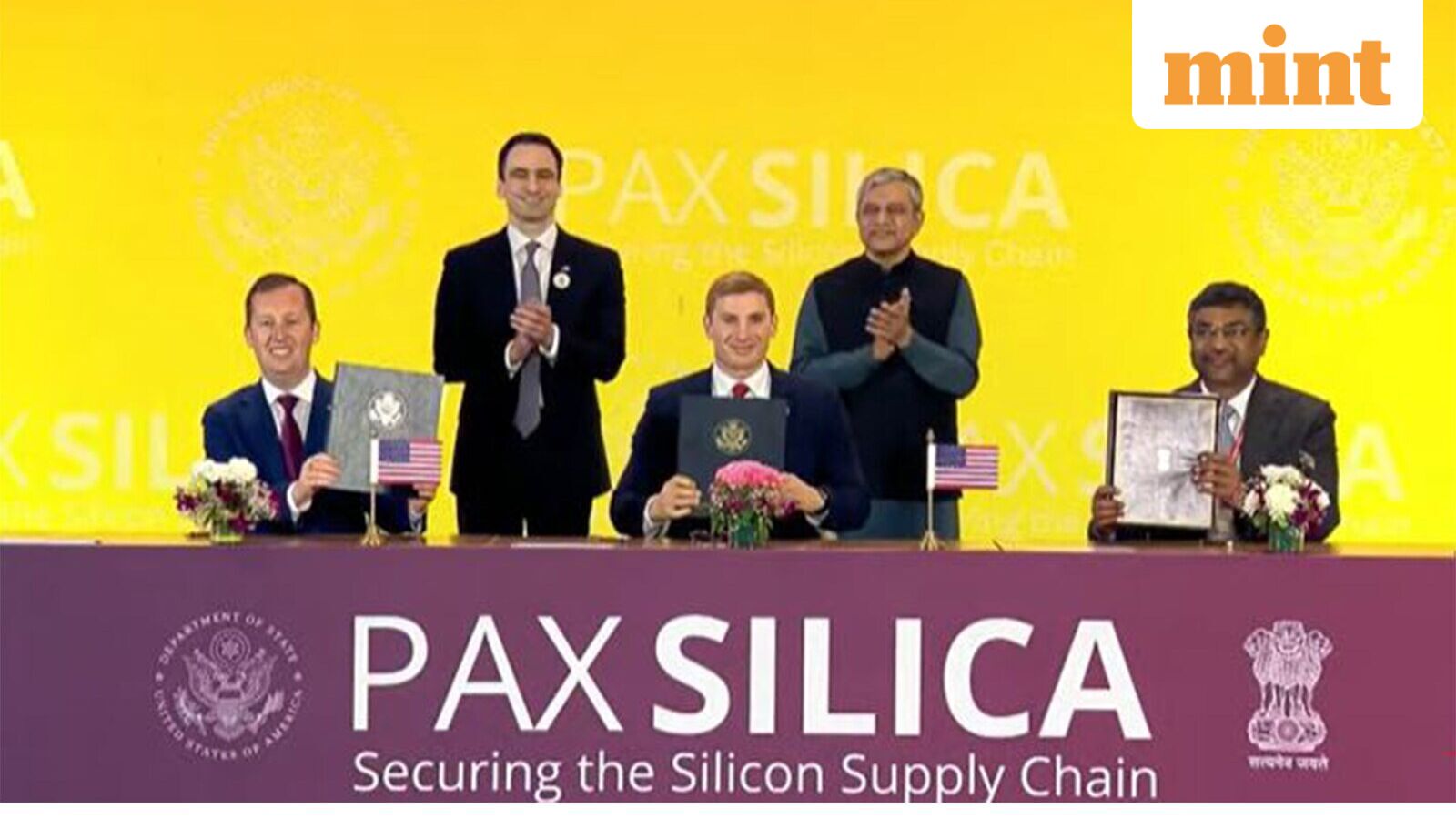
AI Summit 2026: Amid the AI Summit 2026 in New Delhi, India, the US signed the Pax Silica initiative on Friday. The move aims to enable India to secure AI and semiconductor supply chains. The signing was followed by a fireside chat with US Ambassador to India Sergio Gor and Under Secretary of State for Economic Affairs Jacob Helberg. The US-led Pax Silica Declaration would also help the two countries move towards a price floor for critical minerals and counter China’s dominance over global manufacturing supply chains.
According to stock market experts, India’s entry in the US-led Pax Silica initiative would have a positive impact on the Indian stock market in the long term. They said that the Pax Silica Declaration would help the two nations to secure AI and semiconductor supply chains, countering the Chinese dominance in this segment. They said that mining, metal, and tech stocks are expected to benefit from this move. They said that Indian stocks such as GMDC, NALCO, Dixon Technologies, Mahindra & Mahindra (M&M), Bajaj Auto, Bharat Forge, and Gokaldas Exports are expected to benefit from this New Delhi-Washington move.
What Pax Silica initiative mean for the Indian stock market?
Expecting a positive impact of India joining the US-led Pax Silica initiative, Seema Srivastava, Senior Research Analyst at SMC Global Securities, said, “India’s entry into the US-led Pax Silica initiative is structurally positive for long-term economic growth, particularly in semiconductors, AI, electronics manufacturing, and critical minerals.”
Srivastava said that the Pax Silica initiative is expected to help India improve its access to chip design expertise, fabrication technology, and equipment supply chains. This strengthens domestic initiatives such as the India Semiconductor Mission and the Production-Linked Incentive (PLI) schemes, accelerating high-value manufacturing, boosting exports, and reducing import dependence.
The SMC Global Securities expert said that, geopolitically, India is now positioned as a trusted alternative manufacturing hub amid global supply chain diversification, driving FDI, high-skilled job creation, and technology transfer. Although immediate GDP impact may be limited, over 5–10 years, the partnership can raise manufacturing’s share in GDP, strengthen exports, stabilise the currency, and enhance strategic technological autonomy.
“Participation in a secure AI supply ecosystem can attract hyperscale data centres, deepen R&D collaboration, and move India up the value chain from IT services to advanced digital infrastructure, potentially lifting long-term GDP growth through productivity gains across manufacturing, healthcare, logistics, and finance. The alliance also enhances access to critical minerals such as lithium and rare earths, supporting EVs, batteries, and electronics while improving supply security,” Seema added
India is the tenth country to enter the US-led Pax Silica initiative. Before India, nine nations have signed the Pax Silica initiative, including Australia, Greece, Israel, Japan, South Korea, Qatar, Singapore, the UK and the UAE. While other countries joined in December 2025, after the initiative was launched, the UAE joined last month.
Stocks to buy after the Pax Silica agreement
Echoing Seema Srivastava’s views, Anuj Gupta, a SEBI-registered market expert, said that India’s entry into the US-led Pax Silica initiative is expected to benefit companies in the AI and semiconductor business the most. However, one can also look at companies that have exposure to metals, mining, autos, and exports, as the move aims to enhance supply chain quality as well.
On stocks to buy after the Pax Silica agreement, Anuj Gupta listed out the following 15 stocks:
AI: Tata Elxsi, Persistent Systems, and HCL Technologies.
Mining and rare earth minerals: GMDC, NALCO, and NMDC.
Semiconductors: Dixon Tech, CG Power, Avalon Tech.
Auto: Tata Motors, Bajaj Auto, and M&M.
Defence: Bharat Forge and BEL.
Exports: Gokaldas Exports.
Disclaimer: This story is for educational purposes only. The views and recommendations above are those of individual analysts or broking companies, not Mint. We advise investors to check with certified experts before making any investment decisions.
About The Author