In Hwaseong, about an hour south of Seoul, Park Eun-hye has been staying up well past midnight to load up on risky bets on South Korean stocks.
Her go-to is KORU, a triple-leveraged ETF that magnifies every move — a type of product that has become almost an addictive pastime among the country’s day traders. With every selloff, Park sees an opportunity — and for her, a clear one emerged when South Korea’s stock market suffered its worst crash in history last week. When she saw the ETF was down more than 40% during pre-market trading, she couldn’t resist and began buying.
Traders like Park injected more than $520 million, a record amount, into the ETF last week. This move amid a historic selloff highlights an escalating trend that has alarmed local regulators. Concerned that these high-risk overseas investments mask hidden dangers and pressure the national currency, authorities have been tightening rules for leveraged fund buyers.
South Korean retail investors are among the biggest drivers of trading in US-listed leveraged funds globally, often piling into strategies that promise outsize returns. A large amount of Korean retail overseas ETF holdings are in leveraged or inverse funds.
The bet paid off this time — South Korean stocks, which have become the hottest trade this year as investors chase chip heavyweights like Samsung Electronics Co. and SK Hynix Inc., recovered on Thursday morning to post their best day in nearly 20 years after its two-day 18% plunge earlier in the week.
“Semiconductors are booming and KORU has a high exposure to Korean semiconductor stocks,” Park said. “I also had a belief that the Korean stock market will bounce back quickly and I bought it because I wanted to recover three times faster.”
On Monday, the stocks were down again. Park, who had already sold when prices rebounded, bought back in.
These kinds of swings lure traders into leveraged products like KORU. Retail investors poured a record $190 million into the $1 billion ETF amid the crash in a single day. More than 30% of March’s total inflow came from South Korea, according to local depository data.
The surge in leveraged ETF trading may also have amplified swings in the Korean stock market itself, magnifying the plunge in Korean equities earlier this month as investors unwound their heavy leveraged wagers, according to Sean Taylor, chief investment officer at Matthews Asia.
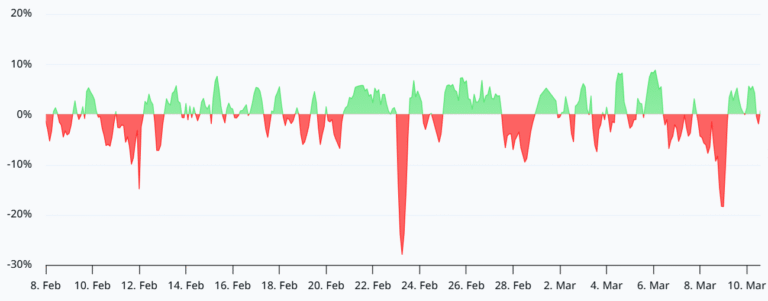
KORU was down more than 40% for the week ending March 6, while the MSCI South Korea 25/50 Index, its underlying gauge, lost 13%.
KORU and its underlying MSCI gauge — as well as the Kospi index — moved with huge swings this week after Trump hinted that the war could be over soon. While the MSCI Korea 25/50 Index is the underlying index that KORU seeks to track, it utilizes the Blackrock iShares ETF to gain exposure to the index, which trades during US market hours.
That type of high-octane bet comes with its own warning labels. Leveraged products typically reset daily to give new buyers the performance they anticipate. And because of this daily resetting, the longer investors hold them, the less accurately they track their benchmarks.
Jongmin Shim, an analyst at CLSA Securities Korea, warned about the danger of investing in these products during times of heightened volatility.
“It’s like flipping a coin. If you can get it right, it’s great,” he said. But anyone on the wrong side of the bet can get wiped out, too.
In December, the country’s financial watchdog asked local brokerages to reinforce warnings on risks of investing in overseas markets and currency volatility. It also rolled out mandatory online training for investors looking to put money in leveraged or inverse ETFs listed in foreign markets.
South Korean regulators have banned single-stock leveraged products in their local market and cap the leverage on index funds to two times. Regulators plan to pull back part of those rules to help bring Korean retail investor money back to the local market, but will likely keep the cap on leverage.
Many of Park’s friends — also retail day traders in South Korea — put their money in KORU because of its heavy exposure to semiconductors, she said. Another similar and popular Direxion strategy is ticker SOXL, which has taken in over $2 billion in March alone.
Inflows into ETFs tracking Korean stocks surged by $21.5 billion through March 6, almost double that of the previous three months and set for the highest quarterly tally ever, according to Bloomberg Intelligence. Leveraged products accounted for about a fifth of the inflows — a rapid increase from previous years when their presence was limited.
Park tracks trades across several brokerage apps popular with Korean retail investors, including Toss — often described as South Korea’s version of Robinhood — where leveraged ETFs like KORU frequently dominate real-time popularity rankings.
“I guess until you actually go through the pain yourself, you tend to think ‘as long as it goes up, that’s all that matters,’” she said. “In reality, it just means you don’t fully understand the risk.”
Now she’s staying awake until 1 a.m. to watch US trading hours, waiting for another dip so she can buy more.
With assistance from Jiyeun Lee, Jack Wang and Sangmi Cha.
This article was generated from an automated news agency feed without modifications to text.
About The Author