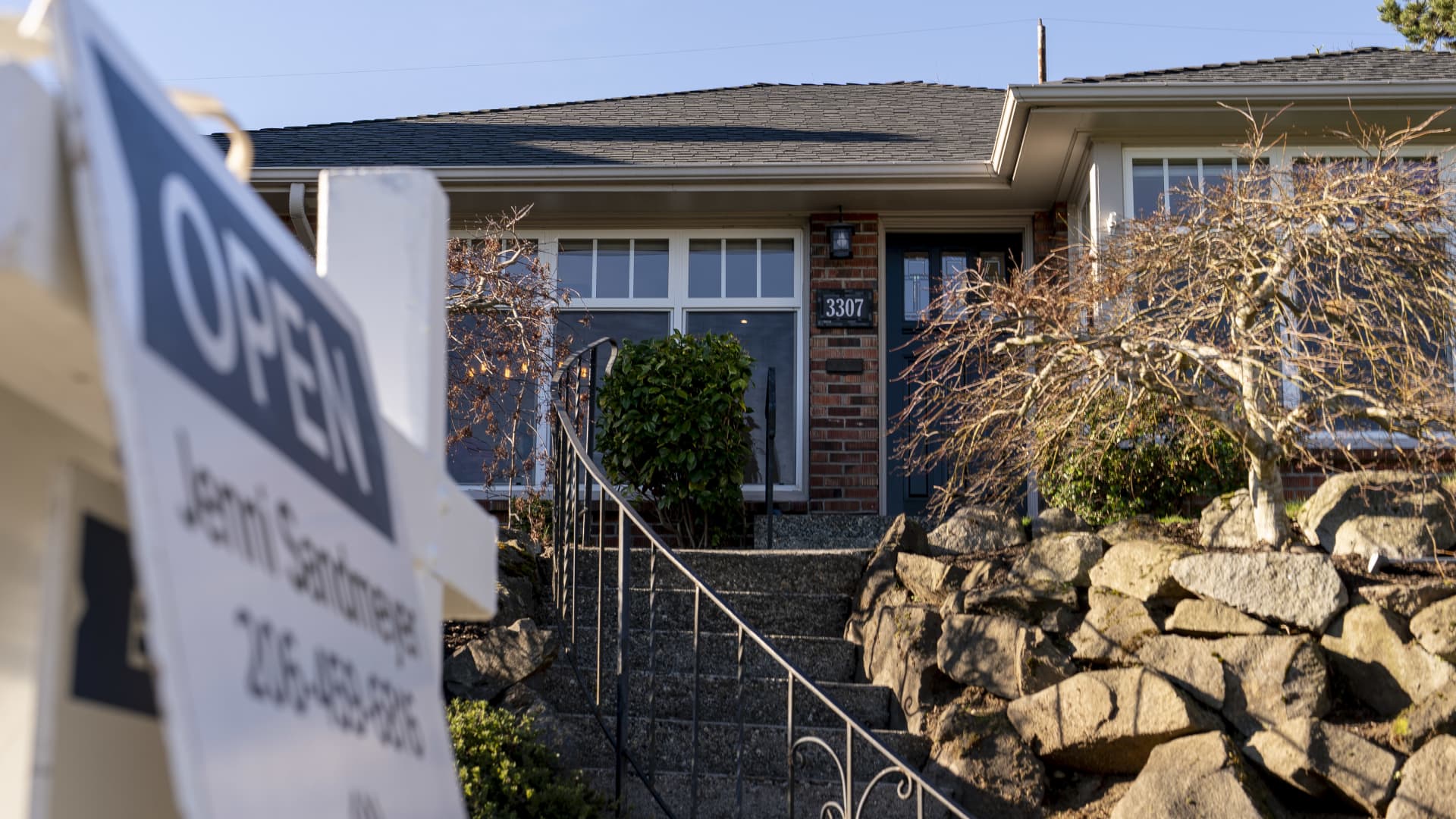
Just as mortgage rates fell below 6% at the end of February — a drop homebuyers awaited for four years — the war in Iran has pushed them back up again. Economists predict rates could fluctuate throughout the year if the fighting continues.
Mortgage rates and the 10-year Treasury yield rose in lockstep with oil prices since the start of the war on Feb. 28: The price-per-barrel of oil rose to a high of $119.48 on March 9; the yield on 10-year Treasurys climbed from 3.96% on Feb. 27 to 4.21% on March 11; and average mortgage rates jumped from 5.99% on Feb. 27 to 6.19% on March 11.
The good news is that, despite the conflict abroad, rates are likely to remain much lower than they were a year ago, when the averagewas 6.63%, said two experts who spoke with CNBC Select. Still, homebuyers hoping to enter the market in the coming months will likely need to be strategic to get a rate near the 5.98% seen in late February.
But before we get into those strategies, here, we outline why mortgage rates tend to move alongside the price of oil.
Talk to us
We want to hear your story. Do you have a financial success, goal or stressor you’re comfortable sharing with a reporter? Please fill out this quick form.
What do oil costs have to do with mortgage rates?
Historically, transportation difficulties among oil exporters have gone hand in hand with military conflict in the Middle East. Prices customarily rise across the economy, as oil is essential for manufacturing and transporting goods, Realtor.com economist Joel Berner told CNBC Select. Investors, in turn, demand higher returns to compensate for heightened risk in an inflationary environment, he added.
Oil prices have already spiked 25% since the war began, and on March 6, Qatar’s Energy Minister Saad al-Kaabi warned that the war could force the shutdown of exports within a few weeks, potentially pushing the cost per barrel to a record high of $150.
The highest per-barrel price was $147.27 in July 2008, when the U.S.-Iraq war created an oil crisis. During that year, mortgage rates rose from a weekly average of 5.91% in April to 6.48% in August, per a CNBC analysis of Freddie Mac’s Primary Mortgage Market Survey data.
However, another factor that may mitigate major jumps in mortgage rates: the oil economy has changed significantly since 2008. The U.S. is much less reliant on foreign oil, said Daryl Fairweather, the chief economist at Redfin.
In 2008, the U.S. imported 12.91 million barrels per day, according to the U.S. Energy Information Administration. In 2022, the most recent year for which data are available, the U.S. imported 8.32 million barrels per day, a 35% decrease.
Simultaneously, consumption has gone up: In 2008, daily consumption was at 19.50 million barrels per day and in 2022, it was at 20.28 million barrels per day.
“We may be able to adapt out of it and stop exporting as much oil and rely more on domestic oil,” Fairweather said. “And so the long-term impacts on oil and inflation might not be all that severe, but I think that it’s yet to be seen so far.”
There’s another component at play, Berner said.
During periods of economic uncertainty, investors move money into Treasurys and mortgage-backed securities because they are considered safer than equities. This is called the “safe haven effect,” and the increased demand typically drives bond prices up and yields down, which in turn pushes mortgage rates lower.
Altogether, news about the economy, oil prices, and inflation rates is “going to lead to more volatility in rates, but it’s probably going to be like a bunch of swings up and down,” Fairweather said.
The best strategy for mortgages this year is to lock in your rate at the right moment, she said. So, if you see rates reach a low point, call your mortgage lender to secure the rate. If rates spike, wait a bit before cementing your rate.
“Locking in your rate is the best way to know exactly what your interest rate is going to be, ” Fairweather said. “But also, don’t worry about it too much, because rates are really hard to predict, and you’re never going to get it 100% right.”
In addition to Fairweather’s advice, here are three other ways you can get the best possible rate — no matter the economic environment.
Choose lenders that have lower-than-average rates
If you’re looking for lower-than-average rates, member-owner credit unions are a great place to start.
With many credit unions, you need to work in a certain field, live in a particular area or fall under another specific category to get membership. But FourLeaf Credit Union — which has lower-than-average rates — is available to anyone who can open a savings account and deposit $5.
Navy Federal, though more restrictive in its membership, is another great option, with some of the lowest rates out there. You must have served in the armed forces, or have had a sibling, spouse, parent or grandparent who served in the armed forces to get membership.
Online lenders also tend to have lower rates. That’s because they don’t incur the costs of physical retail locations. Better Mortgage is one such online lender, and offers lower-than-average rates and other perks, like speedy closing and grants for first-time homebuyers.
Better Mortgage
-
Annual Percentage Rate (APR)
Apply online for personalized rates; fixed-rate and adjustable-rate mortgages included
-
Types of loans
Conventional loan, FHA loan, Jumbo loan and adjustable-rate mortgage (ARM)
-
Terms
-
Credit needed
-
Minimum down payment
3.5% if moving forward with an FHA loan
Optimize your credit score
You can get a significantly lower rate if you take a few months to work on your credit score.
According to Experian, the average mortgage rate on a 30-year fixed-rate mortgage for someone with a 620 credit score is 7.17%, while the average mortgage rate on a 30-year fixed-rate mortgage for someone with a 780 credit score or higher is 6.20%.
To improve your credit, focus on making on-time payments, paying down debt and keeping your credit utilization below 10%.
Additionally, try Experian Boost, which is a free feature that pulls on-time utility and rent payments into your report, which can help increase the number.
Experian Boost®
-
Cost
-
Average credit score increase
13 points, though results vary
-
Credit report affected
-
Credit scoring model used
Results will vary. See website for details.
Consider a 15-year term
Most 15-year fixed-rate mortgages come with rates lower than 30-year fixed-rate mortgages. For example, for the week ending March 5, the average 30-year fixed rate was 6.98% while the average 15-year rate was just 5.43%.
Rocket Mortgage and Bank of America— two companies on our top mortgage lenders list — are great options for 15-year mortgages. Each has high customer satisfaction ratings from J.D. Power, along with a diverse array of loan options.
Rocket Mortgage
-
Annual Percentage Rate (APR)
Apply online for personalized rates; fixed-rate and adjustable-rate mortgages are available.
-
Types of loans
Conventional loans, FHA loans, VA loans, Jumbo loans, low-down-payment mortgages
-
Terms
10-, 15- and 30-year fixed-term conventional loans, 30-year VA and FHA loans, custom mortgages with fixed-rate terms from 8 to 29 years.
-
Credit needed
620 for conventional loans
-
Minimum down payment
0% for VA, 1% for RocketONE+, 3% for conventional, 3.5% for FHA, 10% to 15% for jumbo
Bank of America Home Mortgage Loans
-
Annual Percentage Rate (APR)
Apply online for personalized rates; fixed-rate and adjustable-rate mortgages included
-
Types of loans
Conventional loans, FHA loans, VA loans, Affordable Loan Solution® mortgage, Doctor loans
-
Terms
-
Credit needed
Conventional loans typically require a 620 credit score
-
Minimum down payment
3% with Bank of America’s Affordable Loan Solution® mortgage loan
-
Offers first-time homebuyer assistance?
Subscribe to the CNBC Select Newsletter!
Money matters —so make the most of it. Get expert tips, strategies, news and everything else you need to maximize your money, right to your inbox.Sign up here.
Why trust CNBC Select?
At CNBC Select, our mission is to deliver high-quality service journalism and comprehensive consumer advice to our readers, enabling them to make informed financial decisions. Every mortgage review is based on rigorous reporting by our team of expert writers and editors with extensive knowledge of financial products. While CNBC Select earns a commission from affiliate partners on many offers and links, we create all our content without input from our commercial team or any outside third parties and we pride ourselves on our journalistic standards and ethics.
Meet our experts
AtCNBC Select, we work with experts who have specialized knowledge and authority based on relevant training and/or experience. For this story, we interviewedtwo economists: Daryl Fairweather, chief economist for Redfin, who has a Ph.D in economics from the University of Chicago, where she specialized in behavioral economics; and Joel Berner, a senior economist with Realtor.com, who has a master’s degree in economics from the University of Texas.
Catch up on CNBC Select’s in-depth coverage ofcredit cards,bankingandmoney and follow us onTikTok,Facebook,InstagramandTwitterto stay up to date.
Editorial Note: Opinions, analyses, reviews or recommendations expressed in this article are those of the Select editorial staff’s alone, and have not been reviewed, approved or otherwise endorsed by any third party.
About The Author