Gold (XAU/USD) recovers its intraday losses and climbs back above the $4,400 mark, closer to the daily high during the early part of the European session on Tuesday. Any meaningful upside, however, still seems elusive on the back of hawkish central banks, which tends to dent demand for the non-yielding yellow metal. Furthermore, a firmer US Dollar (USD) should contribute to capping the upside for the commodity.
Iran denied that it had held talks with the US to end the war, contradicting US President Donald Trump’s remarks on Monday that a deal could be reached soon. Moreover, Mohsen Rezaei, the senior military adviser to Iranian Supreme Leader Mojtaba Khamenei, said that the war will continue until Iran receives full compensation for the damage it has sustained. Adding to this, energy infrastructure in Iran has reportedly come under renewed pressure, which, along with the effective closure of the Strait of Hormuz, assists Crude Oil prices to regain positive traction. This, in turn, bolsters bets that central banks around the world will once again consider raising interest rates to curb renewed inflationary pressures and should act as a headwind for the Gold price.
Meanwhile, traders have nearly fully priced out the possibility of any further interest rate cuts by the US Federal Reserve (Fed) and are rapidly increasing bets for a hike by the end of this year. This, in turn, triggers a fresh leg up in US Treasury bond yields, which assists the USD to regain positive traction and contributes to driving flows away from the precious metal. That said, fading hopes for a de-escalation of tensions in the Middle East keep a lid on the overnight market optimism. This, in turn, is seen offering some support to the safe-haven Gold and holding back bearish traders from placing aggressive bets. As the US-Iran conflict drags on further, market participants now look forward to the release of the global flash PMIs to grab short-term opportunities.
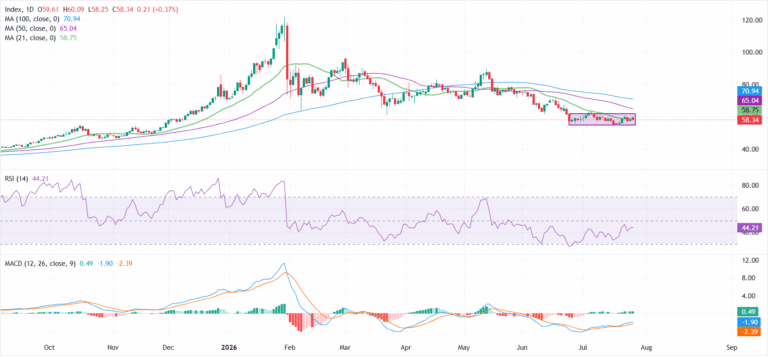
XAU/USD daily chart
Gold bears might now await break below $4,300 before placing fresh bets
From a technical perspective, last week’s breakdown below the 100-day SMA was seen as a key trigger for the XAU/USD bears. The subsequent slump, however, found decent support near the 200-day SMA, around the $4,100 mark, which should now act as a key pivotal point.
Meanwhile, the Moving Average Convergence Divergence (MACD) indicator (12, 26, 9) remains below its signal line in negative territory with an expanding downside histogram, reinforcing strengthening selling pressure. The Relative Strength Index (RSI) at 25.82 sits in oversold territory, which highlights downside dominance but also warns that the current bearish leg is becoming stretched.
In the meantime, the current low around $4,305 is the first support to watch, and a decisive close below this level would extend the downtrend back toward the $4,100, nearer to the 200-day SMA, where medium-term dip buyers could attempt to stabilize the metal.
On the upside, immediate resistance emerges near $4,650, where a recent consolidation high aligns ahead of the falling short-term trajectory and guards the $4,820 area, with the 100-day SMA higher around $4,610 acting as an intermediate dynamic cap. A break above these layers would be needed to ease bearish pressure and open the way toward $5,000.
(The technical analysis of this story was written with the help of an AI tool.)
US Dollar FAQs
The US Dollar (USD) is the official currency of the United States of America, and the ‘de facto’ currency of a significant number of other countries where it is found in circulation alongside local notes. It is the most heavily traded currency in the world, accounting for over 88% of all global foreign exchange turnover, or an average of $6.6 trillion in transactions per day, according to data from 2022.
Following the second world war, the USD took over from the British Pound as the world’s reserve currency. For most of its history, the US Dollar was backed by Gold, until the Bretton Woods Agreement in 1971 when the Gold Standard went away.
The most important single factor impacting on the value of the US Dollar is monetary policy, which is shaped by the Federal Reserve (Fed). The Fed has two mandates: to achieve price stability (control inflation) and foster full employment. Its primary tool to achieve these two goals is by adjusting interest rates.
When prices are rising too quickly and inflation is above the Fed’s 2% target, the Fed will raise rates, which helps the USD value. When inflation falls below 2% or the Unemployment Rate is too high, the Fed may lower interest rates, which weighs on the Greenback.
In extreme situations, the Federal Reserve can also print more Dollars and enact quantitative easing (QE). QE is the process by which the Fed substantially increases the flow of credit in a stuck financial system.
It is a non-standard policy measure used when credit has dried up because banks will not lend to each other (out of the fear of counterparty default). It is a last resort when simply lowering interest rates is unlikely to achieve the necessary result. It was the Fed’s weapon of choice to combat the credit crunch that occurred during the Great Financial Crisis in 2008. It involves the Fed printing more Dollars and using them to buy US government bonds predominantly from financial institutions. QE usually leads to a weaker US Dollar.
Quantitative tightening (QT) is the reverse process whereby the Federal Reserve stops buying bonds from financial institutions and does not reinvest the principal from the bonds it holds maturing in new purchases. It is usually positive for the US Dollar.
About The Author