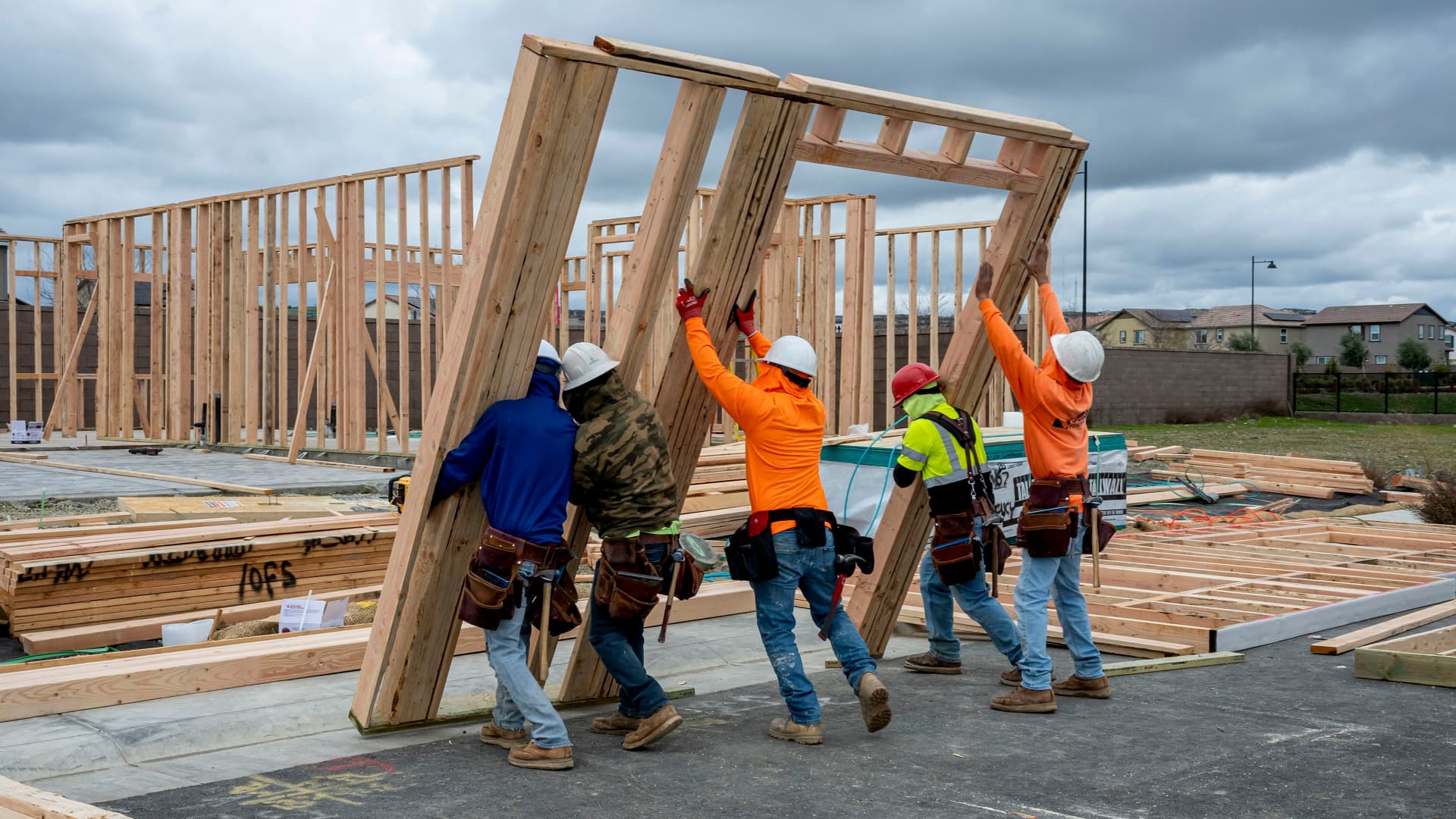
Affordability has gone from being a dry financial term to an all-purposehot button.Groceries, health care,child care, cars, gas — you name it, and affordabilityisattached to itthese days. And then there’s housing,one ofthe stickiest issuesinAmerica’s affordabilitydiscussions.
On March 12, the U.S.Senate passed a massive housing billaddressingaffordabilityandsupply,mostlyof single-family homes.The21st Century ROADto HousingAct, chock-full of more than 40 provisions, garneredrare—bytoday’s rancorous politicalstandards—bipartisan support, tallyinga89-10 vote.The bill features a slew of financing, permitting, zoning and environmental reforms aimed at lowering housing costs and speeding up new home construction.
TheHouse passedan equally bipartisan, if pared-down version in February. The Senate bill, which adopted many of House provisions,now moves back to the lower chamber for consideration, whereit’sfacing anuphill battle, primarilyover the contentious issue ofwhetherlarge institutional investorsshould continuebuying and renting homes, a practicedecried bybothprogressive stalwartSen. Elizabeth Warren, D-Mass.— a co-sponsor of the ROAD Act —and President Donald Trump, who issued an executive order inJanuary calling for anend tothe practice.
Ironically, thatso-called“build-to-rent”portionof the housing market is relativelysmall comparedto another one — factory-built manufactured homes — which received a huge boost from the ROAD Actand is far more consequential toward theoverarchinggoal of building more homes.
The billallowsmanufactured homes to be assembled without a permanent chassis, increasesfederal loan limitsforbuyersand relaxeszoningregulations on where they can be sited.Those changesgo a long way toward removing the stigmahangingoverlow-priced “mobile homes.”
“That is the challenge we’ve had,” said Dr. Lesli Gooch, CEO of the Manufactured Housing Institute, the industry’s trade association.”The stigma comes from what our houses look like and the elevationswe’reable to offer.We will [now] be allowed under our federal building code to build more housing types,” she said. “We were constrained for 50 years that every house webuilt had to be on a permanent chassis.”
By allowing for removable chassis, the bill will enable manufactured homes builders to innovate designs, said Bill Boor, CEO ofCavco Industries, one of the industry’s largest companies, in an email statement. “While we’ll still make permanent-chassis homes, the ability to also make removable chassis homes will continue to break down zoning barriers and increase the supply of lower-cost, high-quality homes,” he wrote.
In anticipation of the legislative changes, Boor says Cavco has invested heavily in retooling its existing plants to increase capacity and change its production processes where possible. “Similarly, in the last two years, we have unified our branding under the Cavco name to expand recognition in the marketplace and segmented our extensive product offering,” he wrote.
Berkshire Hathaway-owned Clayton Homes is the biggest player in this market.
Taken together, the provisions have the potentialtosubstantiallyincreasehousing supply and createlow-cost options for achieving the American Dream of homeownership, an idealthat’sbeen slipping away.More than 70% ofAmericansare concerned about housing affordability, according to several polls. No wonder, considering that the national median price for a single-family home isroughly $400,000, in a real-estate market with a housing supplyshortage of 4 million homesand while 30-year mortgage rates stubbornlyremainabove 6%.
Daryl Fairweather, chief economist forRedfin, anational real estate brokerage firm,deemsthe manufactured housing provisions as themostimportantpartsof theROAD Act. “The incentives for zoning reform and [other] deregulations will matter in parts of the country that have severe housing shortages,” she said. “I’m most excited about building more [manufactured] housing in places where land values are very high, because there’s a lack of available land to build on,” she added.
The National Association of Realtors has expressed its support for the Senate bill in a statement from its executive vice president and chief advocacy officer Shannon McGahn. “The bill gives communities new tools and resources to build more homes, streamlines federal processes that delay construction andupdatesfinancing options for manufactured and rural housing,” she said.
It’snotable that both NAR and Redfinare enthusedabout the market for manufactured homes,historically not a huge focus for many real estate agents.
Fight over factory-built homes
Less sanguine about the bill’s expanded definition of manufactured housing is the Modular Home Builders Association, whichrepresentscompanies in the other burgeoning segment ofaffordable,factory-built housing.Unlike manufactured homes, which follow a national HUD building code and often facefirmzoning restrictions, modular homes areconstructed to the same state, local or regional building codes as traditional site-built homes.That meansmore variabledesignsofmodular homes.
While the bill “makes broad political overtures about studying barriers to expanding modular construction, it simultaneously provides clear and tangiblecompetitive advantages to the manufactured housing sector,” said Tom Hardiman, executive director of the MHBA. Hewarnsthat it mayend up confusinghome buyers, with the removal of the chassis requirement for manufactured homes to further “blur the lines for consumers who may mistakenly believe they are purchasing a modular home.”
That notion doesn’t square with Gooch. “I don’t see how an entry-level home buyer who sees a brand-new home built with the federal seal of approval is going to feel like, ‘Oh, wait, I thought this was built to a different building code. I thought this was modular, not manufactured,'” she said. “To me, it doesn’t make a lot of sense.”
The bill also loosens rules around building increasingly popular accessorydwellingunits (ADUs) — such asgranny flats, in-lawsuitesor backyard cottages— alongside existing structures. That creates more opportunitiesnotonly formanufactured homesbut alsomodular homes.”If you talk to a[Redfin]agent, they will tell you that homes with ADUs are very popular,” Fairweather said.”Anything that makes ADUs easier to build, I think[agents]and their clients are going to like.”
In the end, Hardiman says he is “cautiously optimistic” about the Senate bill and the opportunities it presents to expand factory-built housing across the U.S., despite his concerns about consumer confusion between manufactured and modular homes. “I wouldanticipatemore of our members specializing in some of the project types included in the bill, specifically ADUs,” he said.
Big investors and buy-to-rent controversy
Although enhancements to the factory-built housing industry are far more meaningful in terms of expanding the supply of affordable homes, the investor provisions are receiving outsized attention. Dating back to the Great Recession and the Covid pandemic, when private investment firms began pouring billions into purchasing single-family homes, the issue has become an equal-opportunity boogeyman. The ROAD Act calls for a ban on large institutional investors from buying new single-family homes if they already own at least 350 such dwellings.
There is, however, a carveout that allows those investors to build new homes and rehabilitate existing ones, specifically for the rental market.Butthere’sacriticalcaveat, stipulatingthat those homes would have to be sold to individual buyers after seven years.Unlike Sen. Warren, President TrumpappeasedWall Street, as well ashome builders,by endorsingthisconcessionfor theBTR market, which hasacceleratedin recent yearsin communities across the country.The House-passedversion does not include theinvestorprovisionin any form, and House members are now divided on whether to add itin.
TheBTRissue has drawn mixed reactionsacross the housing industry.While the Senate bill was stillbeing debated,severalindustry groups—including the National Association of Home Builders,theMortgage Bankers Association andtheNational Housing Conference—issued a position paper stating that “the seven-year disposition requirement will effectively shut down BTR development, leading to less supply and fewer options for renters.”According to a recentreportby Redfin,31% of rentalsin the U.S.are single-family homes,the lowest share on record.
The day theROAD Actpassed, NAHBchairmanBill Owensput outa statement quantifying thepossibleimpact of the BTR ban,sayingthat it “could slash single-family production by nearly 40,000 units per year.”
Yet, asoftenas institutional investors have been vilified for scooping upmillions ofhomes, the datadoesn’tbackupthe contention.Indeed, investors who own more than 100 properties make up less than 1% of theU.S.housingmarket, according to an Augustreportfrom the American Enterprise Institute’sHousingCenter.
Nonetheless,at the margin,that’sasignificantshare, especially withinthe BTR market, said Edward Pinto,senior fellow and co-directorof the AEI Housing Center.While BTR communities are arelatively newphenomenon,he said,those homes already account for 4% of total single-family rental stock, and they play an outsize role in some key, populous states across the country.
“The capital being provided by these investors would not be able to be substituted by the building of single-familyownedproperties,” Pinto said. He citedAEIdata showing that 72% of BTR developments areconcentratedinjustsix states —Florida, Texas, Arizona, North Carolina,South Carolinaand Georgia.”It turns out that it’s easier to build a[BTR]development in those six states than it is to build a single-familyfor-sale development.”
A tough road ahead for a new American Dream
As the House now considers moving forward on a final housing bill,BTR critics are urging membersto drop the restriction. Supporters, in turn, argue that increasing the home rental market will shatter thehomeownershipdream. According torecentsurveys, though, that might be an outdated aspiration, especially among younger Americans.
The Center for Generational Kineticslast yearpolled1,000 participants,from ages 18 to 70,who currently live in a single-family rental home. Just 8%defined the American Dream as owning a home, and 70%said they felt relieved to not bear the burden of maintenance costs or taxes.Additionally, 53%of Gen Zrespondentsreported having better access to schools or jobs through renting, whileGen Xers weremore likely to choose renting for convenience.
In his just-released 2026 letter to investors, Larry Fink, CEO of the world’s largest asset manager BlackRock (which has stressed during the current political moment that it is not among investors that buy homes), wondered about the value of homeownership. “Housing is not a guaranteed high-return investment,” he wrote. “Onceyouaccount for property taxes, insurance,maintenanceand transaction costs—all of which have risen meaningfully in many places —long-term returns can be more modest and more uneven than headline price increasessuggest.…If we want broader participation in economic growth, we cannot rely on a single asset,purchasedlater and laterin life, to carry that burden alone.”
Per the NAR, the median age for first-time homebuyers in the U.S.is 40,a record high.
The National Low Income Housing Coalition advocates on behalf of people with the lowest incomes, whose access to affordable, quality housing is especially challenging in today’seconomy.TheROAD Actincludes several provisions thattheNLIHC hadprioritizedin discussions with Congressional lawmakers, said Kim Johnson, senior director of public policy.
Aparticularlyimportant one, Johnson said,would help preserve affordable rental and homeownership opportunities for low-income people in rural areas, cut redtapeand encourage public-private partnerships to increase investment in the rural housing supply.”It would essentially be a voucher,” she said, “and people living in thosehomeswould be able to staythere even if the affordability provisions expire. That wouldimpactabout 400,000 low-income rural residents.”
Most of the NLIHC’s priorities were not in the Housebill. “Ideally we’d like to see a [combined] bill passed that includes all of them,” Johnson said.
That echoesother groups’ calls for a speedy agreement on acompromisebill that could pass muster with President Trump.Butit’sshaping up to be a tough process.SomeHouse Republicans, in exchange forapprovingthe Senatebill,insist onincludingseveralcommunity bank deregulatory bills in pending cryptocurrency legislation. Leaders in both chambershave suggestedthattheSenate billis likely togo to a bicameral conferenceto reconcile their differences.
And that’s not the only monkey wrench in the works. As much as the president has promoted federal action on affordable housing — including the institutional investor ban — Trump has vowed to withhold his signature from any bill that reaches his desk until Congress passes the controversial voter ID measure dubbed the SAVE America Act, which is being hotly debated in the Senate.
“It supersedes everything else,” Trump said.
Looming over all things politics, though, are November’s midterm elections. The risk of not approving some form of housing affordability legislation may outweigh Trump’s intransigence on the SAVE Act. “It comes down to, It’s the election, stupid,” Pinto said, paraphrasing the axiom regarding voters’ perennial focus on the economy. “The election’s coming up and both sides want to be seen as having passed something.”
About The Author