Silver just had its worst month in 15 years. Where investors see it going next
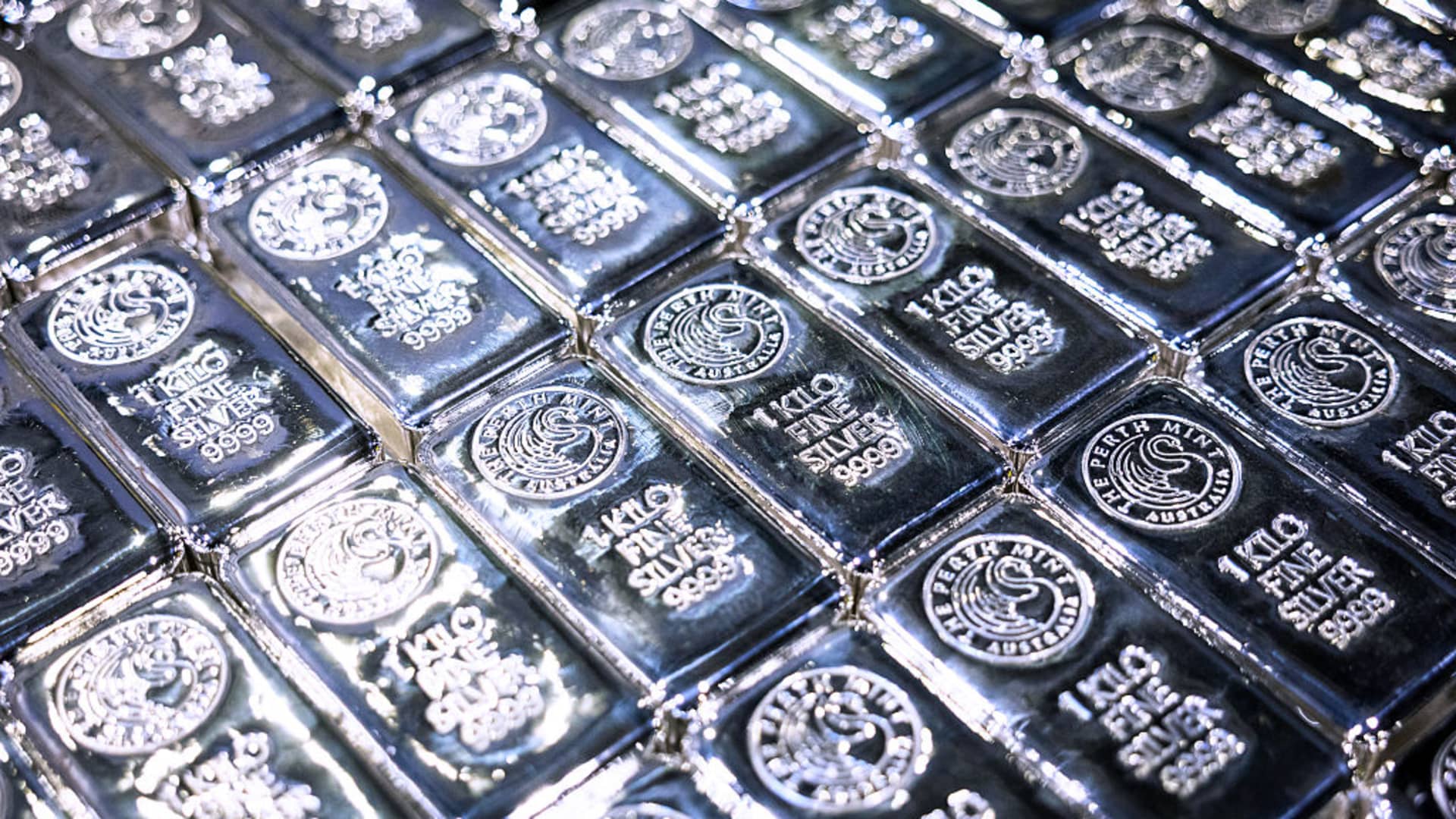
Silver, alongside gold, has long been a safe haven for investors during tumultuous times. In March, that script was flipped on its head. The precious metal ended March 19.7% lower – its largest monthly loss basis since September 2011, when it plunged 28%. March also marked the asset’s first month in the red since April 2025. Those declines came as investors took profits in one of the best trades of 2025 after the U.S.-Iran war began. The conflict has led to big swings in equities, bonds, currencies and commodities markets, with traders trying to handicap how long the war will last. Silver surged 141.4% last year, marking its best annual performance since 1979. The stunning rally caught the attention of both long-time commodities traders and less experienced retail investors. “We’ve shaken out a lot of the fast money, and people can start focusing on the fundamentals again,” Peter Boockvar, chief investment officer of OnePoint BFG Wealth Partners, told CNBC. “There was a huge amount of speculation that was built in [to silver].” Silver as an ‘ATM’ In late February, the U.S. and Israel executed military strikes on Tehran, prompting Iran to largely block off the Strait of Hormuz in retaliation. The closure of the waterway, which accounts for roughly 20% of global oil shipments, led to higher oil prices and pressured other supply chains 0151 putting investors on tenterhooks. As global disruption risks grow, the U.S. has begun weighing the possibility of sending ground troops to the Islamic Republic – a move that would deepen the conflict and potentially prolong its effect on supply chains. “Whenever there’s economic or political distress, people tend to take profits in names or asset classes that they have tremendous profits [in],” said Jeff Kilburg, CEO of KKM Financial. “There has been nowhere to hide in this indiscriminate selling from asset class to asset class. So you are seeing gold and silver being utilized as a cash station, as an ATM, in the same manner you’re seeing the [‘Magnificent Seven’] being utilized as a cash station.” @SI.1 1Y mountain Silver futures 1yr This shakeout, however, may precede a rebound in the precious metal as many of the “weak hands” are forced out of the market, according to Frank Cappelleri, founder of CappThesis. “Early this year, things got parabolic, and then the crash happened,” Cappelleri said. “Anyone who really bought … toward the end of last year, early this year, of course, is now underwater.” “The consistent uptrends that we’ve seen over the last few years in both [gold and silver] are in the rearview mirror,” Cappelleri added. But that “doesn’t mean that the uptrend [for silver] is over with.” Silver futures on Tuesday traded at around $74 per ounce. KKM’s Kilburg thinks the metal can rebound to around $90 and $100 per ounce if the U.S. is able to things out with Iran to secure the reopening of the Strait of Hormuz sooner rather than later. “If we do see some resolution or if we simply see the Strait of Hormuz reopen, it’s going to lift all asset classes that fell victim to the profit taking and the cash-station mentality in the month of March,” Kilburg said. But even if the war doesn’t die down sometime soon, there are other catalysts that can boost silver. OnePoint BFG Wealth Partners’ Boockvar noted that the use of silver is growing in industrials, while its availability remains relatively scarce compared to other materials. “Supply deficits are still there,” Boockvar said. Silver is often created as a byproduct of copper, lead, zinc and some gold through the process of mining, crushing and grinding ore and then refining it. “It’s very difficult to get [naturally occurring] silver out of the ground … [and] you can’t just snap a finger to get more silver supply like you can for some other things,” Boockvar added.