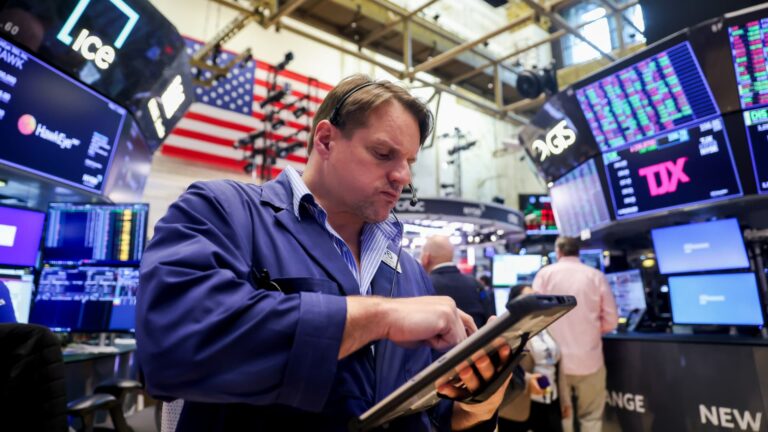
Benchmark indices Sensex and Nifty 50 declined sharply on Tuesday, April 7, as surging crude oil prices and escalating uncertainty around the West Asia conflict weighed on investor sentiment.
The Sensex fell 824 points to 73,282.41, while the Nifty 50 dropped 249 points to 22,719.30. However, the indices recouped the majority of the losses and turned flat. Notably, both indices have corrected nearly 9.5% since the onset of the Iran conflict on February 28.
The weakness comes despite a strong rebound in the previous three sessions, where the Sensex and Nifty 50 rose 3% during this period.
Brent crude climbed 1.2% to above $111 per barrel, adding to inflation concerns and pressuring equities. Continued outflows from foreign institutional investors (FPIs) have intensified the drop, with FPIs offloading ₹1.22 lakh crore in March and an extra ₹29,307 crore already in April.
Dr VK Vijayakumar, Chief Investment Strategist, Geojit Investments, pointed out that the current selling has led to a situation where high-quality, well-priced stocks—especially in the financial sector—are experiencing significant outflows. Given that financials make up a large part of FPI investments, most of the selling occurs within this segment.
However, he remarked that this selling trend is primarily short-term, influenced by the weakness of the rupee and high US bond yields, while underlying fundamentals like credit growth and asset quality remain robust.
In the meantime, Vijayakumar believes that the geopolitical events are still at the forefront of market sentiment, with Donald Trump giving a stern caution to Iran concerning the Strait of Hormuz.
Investors are monitoring these indicators closely, as any viable ceasefire could lead to a significant rally, prompting investors to question if the current trend is ripe for “sell‑on‑rise” or “value buying”.
Is market still a “sell‑on‑rise” or “value buy” amid ceasefire talks?
Sunny Agrawal, Head of Fundamental Research at SBI Securities, explained that given the global uncertainty due to the US-Iran conflict and ongoing geopolitical tensions, we have already witnessed a sharp correction in the market. At the current juncture, he believes valuations have become comfortable.
Agrawal said that the Nifty 50 is trading at a one-year forward price-to-earnings (P/E) multiple of around 17, which is below its ten-year long-term average of 20.
Mid- and small-cap stocks have experienced sharp corrections of 30–40% for the majority of companies, and their valuations have also become more reasonable. Many mid- and small-cap companies are now trading at P/E multiples closer to 20, with a high probability of continuing earnings growth of 20–25% over the next two to three years, the SBI Securities analyst said.
“We believe the recent sell-off is largely driven by liquidity concerns and global uncertainty due to ongoing geopolitical tensions. Valuations have already become attractive, and the earnings outlook remains strong for FY27 and FY28, particularly in the mid- and small-cap space. From a valuation perspective, conditions are now favourable,” added Agrawal.
Therefore, a “rise and sell” strategy is unlikely to be effective at this stage, according to Agrawal. He said that it is more prudent to reshuffle your portfolio toward quality names, as we are at the bottom of a stock-picker’s market. Investors should remain invested and, if deploying new capital, focus on quality stocks and maintain a well-diversified portfolio, he advised.
Regarding the medium-to long-term strategy for investors, Agrawal believes that after approximately 18 months of market consolidation, it is an opportune time to accumulate quality businesses in your portfolio.
DSP Mutual Fund, in its April edition of Netra report on April 6, said that it is also dropping its conservative stance on equities. The fund house believes that the current correction is suitable for adding equity exposure in moderate proportions as valuations become reasonable and multiple factors signal we are approaching extreme pessimism.
“Panic-selling days should be used to add to equity exposure,” DSP MF said.
Can the market bounce back?
Analysts expect the markets to bounce back, but a revival hinges on the outcome of the US-Iran war.
“We hope the conflict will be resolved in the coming weeks, and once stability returns, there could be a solid runway for a stock market rally over the next two to three years,” said Agrawal.
Meanwhile, according to VK Vijayakumar, a sharp escalation in the conflict that pushes crude oil prices above $120—and keeps them elevated for a sustained period—could significantly impact India’s macroeconomic stability. In such a scenario, GDP growth may slow, CPI inflation could rise, and the current account deficit may widen, ultimately weighing on FY27 corporate earnings estimates and triggering further downside in equity markets.
However, he noted that global markets are not currently pricing in a prolonged conflict or persistently high crude prices. Instead, the more probable outcome remains an early reopening of the Strait of Hormuz, which could lead to a correction in crude prices. If this scenario plays out, markets can stage a bounce back.
Disclaimer: This story is for educational purposes only. The views and recommendations above are those of individual analysts or broking companies, not Mint. We advise investors to check with certified experts before making any investment decisions.
About The Author