P&G's solid quarter, confident outlook proves why the stock deserves a spot in our portfolio
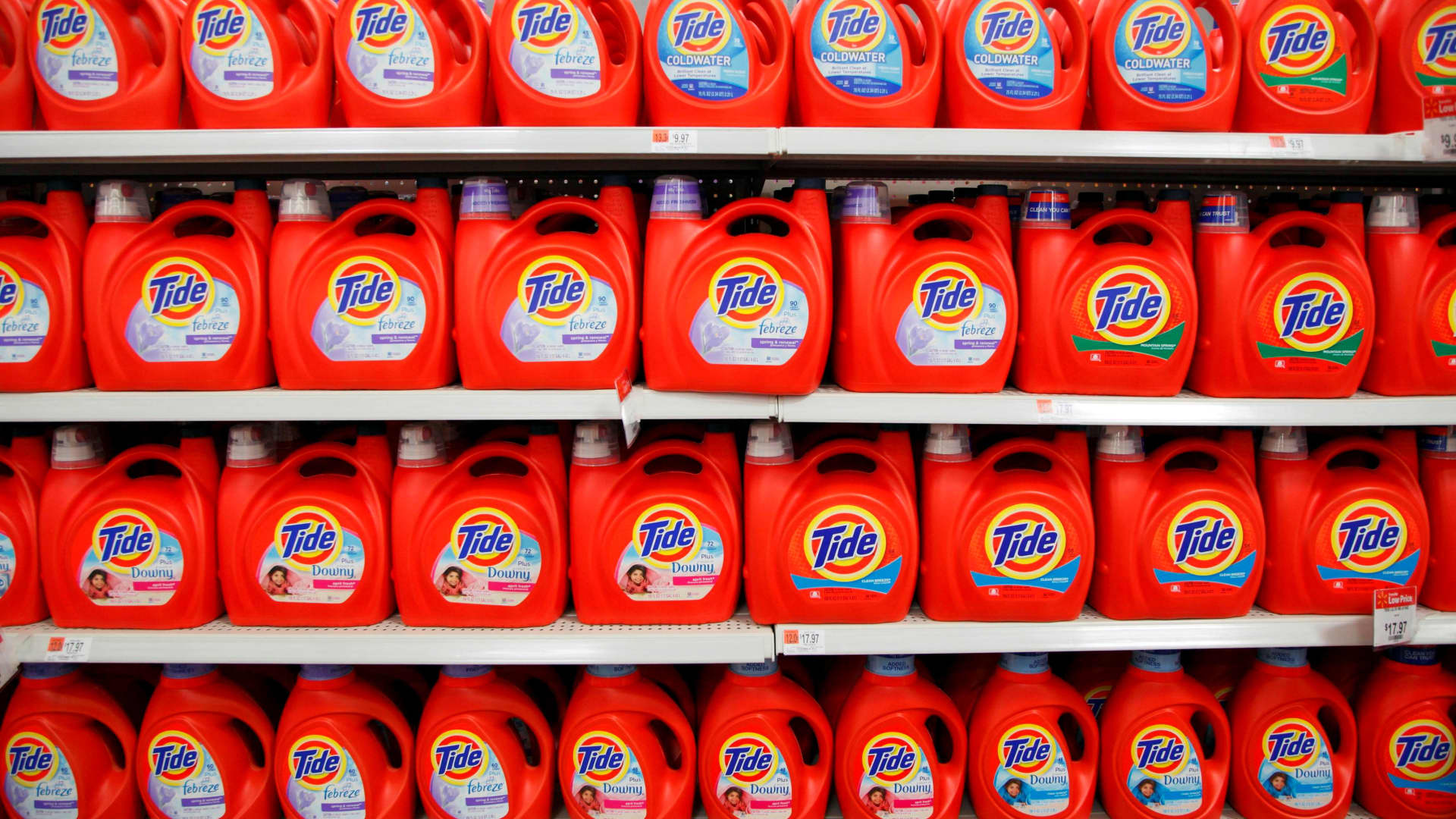
Procter & Gamble shares rose 3% on Friday after the consumer products giant reported top and bottom line beats, while reiterating guidance. P & G was able to do this despite increased commodity prices due to the Iran war. Sales in the company’s fiscal 2026 third quarter, ended March 31, increased 7% year over year to $21.2 billion, outpacing the $20.5 billion expected by analysts, according to data provider LSEG. Adjusted earnings per share (EPS) , which excludes a 4-cent per share benefit from the dissolution of the Glad joint venture business, came in at $1.59, representing a 3% year-over-year increase. That was ahead of the $1.56 estimate compiled by LSEG. Bottom line A solid quarter from Procter & Gamble, with better-than-expected sales in all product categories and organic growth realized in all geographic operating regions, including a 3% organic increase in Greater China, despite what remains a challenging consumer environment. The results again demonstrated that as long as P & G can innovate and provide a best-in-class product , it can use pricing power, when and where needed, to protect profits, no matter the economic environment. P & G products may not always be the cheapest, but they are almost always a leader when it comes to value, something consumers clearly understand. Importantly, the company’s overall 3% organic growth for the quarter was the result of a 1% increase in price and 2% increase in volume. That means demand didn’t wane in the face of higher prices, and that growth was not entirely the result of price actions taken by the company. While raising prices is one way to drive sales growth, it’s not the most sustainable way. The increase in volume indicates that consumers acknowledge that even with the higher prices, P & G products still represent a solid value. PG YTD mountain Procter & Gamble YTD While the detrimental effects of higher energy prices will hit everyone, Procter & Gamble is once again proving that innovation, operational excellence, and — perhaps most importantly — scale can still result in relative winners. “Challenging markets, like the ones we compete in today, are an opportunity for P & G to step out from the pack and to lead,” CFO Andre Schulten said on the post-earnings conference call. The solid quarter and maintained guidance further underscore why we continue to advise Club members to hold on to PG stock. That’s especially true when considering the risks posed by heightened geopolitical tensions. With Friday’s release, management did say that higher energy prices due to the Mideast conflict stand to negatively impact fiscal 2027 profitability. However, P & G might be a winner either way. Should the war resolve quickly and energy prices recede, then management’s fiscal 2027 outlook on costs would likely prove to be conservative. On the other hand, should things get worse, investors will value P & G for the resilient nature of its products, pricing power, and innovation. Either way, we think members should stick with the stock at current levels. We’re reiterating our $165 price target and buy-equivalent 1 rating . Maybe don’t chase Friday’s rally. But Jim Cramer said ahead of earnings earlier this week that under-$140 per share would be a pretty good buy level. Commentary Robust sales growth translated into better-than-expected profits, even as profit margins contracted year over year. On the call, management attributed the margin compression to “healthy reinvestment in innovation and demand creation” that more than offset productivity improvements. Cash generation, meanwhile, was robust, as Procter & Gamble was able to deliver adjusted free cash flow productivity (adjusted free cash flow as a percentage of adjusted earnings) of 82% in the quarter. Looking at organic sales growth for the quarter, four of the segments beat estimates, while Health Care missed. Beauty was up 7% — on a 5% increase in volume, 1% increase in price, and 1% tailwind from sales mix. Grooming was up 1% — on a 2% decrease in volume, which was more than offset by a 3% increase in price. Health care was up 2% — on a 2% increase in price, 1% benefit from mix, and 1% unspecified tailwinds, more than offsetting a 2% decline in volume. Fabric & Home Care was up 3% — on a 2% increase in volume that was compounded by a 1% increase in price. Baby, Feminine & Family Care was up 3% — on driven entirely by volume. Regarding cash returns to shareholders, P & G gave back a total of $3.2 billion during the quarter, with $2.5 billion in dividends and over $600 million by way of share repurchases. Last week, P & G announced an increase to its dividend payout, marking the 70th consecutive annual increase. Procter and Gamble has also now paid a dividend for 136 consecutive years — yet another indicator of the inelastic nature of the consumer demand for its products. Guidance Here are the details around management’s decision to reiterate its full-year guidance. They see sales growth of 1% to 5% year over year; organic sales growth flat to up 4%; 2026 core earnings flat to up 4% versus EPS of $6.83 for fiscal 2025. That EPS range translates to between $6.83 to $7.09, which at the $6.96 midpoint is slightly better than the $6.94 estimate compiled by LSEG. That said, the team did note that it is likely tracking to the lower end of the range because of expected commodity cost headwinds of about $150 million after tax. That would be up from the previously expected neutral designation. The drags posed by tariffs and interest expense, as well as the tailwinds from foreign exchange fluctuations, were left unchanged. The combination of these dynamics is expected to result in an earnings drag of about 25 cents per share. That’s up from the previously forecast 19 cents. The team did not provide an official oil guide for fiscal 2027. But they did say that Brent crude, the international benchmark, priced around $100 per barrel, amounts to a roughly $1 billion after-tax increase in costs, compared to Brent priced in the mid-$60 range, which was where the futures were trading at the beginning of this year. That indication is inclusive of both the direct cost increase of fuel as well as the indirect impact that can have elsewhere in the business. (Jim Cramer’s Charitable Trust is long PG. See here for a full list of the stocks.) As a subscriber to the CNBC Investing Club with Jim Cramer, you will receive a trade alert before Jim makes a trade. Jim waits 45 minutes after sending a trade alert before buying or selling a stock in his charitable trust’s portfolio. If Jim has talked about a stock on CNBC TV, he waits 72 hours after issuing the trade alert before executing the trade. THE ABOVE INVESTING CLUB INFORMATION IS SUBJECT TO OUR TERMS AND CONDITIONS AND PRIVACY POLICY , TOGETHER WITH OUR DISCLAIMER . NO FIDUCIARY OBLIGATION OR DUTY EXISTS, OR IS CREATED, BY VIRTUE OF YOUR RECEIPT OF ANY INFORMATION PROVIDED IN CONNECTION WITH THE INVESTING CLUB. NO SPECIFIC OUTCOME OR PROFIT IS GUARANTEED.