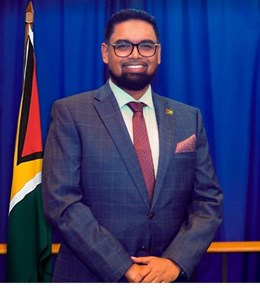
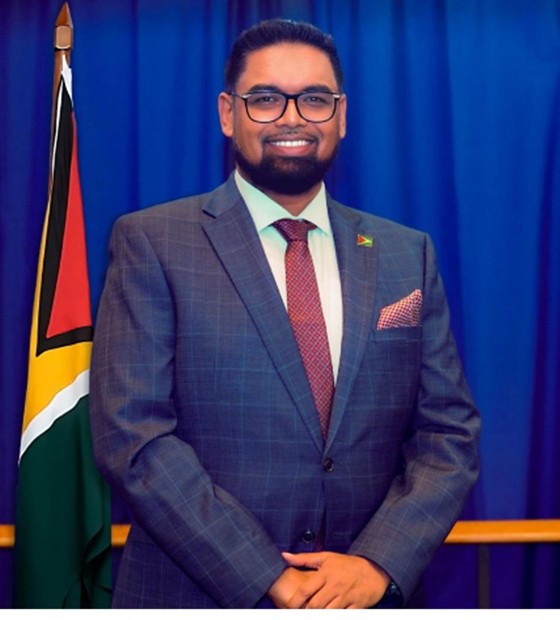
Fig. 1. Guayana’s President, Dr. Mohamed Irfaan Ali. Image: Official photo.
For its 58th year of existence, the Offshore Technology Conference got underway on Monday, May 4, with an Opening General Session that featured Guyana’s President, Dr. Mohamed Irfaan Ali, Fig. 1. It was billed by OTC as a “must-attend” event. However, having heard President Ali’s entire speech, this editor might take issue with that characterization.
A lack of oil and gas elaboration. Given his country’s ascendency in recent years to the league of oil-producing heavyweights, with Guyana expected to hit 1.0 MMbopd shortly, one would have thought that he would spend most of his keynote speech discussing the nation’s hydrocarbon successes. However, if that is what most of the roughly 800 to 1,000 attendees were expecting, they were sorely disappointed.
Instead, he delivered a rather rambling hour-long speech that touched on many different topics but was significantly short on substance about Guyana’s actual oil and gas activities. Yes, he briefly mentioned that Yellowtail field was brought onstream last August and that the fifth field in the Stabroek Block, Uaru, is set to begin production later this year. And President Ali also mentioned, late in his talk that his country working on “the Energy Transition” and renewable energy “is not an existential threat” to Guyana’s hydrocarbon output and reserves.
Energy transition comments. Speaking of renewables, in the context of declaring that the world suffered from an “energy gap,” Dr. Ali spent considerable time discussing the role of renewables in the world’s overall energy mix. He said that moving away from fossil fuels to greater renewable energy sources “is not a simple feat of replacing one source of power with another.” Instead, he advocates build an entirely new global system, from electrical grids to transportation, fueled by renewable energy while still relying on and potentially expanding the use of fossil fuels.
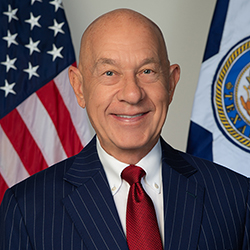
Houston Mayor John Whitmire
Reallocation of financing priorities. President Ali also issued a call for strategic investments in countries that have been underfunded on energy initiatives. The goal, he said, is to achieve what he terms “a global energy balance.” In fact, he championed that term several times in his remarks. Dr. Ali suggested that the countries most in need— developing countries— must benefit from better financing support and more investments in their energy systems to meet ever-growing demand.
Minerals extraction. At one point, the President went far afield from oil and gas, talking about the need to expand mining and develop better technology and methods for extracting rare earth minerals. He commented on this in reference to the growing demand for minerals like lithium and cobalt for renewable energy development. All of this, one way or another, refers back to his concept of a “global energy balance.” By the time his speech was finished, one was hard put to judge what had been the main topic of his remarks.
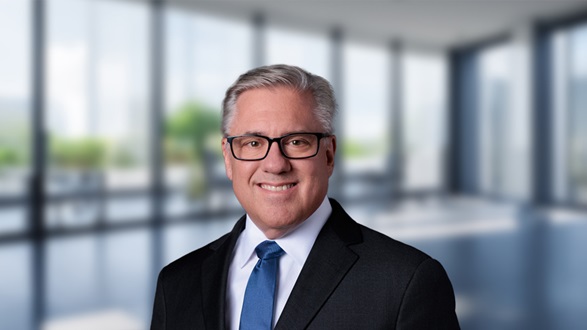
Fig. 3. Robert Clay Neff, President, Upstream, Chevron Corporation. Image: Chevron.
Beginning the session. The actual start of the Opening General Session was led off by OTC Chair Dan McConnell. He welcomed officials and attendees to what he believes will be one of the more important OTCs, given not only the industry’s technology advancements but also the Middle Eastern situation and market conditions.
McConnell was followed by Houston Mayor John Whitmire,Fig. 2,who emphasized that the city wants to collaborate with the oil and gas industry and its professionals. He also was quick to point out to attendees that compared to some of the other large cities in the U.S., Houston has not been suffering from political strife and violence. Chevron’s President for Upstream, Robert “Clay” Neff (Fig. 3), introduced President Ali to the crowd. Neff made mention of Chevron’s significant role as a stakeholder in Guyana’s deepwater offshore play and the continued success that his firm and its partners are having.
About The Author