We're raising our Corning price target after its Nvidia deal, updated financial targets
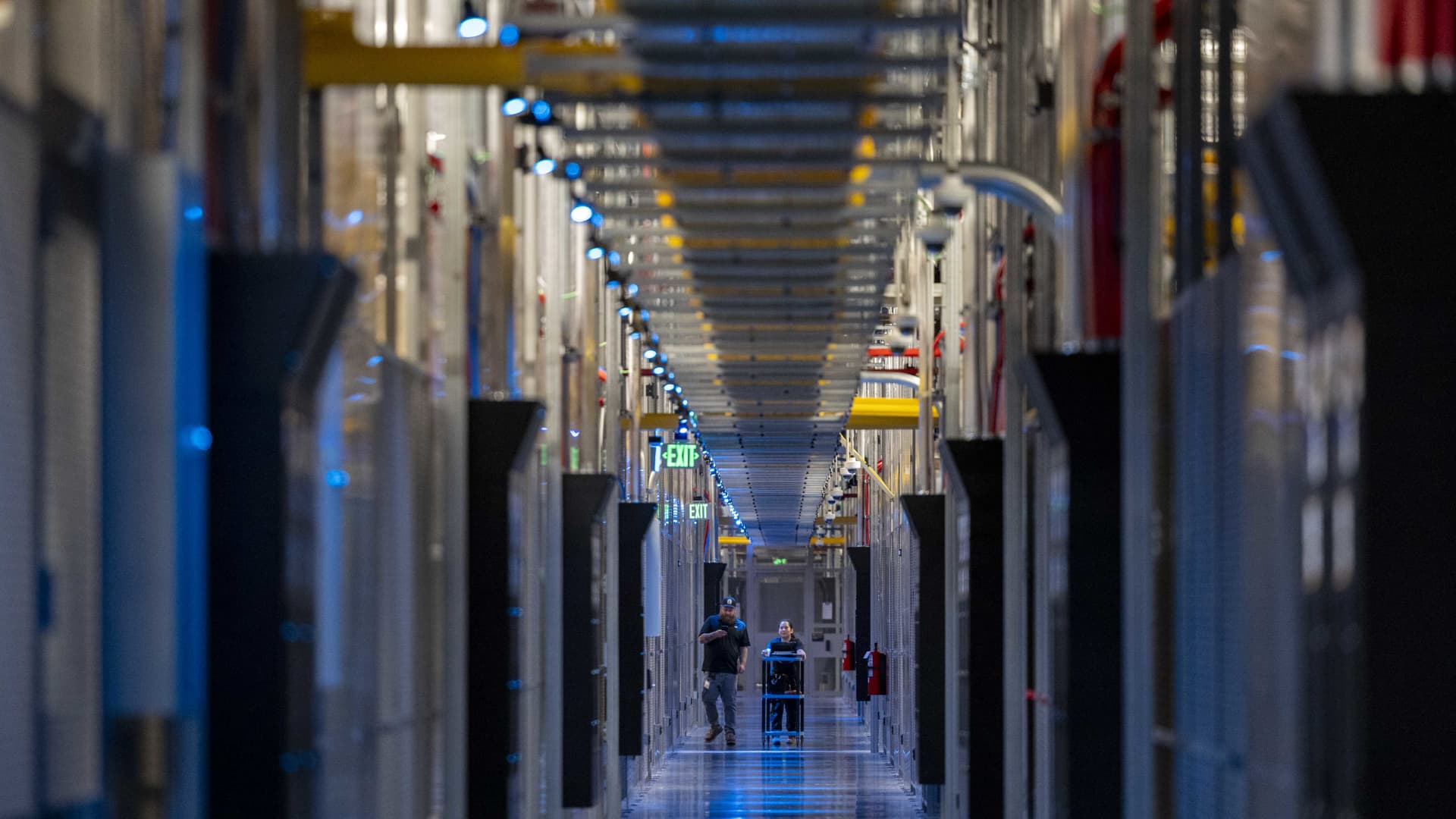
Corning is going to have a seat at the artificial intelligence table for many, many years to come. The maker of fiber optic cables drove that point home at its investor day Wednesday, laying out encouraging long-term financial forecasts and announcing a major supply agreement with AI chip king Nvidia to bring more of its glass technology inside data centers. The one-two punch sent shares of Corning up roughly 14% in Wednesday’s session to almost $185 apiece. The stock had surged over 17% at the opening bell, which could’ve invited some profit-takers to ring the register on a name that’s more than doubled this year. These updates Wednesday give us confidence that Corning has an incredible opportunity ahead, thanks to the need for networking technology that can handle the high speeds and long distances required inside modern AI data centers. Corning’s optical solutions ensure that the data being sent between servers doesn’t degrade — a risk with the copper wires used historically before the era of agentic AI computing. Bigger picture, Corning’s investor day and the Nvidia deal increase our conviction that the AI boom is more of a long-term secular investment trend rather than a short-term trade. It’s another proof point on top of last week’s increased capital expenditure forecasts from Meta Platforms, Amazon, Microsoft, and Alphabet. Investors need some sort of data center exposure in their portfolios for the long-term. That doesn’t mean chase Corning’s move Wednesday, but it should serve as a wake-up call to anyone still doubting the legitimacy of AI investments and the corresponding rallies in stocks benefiting from the tsunami of spending. GLW 1Y mountain Corning’s stock over the past 12 months. Now, let’s get into the details of Corning’s announcements. We’ll start first with the Nvidia deal and then cover the financial targets. It is agreements with companies like Nvidia that help instill confidence in the company’s revenue plans. Nvidia comes on board Corning and Nvidia struck a multiyear partnership and supply agreement that will tie the fortunes of these two Club holdings even closer together. As part of the deal, Corning will expand U.S. optical connectivity manufacturing 10-fold and increase fiber production capacity by 50% in order to keep up with the demand for AI infrastructure initiatives. To meet those targets, Corning said it will build three new manufacturing facilities in North Carolina and Texas, bringing with them more than 3,000 high-paying American jobs. Nvidia also has the option to take an equity stake in Corning. According to a securities filing, Corning granted Nvidia warrants to purchase up to 3 million shares — at an exercise price of fractions of a penny — for a total of $500 million. Additionally, Nvidia has the right to buy up to 15 million shares at an exercise price of $180, potentially totaling $2.7 billion. That’s right around where the stock traded Wednesday afternoon. Anytime a company agrees to give up a piece of itself, existing shareholders have to ask whether they’re OK being diluted. Corning currently has roughly 860 million shares outstanding, meaning those 18 million shares for Nvidia represent only 2% dilution. In exchange for the dilution, we as Corning shareholders get a ton of safety knowing Nvidia will be there to take Corning’s additional supply. In other words, it’s a fair trade to make. This is far from the first time Nvidia has invested, or been given the right to invest, in a company it considers crucial to its supply chain and the broader AI ecosystem. In March, Nvidia invested a combined $4 billion in optical players Coherent and Lumentum . At the time, we said those investments reinforced our belief that optics will supplant more copper inside data centers. Under CEO Jensen Huang, Nvidia has consistently seen around corners and pushed the envelope on the next frontiers of computing. The embrace of optics is no different. As the compute intensity of AI workloads increases and data center footprints grow larger, copper connections have started to reach their limits, especially as agentic AI systems have come onto the scene. These more advanced systems are capable of taking actions on behalf of their users, which goes beyond responding to a prompt with text or an image. Consider this: Jensen told CNBC’s Jon Fortt on Tuesday that the amount of compute needed from generative AI two years ago to today’s agentic AI is 1,000% more. Why? Because agents have to read, use tools, and reason through their tasks. As a result, agents generate a lot more tokens — the basic unit of data in AI computing — than the early versions of ChatGPT. Now layer in the fact that more humans are using AI systems than a few years ago. The result is more intense compute requirements multiplied by greater adoption, leading to an explosion in demand for chips, interconnect solutions between those chips, and the energy to power it all. The issue with sending data over copper is that high transfer speeds and long distances result in integrity degradation. Optical connections, however, can maintain data integrity at the high speeds and over the long distances required by accelerated AI data centers. As part of its investor presentation Wednesday, Corning executives discussed the company’s opportunity to move its optics technology even closer to the AI chip. Right now, Corning’s fiber is being used to connect a bunch of server racks together across the data center; this is called “scale-out” networking. Connecting components inside the server racks themselves is what’s known as “scale-up” networking. Copper remains the go-to material for scale-up connections. However, as the speed of computing increases, we will get to a point where copper is no longer viable even inside the racks. “These technologies will get their start in the scale-out network,” CEO Wendell Weeks. “It is clear that scale-up drives a dramatic increase in size and scale.” He added, “Optical scale-up is new tech that will likely have an exponential adoption curve.” Despite his clearly very bullish view, Weeks conceded that the timing of that ramp is very difficult to gauge. It will be measured in years, not months. For us, the takeaway is that investors need to own the stock now rather than try to time the adoption. Financial targets Corning also upgraded and extended its closely watched financial targets. The company issues them as part of its “Springboard” growth initiative. Going into the investor day, management had only set targets through 2028. Now Springboard goes out to 2030. In the near-term, management is now forecasting a $20 billion annualized sales run rate exiting 2026, resulting in a 15% compound annual growth rate (CAGR) for sales from the fourth quarter of 2023 to Q4 of 2026. Beyond year-end, Corning expects to accelerate its sales CAGR to a 19% rate from the start of 2027 through the end of 2030. As a result, Corning’s most optimistic projection — labeled its “internal plan” — calls for the company to reach a $30 billion annualized sales run rate by year-end 2028. Management said Wednesday they’re looking to add $17 billion in incremental sales by the end of that year, up from the $11 billion target shared with investors in January. That extra $6 billion is a notable update. Corning also issues what it calls its “high-confidence plan,” which takes the internal plan and adjusts for potential risks, resulting in a smaller target. The high-confidence plan calls for a $27 billion annualized revenue run rate exiting 2028. Looking out through the end of the decade, Corning’s internal plan now targets a $40 billion annualized revenue rate exiting 2030, with a high-confidence target of $35 billion. While our FactSet estimates don’t go out to 2030 to see how this stacks up versus the consensus, we welcome the added visibility into the durability of growth. “In our high-confidence plan, we took $5 billion out of sales for 2030 from our internal plan and $3 billion out for 2028. Those are big adjustments,” CFO Ed Schlesinger acknowledged during the investor presentation Wednesday. “Even with those adjustments, we still double the company from the end of 2025. Either way, we expect to double the size of the company.” Revenue targets aren’t the only thing to get excited about. Corning’s efforts to work closely with customers as it expands capacity in the coming years also benefit cash flow performance — something all investors are focused on, given the amount of money flowing into data centers. Historically, Schlesinger said, realizing organic growth meant investing significant capital upfront, taking on risk before revenues or cash flows ever materialize. Now, though, Corning is turning to multiyear agreements to share some of the risk of the investments with its customers. In addition to the Nvidia deal, Corning announced in January a long-term supply agreement with Meta. Last week, it disclosed two additional deals with unnamed hyperscaler customers. Away from its data center business, Corning also has a glass supply agreement with Apple for iPhone and Apple Watch. Thanks to these deals, Corning expects cash flow to grow throughout the planning period. “This time, as we invest, we expect our operating cash flow to grow at a rate that exceeds the increased capital spending,” Schlesinger said. “Therefore, we expect free cash flow to grow as we grow sales.” Bottom line Corning shares have run a lot this year, and since we took a stake in October — an investment motivated by Jim Cramer’s trip to a Corning factory in Kentucky, during which chief executive Weeks mentioned the company’s data center opportunity. That opportunity looks even better now than it did then. So, we think there’s plenty of room left to go for Corning’s stock. The AI trade is clearly going to be with us for a while, and Corning has angled its way into the middle of the action. And it’s not doing it recklessly. By signing deals that see customers share in the risks that come with a capacity expansion, Corning is positioned to grow revenue over the coming years without taking a major axe to its near-term cash flows. That is why the stock is up double-digits Wednesday. That is why the move is real and why it can continue. Accordingly, we are increasing our price target to $200 from $180. We’re reiterating our hold-equivalent 2 rating. (Jim Cramer’s Charitable Trust is long GLW, NVDA, AMZN, META, MSFT and GOOGL. See here for a full list of the stocks.) As a subscriber to the CNBC Investing Club with Jim Cramer, you will receive a trade alert before Jim makes a trade. Jim waits 45 minutes after sending a trade alert before buying or selling a stock in his charitable trust’s portfolio. If Jim has talked about a stock on CNBC TV, he waits 72 hours after issuing the trade alert before executing the trade. THE ABOVE INVESTING CLUB INFORMATION IS SUBJECT TO OUR TERMS AND CONDITIONS AND PRIVACY POLICY , TOGETHER WITH OUR DISCLAIMER . NO FIDUCIARY OBLIGATION OR DUTY EXISTS, OR IS CREATED, BY VIRTUE OF YOUR RECEIPT OF ANY INFORMATION PROVIDED IN CONNECTION WITH THE INVESTING CLUB. NO SPECIFIC OUTCOME OR PROFIT IS GUARANTEED.