Not every coin bearing a historic date was struck in that year. Governments and authorized mints have long produced coins using earlier dates as a deliberate continuation of a recognized design or bullion standard. These coins are known as restrikes. They are official, disclosed, and actively traded. Some circulate as affordable fractional gold. Others carry remarkable stories behind their production. This article will explain what a coin restrike is, how they are valued, and what separates a legitimate reissue from a problematic one, using some of the most notable examples in numismatic history.
Defining Coin Restrikes
Restrike coin meaning is very precise in numismatics, though it is sometimes used loosely in ways that create confusion.
What Is A Restrike Coin?
Mints have long faced a tension between historic coin designs that remain in demand and the practical reality that original production has ended. Rather than abandon a recognized and trusted design entirely, some mints choose to continue striking it, using the original date, the same specifications, and dies that replicate or preserve the original. The result is a restrike: a coin produced after its official issue period that bears a historic date and maintains the original design. Restrikes exist for a range of reasons. Some serve a bullion market that values a familiar format. Some fulfill collector demand for designs that would otherwise be unattainable. Others are produced to generate mint revenue from a historically significant coin without altering its identity. In every case, the coin’s historic date is not an error or a deception; it is an intentional and defining feature of what a coin restrike is.
Restrike Coin vs. Counterfeit
Because restrikes bear historic dates and are designed to look like older coins, they are sometimes confused with counterfeits. The distinction between the two is important and comes down to intent and authorization. A counterfeit is produced to deceive, with the goal of passing a fake off as a genuine original and extracting a premium that the piece does not deserve. A restrike coin is produced openly by an authorized party, with the understanding that it is a later issue rather than an original strike. The complication arises at the margins. When restrikes are sold without adequate disclosure, or when the term is applied loosely to what is actually an unauthorized copy, the line between legitimate reissue and misrepresentation becomes blurred. Not every coin described as a restrike in the marketplace meets the strict coin restrike definition, and buyers should approach unfamiliar pieces with that awareness.
Coin Restrike vs. Reissue
Restrikes are also sometimes confused with reissues, and while the two share some characteristics, they are meaningfully different. A reissue is a coin struck in a later year that bears the actual date of its production. Modern bullion coins like the annual Philharmonic or American Eagle are reissues: the same design struck each year with the current year’s date. A restrike, by contrast, deliberately retains a historic date regardless of when it was actually struck. That distinction matters particularly for collectors, since a restrike’s frozen date is a central part of its identity and its connection to a specific moment in monetary history, even when the coin itself is entirely modern.
Austrian Gold and Silver Coin Restrikes
Austria has one of the longest and most prominent restrike traditions of any mint in the world, producing officially sanctioned restrikes across multiple denominations that serve both the bullion market and the collector community.
The Maria Theresa Thaler
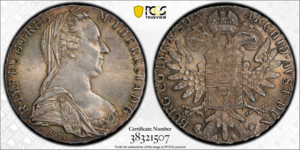
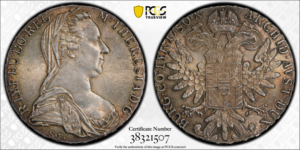
Image: Maria Theresa Thaler 1780 silver coin obverse and reverse, PCGS certified
Source: PCGS
The Maria Theresa Thaler is arguably the most famous silver coin restrike in existence. During her reign, Maria Theresa’s silver thaler became the dominant trade coin across the Middle East, East Africa, and parts of Asia, trusted by traders who recognized its consistent weight and purity. The coin bearing the 1780 date became the standard, and after the Empress’s death that year, Emperor Joseph II authorized the Austrian Mint to continue striking it with the 1780 date frozen, because it was the only coin many trading partners in the Arab world would accept. That practice has continued ever since. By around the year 2000, an estimated 389 million pieces had been struck. The coin is still produced by the Austrian Mint today, always bearing the 1780 date, and trades as a silver bullion coin at premiums close to melt value.
For a closer look at the 1780 Austria restrike Maria Theresa Thaler coin and its remarkable role in global trade, watch this video from a collector who traces the coin’s journey from the Habsburg Empire to the coffee trades and World War II.
Austrian Gold Ducats
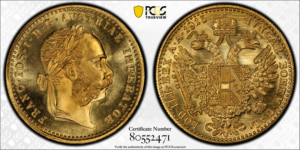
Image: Austrian 1915 gold Ducat obverse and reverse, PCGS certified
Source: PCGS
The 1915-dated gold ducat is the best-known Austrian gold restrike coin in active production, featuring a portrait of Emperor Franz Joseph I on coins originally issued as circulating gold coinage of the Austro-Hungarian Empire. When regular production ended, the Austrian Mint continued striking them with the 1915 date frozen.
The 1 Ducat
The 1915 1 Ducat Austrian restrike gold coin contains 0.1107 troy ounces of .986 fine gold and is one of the more accessible fractional gold options in the European market, trading at modest premiums over spot.
The 4 Ducat
The 1915 Austria 4 Ducat gold coin restrike contains 0.4427 troy ounces of the same .986 fine gold purity and similarly trades close to bullion value, making it a practical mid-range fractional gold holding.
Austrian Gold Coronas
The gold Corona series offers another set of actively traded Austrian restrikes, all struck in .900 fine gold and competing directly with modern fractional bullion coins on the basis of gold content and low premiums, while carrying the additional appeal of historic imperial design.
The 10 Corona
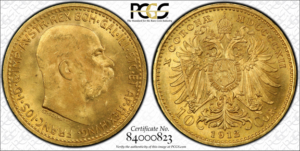
Image: Austrian 10 Corona gold coin 1912 obverse and reverse, PCGS certified
Source: PCGS
The 1912 10 Corona Austrian gold coin (restrike) is one of the smaller fractional options in the Corona range, trading close to melt value in European bullion markets.
The 20 Corona
The 20 Corona bears a 1915 date and offers a larger gold content than the 10 Corona while maintaining the same low-premium bullion-focused appeal.
The 100 Corona
The 100 Corona contains approximately 0.98 troy ounces of gold and is the largest format in the Austrian restrike range, offering near-full-ounce gold content at premiums typically close to those of standard bullion coins.
Why Austria Has Such a Strong Restrike Coin Tradition
Several factors explain why Austria became the world’s most prolific issuer of official restrikes. The Austro-Hungarian Empire produced coins of exceptional design and consistent precious metal standards that earned lasting trust in international trade markets – trust that outlived the Empire itself. Continuing to strike those coins allowed the Austrian Mint to serve ongoing demand without abandoning designs that the market already recognized and valued. Restrikes also provide the mint with a revenue stream from bullion investors and collectors who want historic designs at accessible prices. The result is a program that serves multiple audiences simultaneously: the silver stacker, the fractional gold investor, and the collector drawn to imperial Austrian numismatics, all through coins that require no new design work and carry centuries of established market recognition behind them.
The Kellogg $50 Gold Case Study
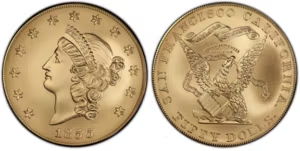
Image: 1855 Kellogg & Co. $50 gold commemorative restrike obverse and reverse
Source: PCGS
The 1855 Kellogg $50 is one of the most discussed examples of a modern commemorative coin restrike in American numismatics – a case where the original coin is virtually unobtainable, and a later authorized issue using historic gold and period-based dies offers collectors a documented connection to the same story.
Historical Context
During the California Gold Rush of the 1850s, the newly established San Francisco Mint could not keep pace with demand for circulating coinage. Private assayers filled the gap. Kellogg & Company, a prominent San Francisco firm, struck $20 and $50 gold pieces that circulated alongside official U.S. coinage as legitimate territorial currency. The $50 denomination, known as a slug, was the largest and most distinctive of these private issues. Only around 14 examples of the original 1855 Kellogg $50 are known to exist today, all proof strikes. The finest known sold for $1 million in 2020. Genuine examples are among the most valuable territorial gold coins in American numismatics and are rarely available on the open market.
The 2001 Restrike
In 2001, the California Gold Marketing Group organized the production of 5,000 commemorative restrikes based on the Kellogg $50 design. The gold used came from Kellogg & Humbert ingots recovered from the wreck of the S.S. Central America, a steamship that sank in a hurricane in 1857 while carrying California gold eastward. Dies were made based on the original 1855 Kellogg dies. Each piece contains approximately 2.41 troy ounces of .887 fine gold and was individually counterstamped with its specific date of striking between August 20 and September 12, 2001. Many pieces were certified by PCGS. The restrike coin is openly described as a modern commemorative and is not represented as an original period coin.
Authentication
Because the design closely follows the original 1855 coin, distinguishing the restrike from a period original requires careful examination. The primary differentiator is the counterstamp on the reverse ribbon: genuine period coins carry no such inscription. Beyond visual inspection, metallurgical composition, weight, and surface characteristics all differ from original 1855 examples. Third-party certification from PCGS or NGC is the most reliable way to confirm status.
Kellogg $50 Restrike Coin Value and Market Standing
The 2001 restrikes trade as collector pieces at a fraction of the value of genuine 1855 originals. Their value is driven by gold content, condition, and the historical interest of the S.S. Central America provenance, not by numismatic rarity. For collectors who want a tangible connection to California Gold Rush history, they represent an accessible entry point that genuine originals can never offer.
Other Notable Restrike Coin Examples
While Austrian coins and the Kellogg $50 represent two well-documented cases, restrikes appear throughout numismatic history in forms that range from officially sanctioned government programs to unauthorized productions that blur the line between restrike and deception.
The 1804 U.S. Silver Dollar
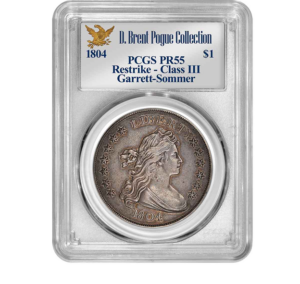
Image: 1804 Draped Bust silver dollar Class III restrike in PCGS PR55 slab, D. Brent Pogue Collection
Source: PCGS
The 1804 dollar is perhaps the most famous example of how a restrike can become more historically significant than the coin it was ostensibly based on. No silver dollars were struck bearing an 1804 date during that year, as silver dollar production had been suspended. The coins now classified as originals were produced in 1834 as diplomatic gifts for foreign rulers, bearing the 1804 date retroactively. Later, in the late 1850s, Mint insiders produced further unauthorized versions for sale to collectors, some artificially worn to disguise their origins. All known examples are extraordinarily rare and valuable today. The story also illustrates an important point about disclosure: the U.S. Mint now operates with full transparency about production dates, a standard that was not consistently applied in the 19th century.
British Sovereign Restrikes
Government mints have sometimes used historic dates for purely practical reasons with no collector intent whatsoever. The Royal Mint’s 1925-dated sovereign is a clear example. When the Mint resumed sovereign production in 1949 to meet bullion market demand, it used the 1925 date as the expedient choice given the practical circumstances of resuming production at the time. The resulting coins are visually indistinguishable from the originals, which means they are not always described as restrikes in the conventional sense, but they meet the definition. They trade as bullion rather than numismatic pieces, and their restrike status has minimal impact on value.
Ancient and Historical Reproductions
At the furthest end of the spectrum sit modern strikes inspired by ancient Roman, Greek, and medieval designs. Some are properly authorized educational reproductions, clearly marked as modern pieces and priced accordingly. Others are produced with less transparency and sold in ways that invite confusion with genuine ancient coins. The legal and ethical standing of these pieces varies considerably by producer and jurisdiction, but the core principle remains consistent with the rest of the coin restrike category: authorization and disclosure are what separate a legitimate reissue from a problematic one.
Identifying Restrikes
Knowing how to identify a restrike coin matters whether you are buying, selling, or simply trying to understand what you own.
Visual Examination
The most immediate clues are often visible to the naked eye. Restrikes struck with modern equipment tend to display sharper detail and more consistent surfaces than genuine period coins, which may show circulation wear, die fatigue, or the subtle imperfections of older production methods. A coin that appears suspiciously pristine for its supposed age warrants closer examination. Disclosed restrikes like the Austrian ducats and the 2001 Kellogg commemorative also carry specific inscriptions or counterstamps that distinguish them from originals.
Technical Analysis
When visual examination is inconclusive, technical methods provide more definitive answers. Metallurgical testing can detect whether a coin’s gold or silver composition matches the standards of the period it claims to represent. Weight comparison against known specifications is another reliable indicator, since even small variations can be significant. Edge details, such as reeding, lettering, or surface texture, often differ between period originals and later strikes due to changes in minting technology.
Documentation and Expert Resources
For high-value pieces, third-party certification from PCGS or NGC is the most reliable confirmation of a coin’s status. Both services note restrike designations where applicable. Mint records, numismatic reference literature, and provenance documentation can also help establish whether a given coin is an original issue or a later production. When in doubt, consulting a specialist dealer is advisable before making any purchase or sale decision.
Coin Restrike Values and Market
Not all restrikes are equal in value, and understanding what drives pricing is essential before buying or selling.
What Determines a Restrike’s Value
Several factors combine to determine what a restrike coin is worth. Authorization matters significantly: official government restrikes carry the backing of a recognized mint and trade confidently in established dealer networks, while unauthorized restrikes carry more risk and typically command lower prices. Additionally, precious metal content establishes a value floor: a gold restrike is always worth at least its melt value regardless of numismatic demand. Above that floor, collector interest, scarcity, and provenance can push prices higher, though for most standard restrikes the premium over melt remains modest. Well-known government issues such as Austrian restrikes illustrate this dynamic clearly, trading close to spot while offering historic designs at accessible prices.
Problematic Restrikes
The market becomes cautious around restrikes sold without adequate disclosure or priced as though they carry numismatic value they do not possess. A restrike sold as an original, or priced at a premium only an original would justify, is misrepresentation. Third-party certification from PCGS or NGC is the most reliable protection, as both services note restrike status clearly in their designations.
Collecting Strategies
Restrikes occupy a specific and useful place in a precious metals or numismatic collection, provided expectations are set correctly from the outset.
The Bullion Approach
For investors, an Austrian gold coin restrike offers a practical entry point into fractional gold. The 1 Ducat, 4 Ducat, and gold Corona series all provide gold content at premiums competitive with modern fractional bullion coins, with the added appeal of historic imperial design. Buyers who want variety within a bullion position without paying numismatic premiums will find the Austrian restrike range well suited to that goal.
The Collector Approach
For collectors, restrikes offer access to designs that would otherwise be completely unattainable. The 2001 Kellogg $50 commemorative is a clear example: genuine originals trade for seven figures, while the restrike provides a documented connection to the same history at a fraction of the cost. Type collectors building representative sets of historic designs will also find restrikes a practical solution where originals are scarce or prohibitively priced.
What to Avoid
Buying restrikes without understanding their status is the primary risk. A restrike purchased at original coin prices, or held with expectations of numismatic appreciation, is unlikely to perform as hoped. Third-party certification, transparent dealer disclosure, and realistic pricing relative to metal content are the baseline requirements for any restrike coin purchase worth making.
Conclusion
Restrikes occupy a legitimate and well-defined place in the precious metals and numismatic world. They range from centuries-old government bullion programs like the Austria Maria Theresa Thaler silver coin restrike to carefully documented commemoratives like the 2001 Kellogg $50. Understanding what a restrike is, who authorized it, and what it is genuinely worth protects buyers from overpaying and helps collectors make informed decisions. When acquired with realistic expectations and proper verification, restrikes offer something genuinely useful: historic design, documented provenance, and precious metal content, often at prices that genuine originals could never match. Explore Blanchard’s selection of rare coins to find pieces with the history and quality that matter to you.
FAQs
What is a coin restrike?
A coin restrike is a coin produced after its original issue period, bearing a historic date and maintaining the original design, struck by an authorized party using original or period-based dies.
Is a restrike coin worth anything?
Yes, official restrikes struck in precious metals are always worth at least their metal content, and some carry additional collector value depending on their authorization, provenance, and historical significance.
How can you tell if a coin is a restrike?
Visual examination, weight and metallurgical testing, and comparison against known specifications can all help identify restrikes, though third-party certification from PCGS or NGC is the most reliable confirmation.
Are Austrian gold coin restrikes valuable?
Austrian gold restrikes trade close to their precious metal value with modest premiums, making them practical bullion holdings rather than numismatic investments. Their appeal lies in historic design at competitive gold prices.
About The Author