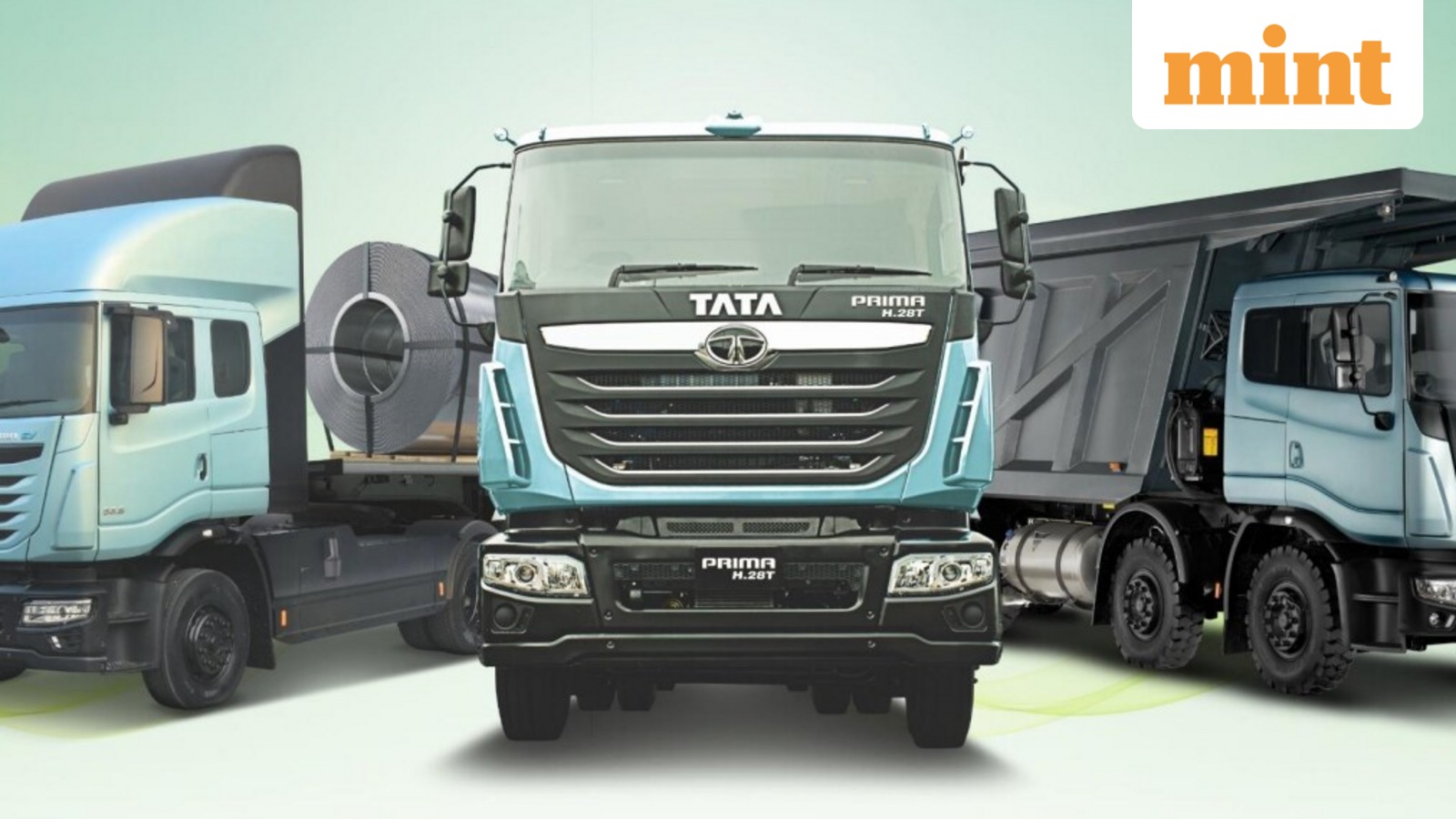
Commercial vehicle manufacturer Tata Motors shares will likely hog the limelight in trade tomorrow, 14 May, after it announced a stellar set of earnings for the January-March quarter of the financial year 2025-26 post-market hours today.
Ahead of the earnings announcement, Tata Motors’ stock had ended marginally lower, down 0.74% at ₹384.35 apiece on the BSE.
Tata Motors Q4 Results
The demerged Tata Motors arm, on 13 May, posted a massive 69.56% year-on-year (YoY) jump in its standalone profit to ₹2,406 crore for Q4FY26. The profit stood at ₹1,419 crore in the same period last year.
People also ask
AI powered insights from this story
•5 QUESTIONS
Tata Motors reported a standalone profit of ₹2,406 crore for Q4 FY26, a 69.56% year-on-year jump. The quarterly revenue stood at ₹24,452 crore, marking a 22% year-on-year growth.
Tata Motors achieved an EBITDA of ₹3,400 crore in Q4 FY26, a 35% year-on-year increase. The EBITDA margin was reported at 13.9%, an improvement of 130 basis points year-on-year.
From a long-term perspective, analysts recommend holding the stock due to its fundamental strength, improving profitability, and cash generation. However, potential risks include cyclical auto demand and commodity price volatility.
Tata Motors views FY26 as an inflection point for the commercial vehicles industry, surpassing pre-FY19 peaks. The company reinforced its industry leadership and market position, with resilient underlying demand fundamentals despite near-term moderation.
Yes, the Board of Directors recommended a final dividend of ₹4 per equity share for the financial year ended March 31, 2026. This dividend, if approved, will be paid to eligible shareholders on or before July 2, 2026.
Meanwhile, the quarterly revenue stood at ₹24,452 crore, recording a growth of 22% YoY, with EBITDA at ₹3,400 crore, an upside of 35% YoY. The company achieved EBITDA margin at 13.9% (up 130 bps), ahead of its mid-term guidance.
Tata Motors said it delivered a record Q4 FY26 performance and a strong full year, underpinned by disciplined execution and focus on profitable growth.
Strong operational performance and efficient working capital management through the year resulted in consistent growth in full-year free cash flow of ₹9200 crore. Meanwhile, net cash for the domestic business stood at ₹7,500 crore as of March 31, 2026.
The company’s disciplined approach to capital allocation has led to an industry-leading Auto ROCE of 72% in FY26 (vs. 61% in FY25), it said in an exchange filing.
The Board of Directors of Tata Motors also recommended a final dividend of ₹4 per equity share of ₹2 each for the financial year ended March 31, 2026. The dividend, if approved at the AGM, shall be paid to the eligible shareholders on or before July 2, 2026.
Should you buy Tata Motors stock after Q4 show?
Seema Srivastava, Senior Research Analyst at SMC Global Securities, said that Tata Motors delivered a strong Q4 FY26 performance, beating street expectations on margins and profitability.
Therefore, from a long-term investment perspective, she recommends that investors continue holding the stock as Tata Motors appears fundamentally strong with improving profitability, cash generation, technology transition readiness, and leadership in commercial EVs. “However, cyclical auto demand, commodity price volatility, and execution risks in global acquisitions remain key monitorable factors for long-term investors,” she cautioned.
On the technical front, Tata Motors is currently navigating a period of significant distribution and price correction on the daily timeframe, said Virat Jagad, Sr. Technical Research Analyst at Bonanza. The stock has lost 10% YTD.
“After peaking near the 500 level in early March 2026, the stock has entered a corrective phase characterised by a classic ‘Lower High – Lower Low’ structure. The stock is currently hovering at a make-or-break support level near 380–385 (indicated by the dotted red line). This level is crucial; a decisive close below this could trigger another leg of selling toward the 340–350 zone,” he added.
Disclaimer: This story is for educational purposes only. The views and recommendations made above are those of individual analysts or broking companies, and not of Mint. We advise investors to check with certified experts before making any investment decisions.
About The Author