Don’t look now, but the pain from high energy prices might be about to bite Americans twice.
With no end in sight to the war in Iran and oil prices stuck above $100 a barrel, bond traders worried about inflation have sold off long-term government debt in the U.S. and developed economies in recent days. That has the effect of raising bond yields, including on the benchmark 10-year Treasury note, which rose nearly 24 basis points in the past week to end Friday near 4.6%.
The 10-year Treasury yield influences the cost of mortgages, auto loans, credit card rates and other consumer debt. When it goes up, consumers feel the pinch.Its rate is set by the market, not the Federal Reserve.
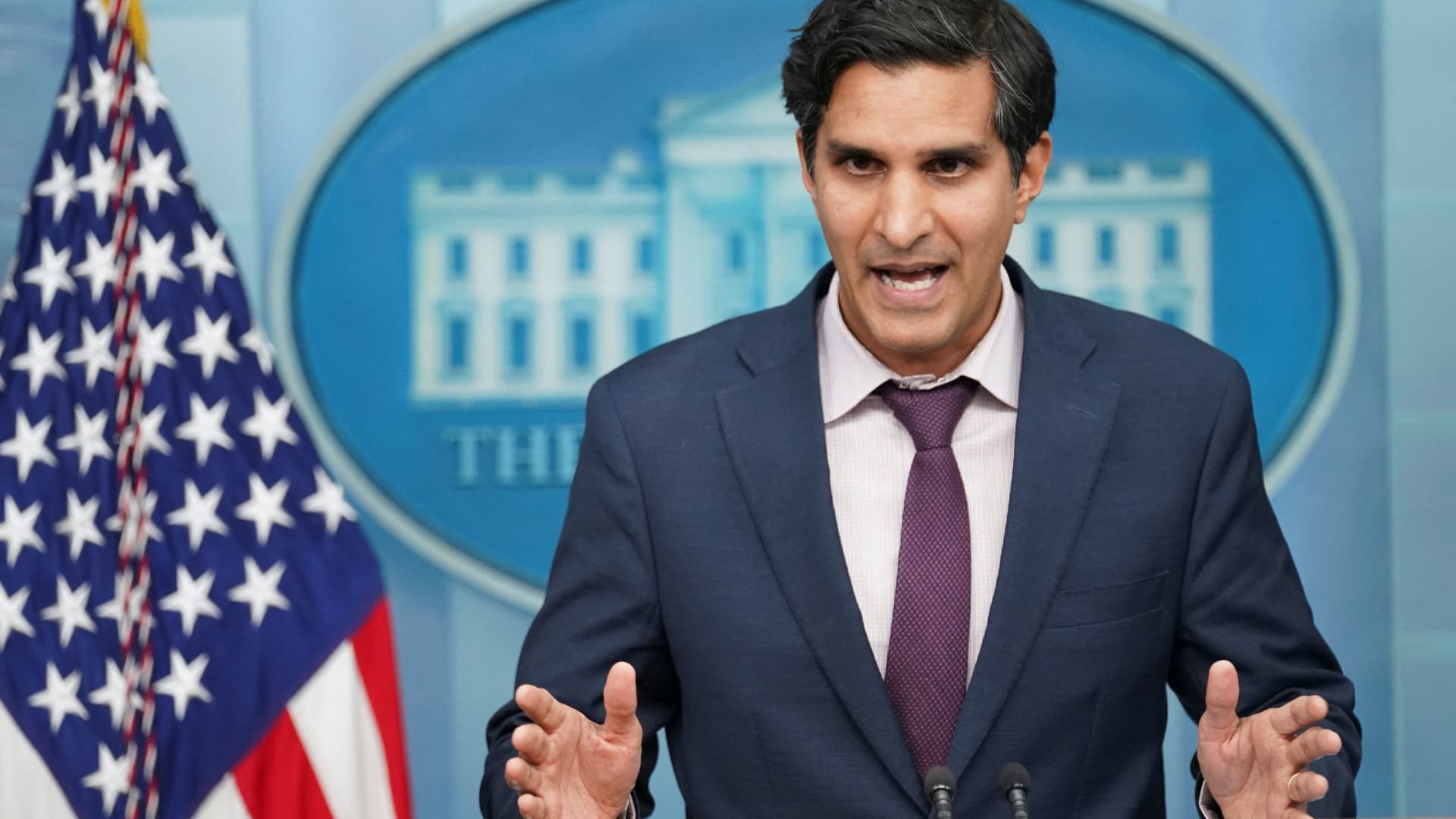
To unpack what’s happening at the intersection of geopolitics, energy, and global debt, CNBC reached out to Daleep Singh, vice chair and chief global economist at asset manager PGIM. Singh has seen global energy conflicts up close: As deputy national security adviser under President Joe Biden, he designed that administration’s economic effort to cut off Russia’s oil revenue. Earlier in his career, Singh ran the New York Federal Reserve Bank’s markets desk, a sensitive position that looks directly into the guts of the global financial system.
Singh may have been appointed by a Democrat, but he isn’t singing the party line. He began by praising Kevin Warsh, the conservative economist appointed by President Donald Trump and confirmed by the Senate on Wednesday to chair the Fed.
The transcript of Singh’s conversation has been edited for length and clarity. He spoke over Zoom on Friday.
Q: How do you think Kevin Warsh will fare as Fed chair?
Daleep Singh: I’m optimistic about Kevin Warsh. His intellectual work has been centered on how to sustain the Fed’s most important asset, which is its credibility. That could not be more important at a time when the central bank is under political assault. I think he is going to be thoughtful and deliberate about judging the trade-offs that are necessary to preserve the independence of monetary policy, maybe to the detriment of other responsibilities the Fed once held.
It’s also super important to have a Fed chair who has been battle-tested. Warsh has been, through the global financial crisis. [Warsh was a Fed governor from 2006 to 2011.] He was credited by almost everyone as being the eyes and ears of the Fed into Wall Street, and how that was going in terms of transmitting the response to the real economy.
People who dismiss him as reflexively partisan are missing a lot of what he brings to the table in terms of working across the aisle.
Having said that, look, I do not think the Fed should be cutting rates in this moment.We’re going to find out really soon how much scope he has to do the right thing.
Q: There is a perception Warsh will try to convince the Fed to cut rates and get laughed out of there. Then Trump will explode at him. Are people underestimating his ability to sway Trump?
Singh: The deepest question of all is whether it’s in President Trump’s political interests to push the Fed into easing. The market is now pricing a greater probability of the Fed hiking than easing this year, and for good reason.
We’ve seen a structural break in the economy. These supply-side shocks, they’re not independent of each other, and they’re not mean-reverting in terms of the impact on the global economy. They are related and they are overlapping.
Just look at the past five years, we’ve had nothing but supply shock after supply shock, from Covid, to Ukraine, to the step change in tariffs to the immigration restrictions, and now Iran. These are overlapping supply-side shocks that suggest to me we’re going to be in a structurally higher inflation environment.
Q: The 10-year Treasury yield topped 4.6% at one point on Friday, the highest in nearly a year. Yields in the U.K., Japan, and elsewhere are rising. What is your diagnosis of the global bond market?
Singh: It’s the byproduct of these forces we’re discussing. If we’re going to live in a world in which fiscal deficits continue to increase indefinitely, there’s really not any political will to do something about that, and you have, at least in the U.S., a central bank that’s, let’s just say, uniquely hesitant to hike, then it just stands to reason that the yield curve is going to steepen. Long-term yields will continue to increase, because buyers need more compensation against the fiscal risk and the inflation risk that they’re absorbing now.
Savvy investors will understand this is a multi-stage process, and the U.S. government will also get to decide how to react to a sharp and sustained spike in long-end yields.
If this continues, and let’s say Treasury yields [on the 10-year note] march to 5% or above, it won’t be long before the Treasury secretary says, “Listen, I have a toolkit as well, and I’m not afraid to use it.” The Treasury secretary can shorten the weighted average maturity of our debt issuance, make more aggressive use of the buyback tool, and potentially jawbone the market with the Fed and say we may have to engage in purchases of long-end bonds to align them with long-term fundamentals.
In other words, that is financial repression [when the government artificially holds interest rates down, making debt more manageable at the cost of harming savers, among other risks].
I think that’s the end game for the bond market, because 5%-plus bond yields are not sustainable for a variety of reasons.
Q: How great is the risk of the 10-year Treasury yield getting to 5% in the next couple of months?
Singh: I think it’s probable. We’re on the cusp of a bond-vigilante trade right now. It’s materializing in the U.K. These moves tend to take on a life of their own, and they don’t self-correct until there’s a policy response.
This is a very savvy U.S. government that understands bond-market dynamics and is well-aware of how to arrest an upward spike in yields. I personally don’t think the bond-vigilante trade will be alive very long.
Q: Let’s turn to Iran. Can you lay out your thinking on what is happening there?
Singh: I think neither side has escalation dominance, but neither the U.S. nor Iran fully realizes that reality.
The costs both politically and economically of a ground invasion that effectuates regime change in Iran are too high for President Trump, both because of the casualty count on the ground, but also because Iran would undoubtedly further weaponize its asymmetric advantages in the Strait of Hormuz and the Red Sea.
For Iran, I think it also understands that if it overplays its hand, it may precipitate what it’s trying to prevent, which is the U.S. sending in ground troops.
We require both sides to recognize this reality that neither side can subdue the other, and that’s why we’re in this stalemate.
A deal would have to be guaranteed by a trusted third party. There’s no trust at all between the U.S. and Tehran right now, because the bombs have been dropping every time they’ve sat down to negotiate. That’s where China comes in, and I’ll be interested to hear more details of what was said and agreed in Beijing [during Trump’s summit with Xi Jinping].
We’re probably a month or two away from this type of deal coming together, because if it lingers much longer then this becomes an unsustainable conflict for the White House.
Q: Still, a month or two more would mean a lot of economic pain.
Singh: I was just in Texas. I heard directly that the most that could be expected from the Permian Basin, for example, in terms of additional output, is something like 250,000 barrels per day. That’s just a tiny fraction of the shortfall in the Strait of Hormuz. [The oil market may be missing as much as 100 million barrels a week, according to some estimates.]
The situation really is becoming dire. I think we have a lingering risk premium on Brent oil, and it’s going to be in the range of $80 to $100 a barrel for the foreseeable future.
Q: What is your sense of how long the Iranians can withstand the kind of economic pressure that they’re under now from the blockade?
Singh: My experience firsthand, in terms of applying maximal economic pressure to an autocratic regime, is they tend to have a much longer runway than democratic, Western leaders assume, because necessity is the mother of invention. They will, they will develop workarounds to get paid through barter arrangements, through crypto, through non-dollar currencies, and it becomes a cat-and-mouse game.
Because their risks are existential, they have a greater incentive to find ways to continue to get paid that are outside of our capacity to detect.
I’ve been very skeptical of claims that the blockade by itself is sufficient to cause the Iranian regime to surrender to an unfavorable deal.
About The Author