(This is the Warren Buffett Watch newsletter, news and analysis on all things Warren Buffett and Berkshire Hathaway. You can sign up here to receive it every Friday evening in your inbox.)
ABEL GOES HIS OWN WAY WITH NEW INVESTMENTSIN HOME BUILDING … AND AI
Buffett praises new CEO for ‘fast’ and ‘smooth’ acquisition
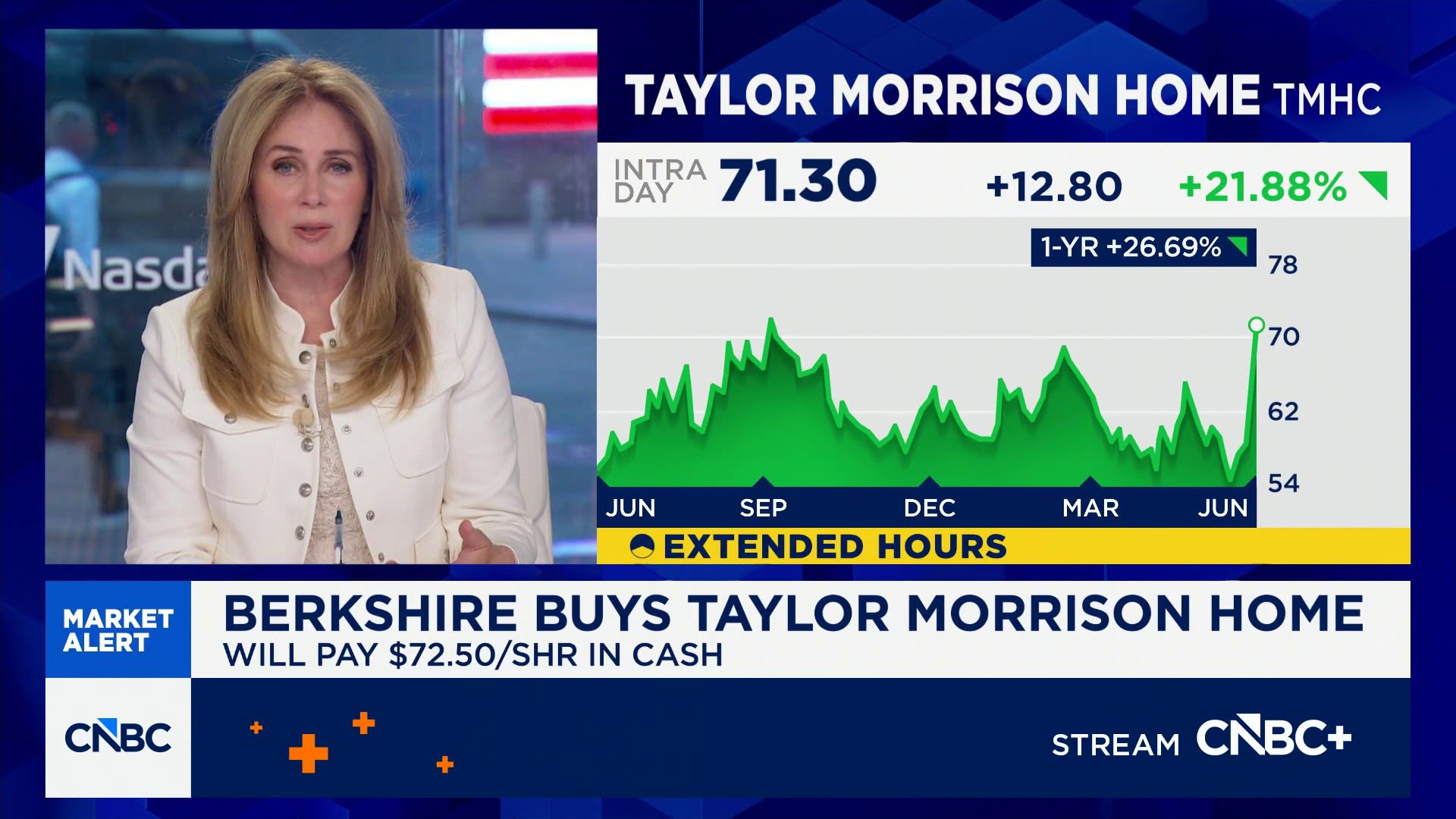
Warren Buffett tells CNBC’s Becky Quick new Berkshire Hathaway CEO Greg Abel has “launched” withhis first major deal, the $6.8 billion acquisition ofTaylor Morrison Home, aresidential homebuilder and developerwith operations in 12 states.
On Monday’s “Squawk Box,”Becky quoted Buffettfrom a phone conversation the day before when the deal was announced:
“Greg did this faster than I could have done it, smoother than I could have done it, and I never talked to the CEO.
“He has launched.”

Becky noted that when Buffett wanted to do a deal, he would move quickly, and “this is basically what Greg has picked up and done, too.”
She reports Abel went to Arizona and spent around five hours with Taylor Morrison CEO Sheryl Palmer, but when he came back, he did not think he had a deal.
Then, a few days later, Palmer called to say the price was fair and her board was ready to proceed.
Becky says Abel spoke with Buffett and Berkshire lead director Sue Decker but didn’t tell the rest of the board until after the deal had been completed.
“That’s kind of the Berkshire way, to try and move quickly on these things,” she added.

Appearing on Monday’s “Squawk on the Street” later that morning, Palmer said joining Berkshire is a “once in a lifetime opportunity for the company, for the brand, and for team members across the country.” (The entire interviewis available toCNBC Prosubscribers.)
She started speaking with Abel “probably just a number of weeks ago,” and his “pitch” was that Berkshire “has this wonderful collection of on-site builders, and they build generally around the first-time buyer … and if you think about the Berkshire eco-system, and what they’ve build for decades, I think what Greg saw was the opportunity, on a national scale, to build a platform.”
Berkshire housing and home improvement subsidiaries includeClayton Homes,Shaw Industries,Johns Manville, andBenjamin Moore.
A home under construction stands behind a “sold” sign in a new development in York County, South Carolina, U.S., February 29, 2020.
Lucas Jackson | Reuters
In ajoint news releaseon the deal, Abel echoed Palmer, saying, “Over time, we expect to unify our site-built homebuilding operations into a combined platform enabling us to deliver the dream of homeownership to more Americans.”
Christopher Davis at Hudson Value Partnerspoints out toBloombergthe goal of unifying operations is a “notable departure” from Berkshire’s long-standing practice of letting subsidiaries run independently, but he thinks investors “will welcome that evolution in approach.”
CFRA Research analyst Cathy Seiferttells theAP, “Given Greg’s strength as an operator it will be interesting to see if he does consolidate these units to get some greater scale and efficiencies.”
ReutersreportsUBS analyst John Lovallo is telling clients a combination of Taylor Morrison with Clayton would create one of the country’s five largest homebuilders.
He calls the acquisition “a strong vote of confidence in the mid-long term outlook for the homebuilding industry,” which has a shortage of around 7 million homes.
Abel adds to big bet on Alphabet’s AI ambitions
And in what appears to be a vote of confidence in the future of artificial intelligence, Berkshire will invest $10 billion in Alphabet, helping to fund that company’s big spending on its “world-class AI compute infrastructure to meet its unprecedented customer demand.”
As part of a larger plan to raise around$80 billion from stock sales, Google’s parent will use aprivate placementto sell $5 billion of itsClass A shares (GOOGL)to Berkshire for $351.81 each and another $5 billion ofClass C shares (GOOG)for $348.20 each.
According toBloomberg, the purchase was the result of a “stealthy weekend call” to Berkshire by Goldman Sachs, the firm putting together Alphabet’s enormous equity offering, and a “rapid signoff” from Abel, offering “fresh reassurance that Warren Buffett’s investing conglomerate remains the first port of call for companies in need of a big check or a vote of confidence.”
When the deal was announced after Monday’s close of trading, Berkshire’s GOOGL purchase price was 5.5% below the stock’s market value and GOOG was a 6.5% bargain.
Now the discounts are down to 4.5% and 4.8%.
Berkshire already owns $21.3 billion of Alphabet’s Class A shares, making it the fifth largest position in itsequity portfolio.
It was apparently Abel’s decision to more than triple the stake in the first quarter to almost 58 million shares from the close to 18 million shares Berkshire purchased in last year’s third quarter.
When the new shares are added, Alphabet will probably become Berkshire’s third or fourth biggest stock holding, rivaling its long-heldCoca-Colastake, which is currently worth almost $32 billion.
Abel’s enthusiasm for Alphabet is a marked contrast to Buffett’s great reluctance to invest in tech.
He felt he didn’t have the ability to predict which companies would prosper in the long term, so he was “perfectly willing to trade away a big payoff for a certain payoff” in areas he better understood, especially during what turned out to be adot-com bubblein the late 1990s.
So far, Buffett hasn’t said anything publicly about Berkshire’s Alphabet investments.
BUFFETT & BERKSHIRE AROUND THE INTERNET
Some links may require a subscription:
HIGHLIGHTS FROM CNBC’S BUFFETT ARCHIVE
Buffett missed the boat on Google (2017)
In a 2017 interview with CNBC,Warren Buffett sayshe should have known about Google’s profit potential because GEICO had been a major customer of the company.
WARREN BUFFETT: Google I should have had some insight into, because GEICO was a heavy user very early on.
So here we saw value in something. At — at that time — I have no idea what we’re paying for a click now, but — but we were paying $10 or $11 a click for something that had no cost of goods sold, and we were going to keep doing it. I mean we could see that.
So — I should have had more insight into that.
Now, whether Bing was going to come along or other people were going to take away the market, that’s another question.
Whether you had sort of a — first user advantage that would be — would prevail — and there is a lot of technology to it.
So — so somebody could have come along with a better technological product that I would not have had any insights into that.
I certainly had insights into the benefit for the user.
BERKSHIRE STOCK WATCH
BRK.A stock price: $733,550.00
BRK.B stock price: $488.13
BRK.B P/E (TTM): 14.53
Berkshire market capitalization: $1,053,525,726,365
Berkshire Cash as of March 31: $397.4 billion (Up 6.5% from Dec. 31)
Excluding Rail Cash and Subtracting T-Bills Payable: $380.2 billion (Up 3.0% from Dec. 31)
Berkshire repurchased $234 million of its shares in Q1 2026.
(All figures are as of the date of publication, unless otherwise indicated)
BERKSHIRE’S TOP EQUITY HOLDINGS – Jun. 5, 2026
Berkshire’s top holdings of disclosed publicly traded stocks in the U.S. and Japan, by market value, based on the latest closing prices.
Holdings are as of March 31, 2026, as reported inBerkshire Hathaway’s 13F filingon May 15, 2026, except for:
The full list of holdings and current market values is available from CNBC.com’sBerkshire Hathaway Portfolio Tracker.
QUESTIONS OR COMMENTS
Please send any questions or comments about the newsletter to me atalex.crippen@nbcuni.com. (Sorry, but we don’t forward questions or comments to Buffett himself.)
If you aren’t already subscribed to this newsletter, you can sign uphere.
Also, Buffett’s annual letters to shareholders are highly recommended reading. There are collectedhere on Berkshire’s website.
— Alex Crippen, Editor, Warren Buffett Watch
About The Author