- Gold price drifts lower as signs of easing US-China trade tensions undermine safe-haven demand.
- The USD reverses a part of the overnight slide and exerts additional pressure on the XAU/USD pair.
- Fed rate cut bets might cap the USD and help limit losses for the commodity amid geopolitical risks.
Gold price (XAU/USD) remains heavily offered through the early European session, though it manages to hold above the $3,300 mark amid mixed fundamental cues. Signs of easing US-China trade tensions continue to drive flows away from traditional safe-haven assets and undermine demand for the precious metal. Apart from this, a modest US Dollar (USD) strength is seen as another factor exerting downward pressure on the commodity.
However, the uncertainty over US President Donald Trump’s trade policies, along with persistent geopolitical tensions, keeps investors on the edge and should cap the optimism. Furthermore, prospects for more aggressive policy easing by the Federal Reserve (Fed) could act as a headwind for the USD and help limit the downside for the non-yielding Gold price. Traders now look to the US JOLTS Job Openings data for some impetus.
Daily Digest Market Movers: Gold price remains depressed as trade deal hopes undermine safe-haven assets
- China’s recent moves to exempt certain US goods from its retaliatory tariffs showed a willingness to de-escalate tensions between the world’s two largest economies. Moreover, US Treasury Secretary Scott Bessent said on Monday that many top US trading partners have made “very good” tariff proposals.
- Signs of trade progress support the upbeat market mood. Meanwhile, the US Dollar regains traction and drives flows away from the safe-haven Gold price.
- Investors, however, remain on the edge on the back of mixed signals regarding the state of negotiations between the US and China. In fact, US President Donald Trump said last week that trade talks with China were underway, though China has denied that any tariff negotiations were taking place.
- Meanwhile, traders expect the Federal Reserve to resume its rate-cutting cycle in June. Moreover, the current market pricing indicates the possibility of at least three rate cuts by the end of this year. Lower borrowing costs could help the non-yielding yellow metal to maintain a floor in the near term.
- Russian President Vladimir Putin declared a 72-hour unilateral ceasefire in the Ukraine conflict from May 8, though Ukraine’s President Volodymyr Zelensky dismissed the three-day truce. Moreover, North Korea’s involvement in the Russia-Ukraine war keeps the geopolitical risk premium in play.
- Traders now look forward to the release of the US JOLTS Job Openings data for some impetus later this Tuesday. Apart from this, US Personal Consumption Expenditures on Wednesday, and the Nonfarm Payrolls (NFP) report on Friday could provide a fresh insight into the Fed’s policy outlook.
Gold price needs to find acceptance below 38.2% Fibo. level for bears to seize near-term control
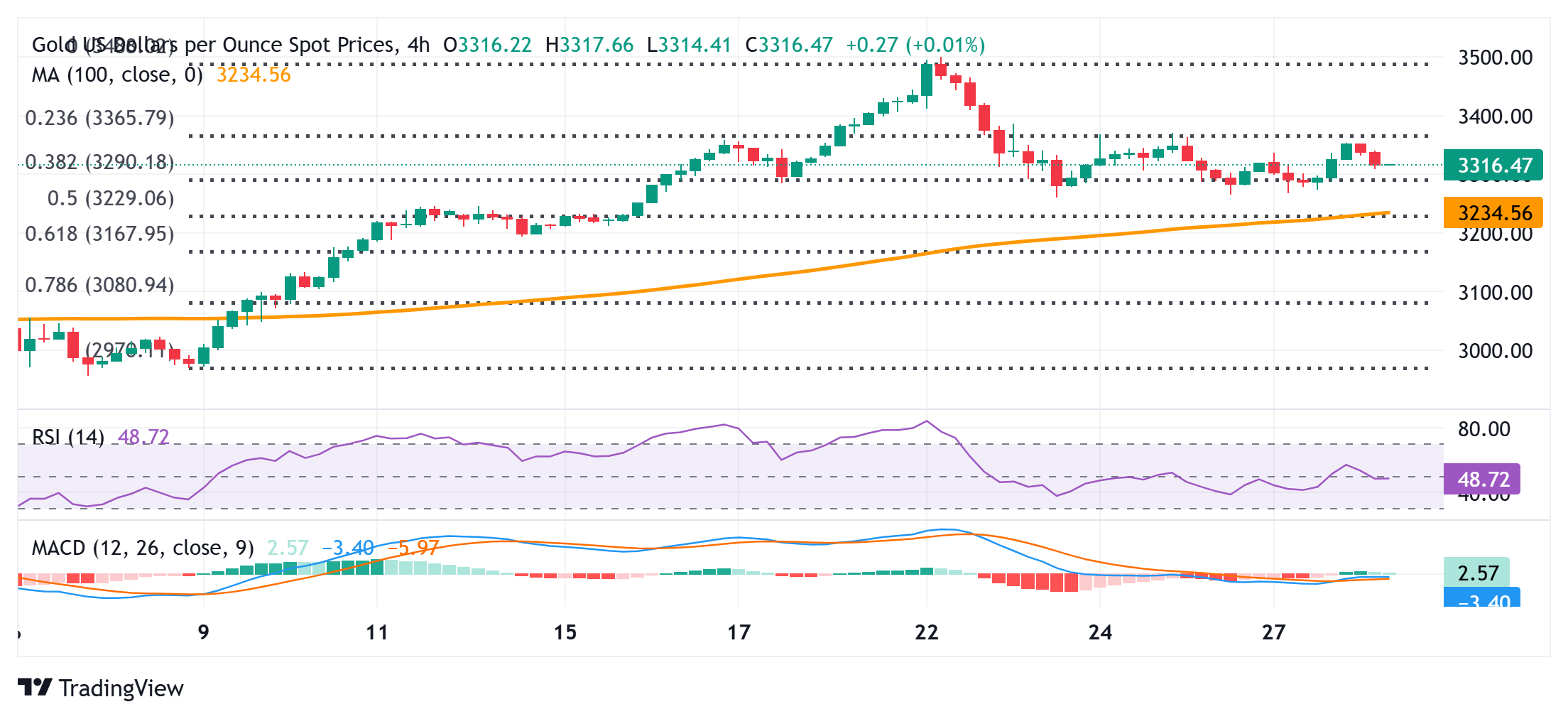
Weakness below the $3,300-3,290 area, representing the 38.2% Fibonacci retracement level of the latest leg up from the vicinity of mid-$2,900s or the monthly swing low, might continue to find decent support near the $3,265-3,260 horizontal zone. A convincing break below the latter will be seen as a fresh trigger for bearish traders and set the stage for an extension of the recent pullback from the all-time peak touched last week. The subsequent downfall could drag the Gold price to the 50% retracement level, around the $3,225 region, en route to the $3,200 mark.
On the flip side, the $3,348-3,353 region now seems to have emerged as an immediate hurdle. This is closely followed by the $3,366-3,368 supply zone, which if cleared decisively should allow the Gold price to reclaim the $3,400 mark. The momentum could extend further toward the $3,425-3,427 intermediate hurdle before bulls make a fresh attempt to conquer the $3,500 psychological mark.
Risk sentiment FAQs
In the world of financial jargon the two widely used terms “risk-on” and “risk off” refer to the level of risk that investors are willing to stomach during the period referenced. In a “risk-on” market, investors are optimistic about the future and more willing to buy risky assets. In a “risk-off” market investors start to ‘play it safe’ because they are worried about the future, and therefore buy less risky assets that are more certain of bringing a return, even if it is relatively modest.
Typically, during periods of “risk-on”, stock markets will rise, most commodities – except Gold – will also gain in value, since they benefit from a positive growth outlook. The currencies of nations that are heavy commodity exporters strengthen because of increased demand, and Cryptocurrencies rise. In a “risk-off” market, Bonds go up – especially major government Bonds – Gold shines, and safe-haven currencies such as the Japanese Yen, Swiss Franc and US Dollar all benefit.
The Australian Dollar (AUD), the Canadian Dollar (CAD), the New Zealand Dollar (NZD) and minor FX like the Ruble (RUB) and the South African Rand (ZAR), all tend to rise in markets that are “risk-on”. This is because the economies of these currencies are heavily reliant on commodity exports for growth, and commodities tend to rise in price during risk-on periods. This is because investors foresee greater demand for raw materials in the future due to heightened economic activity.
The major currencies that tend to rise during periods of “risk-off” are the US Dollar (USD), the Japanese Yen (JPY) and the Swiss Franc (CHF). The US Dollar, because it is the world’s reserve currency, and because in times of crisis investors buy US government debt, which is seen as safe because the largest economy in the world is unlikely to default. The Yen, from increased demand for Japanese government bonds, because a high proportion are held by domestic investors who are unlikely to dump them – even in a crisis. The Swiss Franc, because strict Swiss banking laws offer investors enhanced capital protection.
About The Author