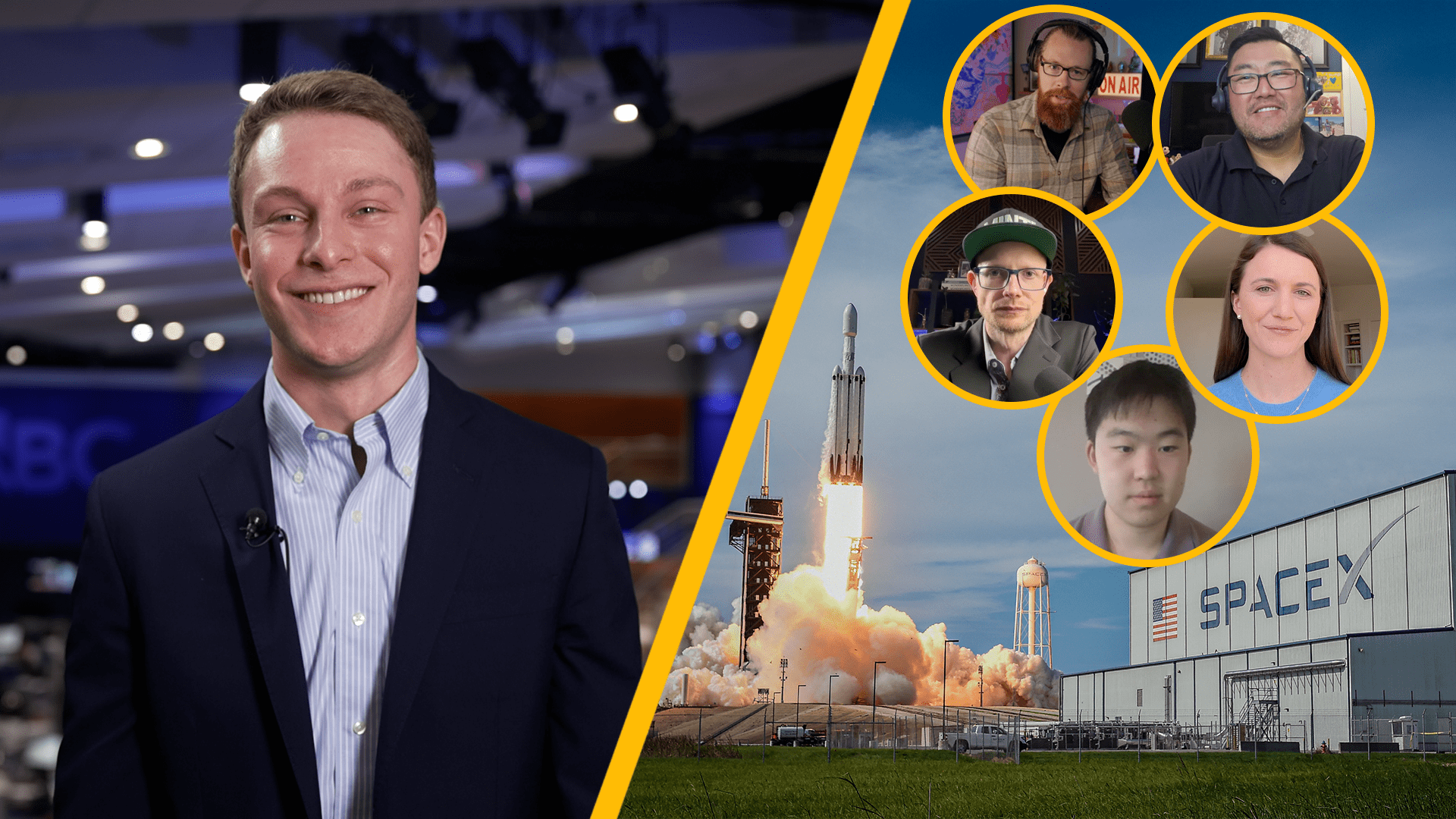

Marvin Jung isn’t buying into SpaceX because he thinks it’s a bargain.
The 51-year-old regional director of operations in veterinary care believes Elon Musk’s rocket company is coming public at a valuation that is “really, really aggressive.” Yet, he still requested 1,000 shares through Robinhood, betting enthusiasm for one of the world’s most anticipated initial public offerings will overwhelm concerns about price.
SpaceX has set a fixed price of $135 per share in the leadup to its IPO on Friday, placing its valuation at $1.77 trillion. That would make SpaceX immediately the seventh-biggest company in the U.S. based on market cap – higher than Tesla even.
“It’s outrageous. It’s stupid. It’s unreasonable, to be frankly honest with you,” Jung said of the valuation.
That hasn’t stopped him from trying to get an allocation, especially given that SpaceX is directing an unusually high amount of shares to retail. The retail allocation is in the low 20% range. Although that’s lower than the 30% previously expected, that’s still a much bigger cut than usual, as most IPOs only offer between 5% and 10% to retail, per Fidelity.
Traders can request access to IPO shares through various brokerage platforms, including Fidelity, which has set its brokerage account balance minimum for traders at $2,000.
That’s significantly lower than the threshold of between $100,000 and $500,000 that Fidelity typically sets for IPOs, according to a source familiar with the matter.
A self-directed investor who trades in his spare time, Jung was active during the meme-stock boom and follows markets closely through Reddit investing forums. His plan isn’t to become a long-term SpaceX shareholder. Instead, he hopes to capitalize on what he expects will be a powerful first-day rally and then move on.
“With SpaceX and what Elon is doing, this is like a beautiful symphony of all the right trigger meme words,” he said. “I think this has got pretty good potential to pop strong the first day. I’m going to guess at least 30% minimum.”
Jung said he intends to sell shortly after trading begins. He wants to free up capital for what he sees as the next wave of blockbuster offerings – Anthropic and OpenAI.
The investor has to be careful though, as retail brokerage firms have anti-flipping policies to penalize traders who get out too early. Fidelity, for instance, specifies that if a trader sells their allocation within the first 15 calendar days from the debut, their ability to participate in future public offerings will be impacted.
“Time to go. Thank you, Elon. I spent a lot on my wife’s Tesla. I need some of that back,” he said with a laugh.
Not betting against Elon
Since Elon Musk founded SpaceX in 2002, the company has grown into a conglomerate, comprising not just its business in reusable rockets but also satellite internet service Starlink and xAI. With its IPO, Musk’s net worth could move past $1 trillion.
“Elon gets this premium multiple because he has this vision of what’s going to happen in the future,” said Michael Monaghan, portfolio manager at Founder ETFs, a firm that tracks 100 founder-led U.S.-listed companies through the actively managed Founders 100 ETF (FFF). “He builds it faster than anyone else,” he continued, before later saying, “You just can’t model that in a traditional valuation framework.”
His remarks come as SpaceX has secured key compute deals with Anthropic and Google in recent weeks. Anthropic has agreed to pay the company $1.25 billion per month through May 2029, while Google has committed to give SpaceX $920 million a month for 32 months.
SpaceX, Tesla and X CEO Elon Musk (R) and Google CEO Sundar Pichai attend the presidential inauguration of Donald Trump at the Rotunda of the US Capitol in Washington, on January 20, 2025. Trump takes office for his second non-consecutive term as the 47th president of the United States.
Kevin Lamarque | Afp | Getty Images
With the addition of the Google deal disclosed during SpaceX’s roadshow last week, the company more than doubled its revenue projections for 2026, Monaghan said.
“I’ve never seen anything like it,” he continued. The portfolio manager estimates that SpaceX could reach $200 billion in revenue by 2030 – a forecast he deems “conservative.”
With all the optimism surrounding the IPO – and the odds that Musk could be the world’s first trillionaire – retail investor Mikey Moran has a fear of missing out just like other investors. Moran is no stranger to catching a hype wave: In July 2025, he bought 10,000 shares of Opendoor Technologies. The next two days, the stock surged roughly 79%.
“This is the Super Bowl of IPOs,” he said about SpaceX.
Moran, a 49-year-old founder of a hair extension and beauty supply company, ultimately received 11 of the 20 shares he requested through Robinhood, though he had mentioned he’s “on the fence of whether it’s a good trade.” To him, it’ll be a shorter-term investment rather than a long-term holding, with Moran saying he’s willing to take “a little bit of a risk” despite concerns about the company’s valuation.
“How can you not want to be part of the biggest?” he added.
Moran revealed that getting out of Tesla too early years ago was one of the biggest trading mistakes he’s ever made. Back in 2018, the trader bought the stock and held it for only a couple weeks, thinking that he should quit while he was ahead and take some profits as the stock was ramping up. Little did he know Tesla shares would continue to surge in the years to come. Since the beginning of 2018, the stock has skyrocketed more than a whopping 1,700% to a $1.5 trillion valuation.

TSLA shares, since the beginning of 2018
This time around, the Atlanta-based entrepreneur said Musk himself was a primary reason for wanting to get into the trade, describing him as someone who “makes it happen.”
“It’s hard to bet against Elon Musk in whatever he does,” Moran told CNBC. “It’s really hard to dispute that [Musk] is not the greatest entrepreneur of all time.”
Andrew Chen learned the hard way not to bet against Elon Musk.
The 21-year-old Cornell University student, who studies finance and computer science and trades stocks on the side, once invested in aircraft-connectivity companies that many investors believed would be insulated from competition. Instead, they were disrupted by SpaceX’s Starlink satellite internet network.
“I was long a lot of those names and ended up being completely wrong because Elon was able to execute,” Chen said. “I’ve been wrong before betting against Elon, and I don’t think that he’ll be wrong when it comes to executing in space, he’s obviously been tremendously successful.”
Now, as SpaceX prepares for its highly anticipated public debut, Chen is taking the opposite side of the trade. He requested five shares through Robinhood and plans to hold them despite concerns from some investors that the company’s valuation has become stretched.
“In terms of corporate finance and fundamentals, there’s no way you can multiply your way into a $1.7 trillion market cap,” he said. “It hinges so much on future execution.”
For Chen, however, that uncertainty is precisely the point. Having watched Musk repeatedly overcome skepticism from investors and competitors alike, he is willing to place another bet on the entrepreneur’s ability to deliver.
“I think it’s a once-in-a-lifetime opportunity to be able to buy the stock right now,” he said.
Looking beyond
SpaceX has been one of the most discussed names on Reddit’s WallStreetBets forum in the days leading up to the IPO, with more than 1,600 mentions since Monday, according to Breakout Point.
Even with all the buzz, Ross Cameron, 41, still isn’t fully convinced the demand is there. Cameron, who lives in the Berkshires of Massachusetts, founded trading education platform Warrior Treading more than a decade ago, and his YouTube channel has more than 2 million subscribers. He requested 2,500 shares on Charles Schwab, stressing that his decision on whether he will move forward with the investment in the SpaceX IPO is dependent on just how much they give him.
“If they say, ‘We got them, here, you can have all of them,’ I’m going to say, ‘No thanks,’ because that’s going to tell me that there’s an abundance of supply,” he said. “If they say, ‘We could only get you 1,000 shares or 2,000,’ then I’ll probably take them, because that tells me there’s a lot of demand, and that indicates more likely that at the IPO it will open higher, and we’ll still see more demand.”
If he were to invest, it wouldn’t be for long anyways before he’d exit. He’s already skeptical about the IPO price, saying, “We are buying at the very highest price it has ever traded, and that kind of defines dumb money.” With the retail allocation being the “biggest wild card,” he believes he’ll have a better chance to secure a “good” risk-to-reward ratio after evaluating the stock’s movement over six months and once the lock-up period has ended.
“My feeling on SpaceX is to trade it and not to marry it yet to give it a chance to sell off, let all the insiders cash out, and then see where it finds support,” Cameron said. “Then, maybe there’s something to work with.”
Helaine Markham sees opportunity well past that point. Markham, who’s 30 years old and lives in Monterey Bay, CA, runs Markham Trading – a market education platform – alongside her husband, Blane Markham. While she thinks the short-term growth opportunity lies in Starlink, there’s another part of the company that excites her down the line.
As seen from Canaveral National Seashore, a SpaceX Falcon 9 rocket carrying 60 Starlink satellites launches from pad 39A at the Kennedy Space Center on October 6, 2020 in Cape Canaveral, Florida. This is the 13th batch of satellites placed into orbit by SpaceX as part of a constellation designed to provide broadband internet service around the globe. (Photo by Paul Hennessy/NurPhoto via Getty Images)
Nurphoto | Nurphoto | Getty Images
“The long-term growth opportunity is the space-related arm of the business,” Markham said. She noted the “potential to be in space-related industries that aren’t even yet in existence like mineral extraction from space and also the potential for [artificial intelligence] data centers in space.”
Though Markham only requested two shares through Robinhood, she wants to possibly increase her holding gradually.
“I’m really hoping to hold this for the long term, for the next 10-plus years, to realize the full long-term growth opportunity at hand,” she said. “It could turn into a legacy investment that’s passed down to my children over time.”
She might be on to something, as there’s been a burgeoning interest in space among investors. Maurits Pot, CEO of Tema ETFs, views it as an inevitability that there will be multiple space-related constituents in the S&P 500 by 2030.
Pot runs the largest space-themed ETF in the world known as Tema Space Innovators ETF (NASA), which debuted at the end of March. The fund has roughly $2.6 billion in assets under management and is the only space ETF that will own SpaceX directly at about 7% of net asset value. Quarter to date, the ETF has jumped about 40%.
NASA shares, quarter-to-date
The chief executive emphasized that the fund is not a way to trade SpaceX. He also doesn’t view the SpaceX IPO as an effective opportunity to flip the stock.
“If people are investing in the space economy, buying and selling at the SpaceX IPO would seem a bit foolish,” Pot said.
“The space economy will only grow,” he also said. “The SpaceX IPO is not the destination.”
SpaceX didn’t respond to CNBC’s request for comment about valuation concerns.
— CNBC’s Charlotte Morabito and Alex Harring contributed reporting.
About The Author