FedEx's yearslong turnaround is facing a big test after executing on a major catalyst
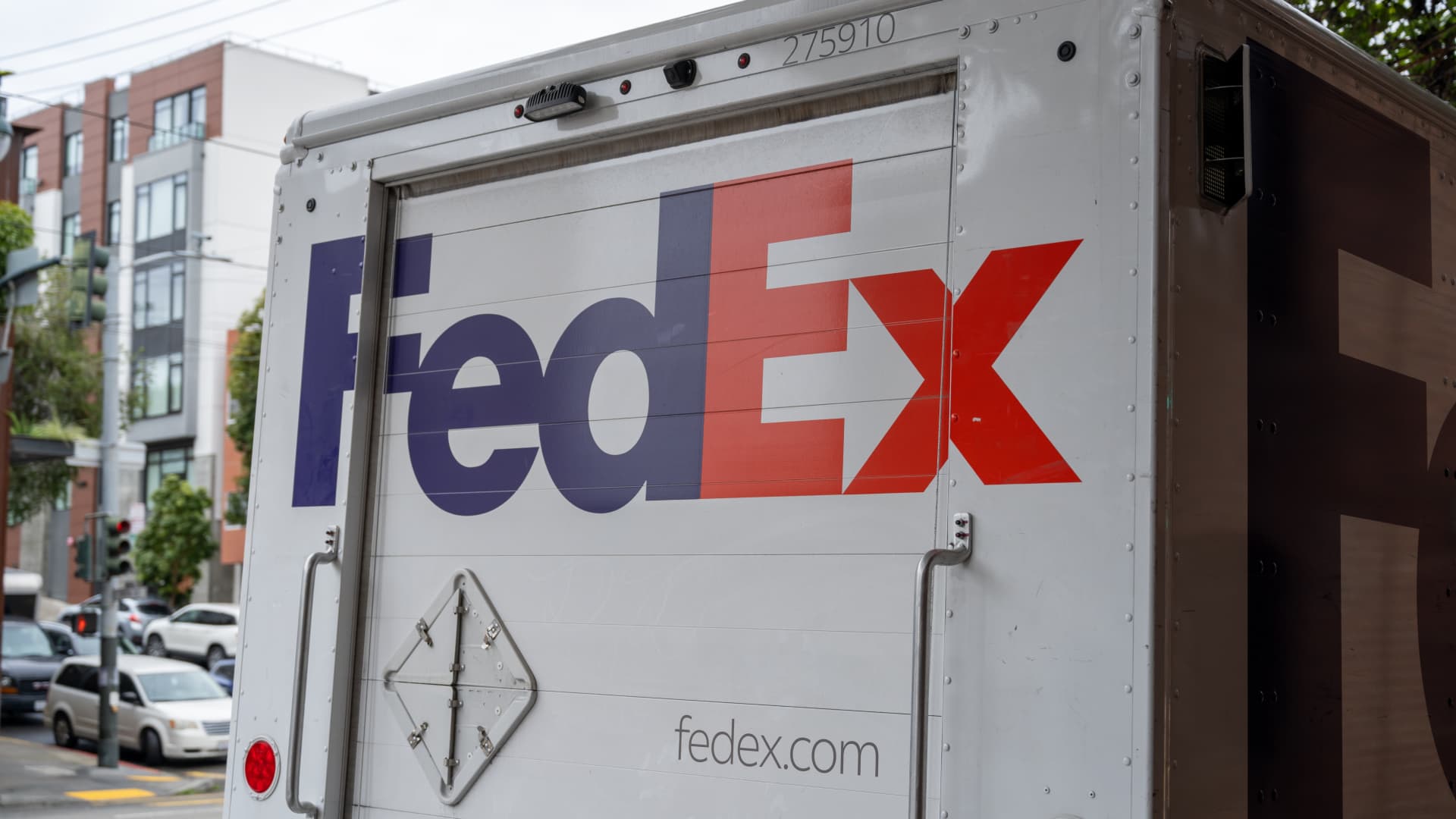
FedEx has spent the last three years rebuilding its business. Investors now want to know if the payoff is finally arriving. FedEx reports is fiscal 2026 fourth quarter earnings on the evening of June 23, giving shareholders their latest look at the company’s business turnaround. Shares of the package delivery company are up 42% year to date, as Wall Street increasingly embraces CEO Raj Subramaniam’s transformation plan. After that strong run, including a 52-week high Friday, the key question heading into the print is whether FedEx can continue generating higher profits from every package moving through its network. That means the delivery giant must continue to expand margins. Jim Cramer thinks it can, and came away further convinced after interviewing Subramaniam and John Smith, CEO of the newly spun-off FedEx Freight, on May 12 from the company’s largest global sorting hub at the Memphis International Airport. Less than a week later, the Club initiated a position in FedEx , and captured a stake in FedEx Freight when it was separated on June 1. We got one FDXF shares for every two FDX shares we owned. FedEx kept 20% ownership in FedEx Freight, the largest less-than-truckload (LTL) carrier in North America, with industry-leading transit times. FDXF opened on its first trading day as an independent company at $164 and has moved up slightly of the past 10 trading days. We intend to kept our Freight shares. FedEx Freight did hit a rough patch Friday on a price target cut and earlier this week after Amazon announced a U.S. expansion of its LTL offering as part of recently formed Amazon Supply Chain Services (ASCS) arm. In logistics, less-than-truckload service is for items too big for regular delivery but not big enough for an entire tractor trailer. So, those multiple smaller loads from different shippers are put together to fill up a whole truck. That Amazon news on Wednesday sent shares of FedEx Freight down more than 3%, along with other LTL stocks including XPO , ArcBest , and Saia over concerns expansion to outbound freight, non-Amazon destinations, and the targeting of large shippers. Amazon noted the focus remains on retail freight. We viewed the FedEx Freight selling as an overreaction. The turnaround During the pandemic, FedEx became an essential link in the global supply chain as shoppers stuck at home increasingly turned to online shopping. Business-to-consumer (B2C) shipments surged while business-to-business (B2B) shipping activity weakened due to the Covid lockdowns and disruptions. To accommodate this unprecedented demand, FedEx rapidly expanded its delivery network and facilities. However, as the pandemic wound down and e-commerce growth normalized, the company found itself with excess capacity and a network built for a level of delivery demand that no longer existed. It forced management to rethink how FedEx operated. Since taking over as CEO four years ago, Subramaniam has reshaped the company around four strategic priorities: growing in higher-margin verticals, transforming the network, leveraging data and technology, and cutting costs. Subramaniam, a company veteran, joined in 1991 and held leadership roles across Asia and the U.S. He became chief marketing and communications officer, was promoted to president and chief operator officer in 2019. He joined the board a year later — and ultimately succeeded founder Fred Smith as CEO in June 2022. Under Subramanian, the first initiative FedEx announced was DRIVE, an efficiency plan that aimed to simplify operations through procurement savings, transportation optimization, automation and find different ways to lower overhead expenses. From fiscal 2023 through fiscal 2025, FedEx removed about $4 billion in costs from the business. Management expects another $2 billion of cost savings by fiscal 2027. The second initiative was FedEx Network 2.0, aimed at streamlining logistics. The effort makes package pickups and deliveries easier and faster through a new unified consolidated transportation structure. Under the Network 2.0 model, FedEx closed 100 stations, allowing the company to move the same amount of freight through fewer facilities. That helped eliminate redundant transportation routes and combine ground and express operations. Management also scaled back on spending. Historically, FedEx spent heavily on expanding capacity. In fiscal 2025, capital expenditures were reduced by about $1.1 billion for a total of $4.1 billion compared to the prior fiscal year’s $5.2 billion in spend. The company’s capex as a percentage of revenue was 4.6%, the lowest since FedEx was established in 1998. An important variable in FedEx’s improving profitability profile — and what Wall Street sees as the most underappreciated part of the FedEx story — is increased focus on higher yielding B2B shipments rather than lower-margin package volume. The company identified four key B2B verticals — healthcare, automotive, aerospace, and data center markets — all of which management said are growing faster than the U.S. economy as measured by government gross domestic product (GDP) figures. As priority growth areas, representing a combined $130 billion market opportunity, these categories typically require premium transportation services and generate better economics than traditional parcel delivery. During its Investor Day back in February, FedEx highlighted how it is “enabling the AI revolution from the ground up,” by transporting semiconductors, large servers and other critical equipment supporting artificial intelligence infrastructure buildouts. The company estimated that this data center-related transportation market alone represents roughly a $7 billion opportunity, saying it is “extremely well positioned to benefit from the wave of capital investment” in the new AI economy. Goldman Sachs called FedEx’s “strategic shift” toward B2B shipments “the primary lever for structural margin expansion,” in a research note published June 1, the day of the Freight spinoff. “By capturing higher-yielding, high-density B2B volumes, FedEx is positioned to extract more value per stop compared to traditional residential delivery,” the analysts wrote. Goldman’s bull case depends on earnings before interest and taxes (EBIT) growing much faster than revenue through 2029. The analysts said their long-term potential financial trajectory “remains a key centerpiece of our bull case.” They target $16.40 for earnings per share (EPS) in 2026, up from $15 at the time of FedEx’s Investor Day. By 2029, they target $25 in EPS, assuming a 4% revenue growth rate and double-digit EBIT growth. Goldman’s new price target of $375 per share, implies a 11% upside from Friday levels. Analysts point to FedEx’s “lower cost to serve network that should provide meaningful operating leverage torque,” as the freight industry moves out of the longest recessions in recent memory. While FedEx is no longer in the freight business, when it reports earnings in late June, the company will include FedEx Freight results on both a segmented and fiscal basis through May 31, alongside a separate Freight earnings call discussing the post-June 1 transition period and prior year comparables, according to Morgan Stanley. FedEx management believes that separating Freight will allow both companies to better pursue their own growth strategies and improve operations and execution. The Club agreed. It’s a catalyst that investors had been waiting for. We view FedEx Freight as an undervalued asset that was overlooked inside the larger organization that was focused on a broader turnaround story. As a standalone company, Freight should have more flexibility to improve customer service and achieve greater productivity gains. The company said it expects to generate $8.7 billion in revenue in fiscal 2028, and an adjusted operating margin of roughly 12%. Smith, the Freight CEO, aims for a 15% margin by 2029, up from roughly the current 12%. Smith did suggest there could be additional upside beyond that target. The competition Amazon’s May announcement of ASCS, an expansion of its logistics business that allows merchants to use Amazon’s transportation, warehousing, fulfillment and delivery network even if they don’t sell products on Amazon’s marketplace. Amazon is attempting to turn the infrastructure it built to support its own ecommerce business to a service for other companies. The announcement initially rattled FedEx and fellow traditional logistics competitor United Parcel Service . While Amazon may pose competition, Subramaniam argued in a “Mad Money” interview with Jim that FedEx operates a true end-to-end transportation network while ASCS functions primarily as a third-party logistics provider. He also mentioned that Amazon remains an important customer. In fact, Barclays noted that FedEx’s relationship with Amazon has recently expanded and highlighted that FedEx has become a part of Amazon’s returns network through FedEx Office locations. Barclays added that parcel operations are “fundamentally different” between the two companies. The analysts argued that FedEx’s value proposition remains compelling as Amazon’s ASCS news being “more noise than risk.” That’s because FedEx feeds its own network through hundreds of thousands of daily pick-up points, while Amazon picks up from 1,000 to 2,000 facilities that have already been stocked with inventory, traveling likely less than 75 miles to destination. That’s much less distance traveled than FedEx’s more than 600 miles for roughly half of its volume, according to Barclays. Taken together, it still remains to be seen if Amazon can truly replace the industry’s current leaders. Importantly, the firm points to continued FedEx market share gains in the key U.S. market at the expense of top competitor UPS, supported by FedEx’s weekend delivery coverage and faster transit times. Jim remains bullish on FedEx as the industry’s top player. “They’re up against a weak competitor – UPS,” he said during the May Monthly Meeting, arguing that FedEx has closed the competitive gap considerably. His conclusion is the FedEx stock “is going higher.” Bottom line Heading into earnings, we believe the important metric to look at is FedEx’s margin performance. While the company has already proven it can cut costs, the next phase is demonstrating that those savings combined with a greater mix of higher margin services can drive sustainable earnings growth. The Freight spinoff adds another longer-term catalyst as industry demand recovers. After the stock’s rally this year, expectations are certainly higher. But if management continues to execute on its turnaround plan and reinforces long-term margin targets, it’s possible there’s more to squeeze out of the stock. (Jim Cramer’s Charitable Trust is long FDX, FDXF. See here for a full list of the stocks.) As a subscriber to the CNBC Investing Club with Jim Cramer, you will receive a trade alert before Jim makes a trade. Jim waits 45 minutes after sending a trade alert before buying or selling a stock in his charitable trust’s portfolio. If Jim has talked about a stock on CNBC TV, he waits 72 hours after issuing the trade alert before executing the trade. THE ABOVE INVESTING CLUB INFORMATION IS SUBJECT TO OUR TERMS AND CONDITIONS AND PRIVACY POLICY , TOGETHER WITH OUR DISCLAIMER . NO FIDUCIARY OBLIGATION OR DUTY EXISTS, OR IS CREATED, BY VIRTUE OF YOUR RECEIPT OF ANY INFORMATION PROVIDED IN CONNECTION WITH THE INVESTING CLUB. NO SPECIFIC OUTCOME OR PROFIT IS GUARANTEED.