What DuPont's coming 1-for-3 reverse stock split means for investors
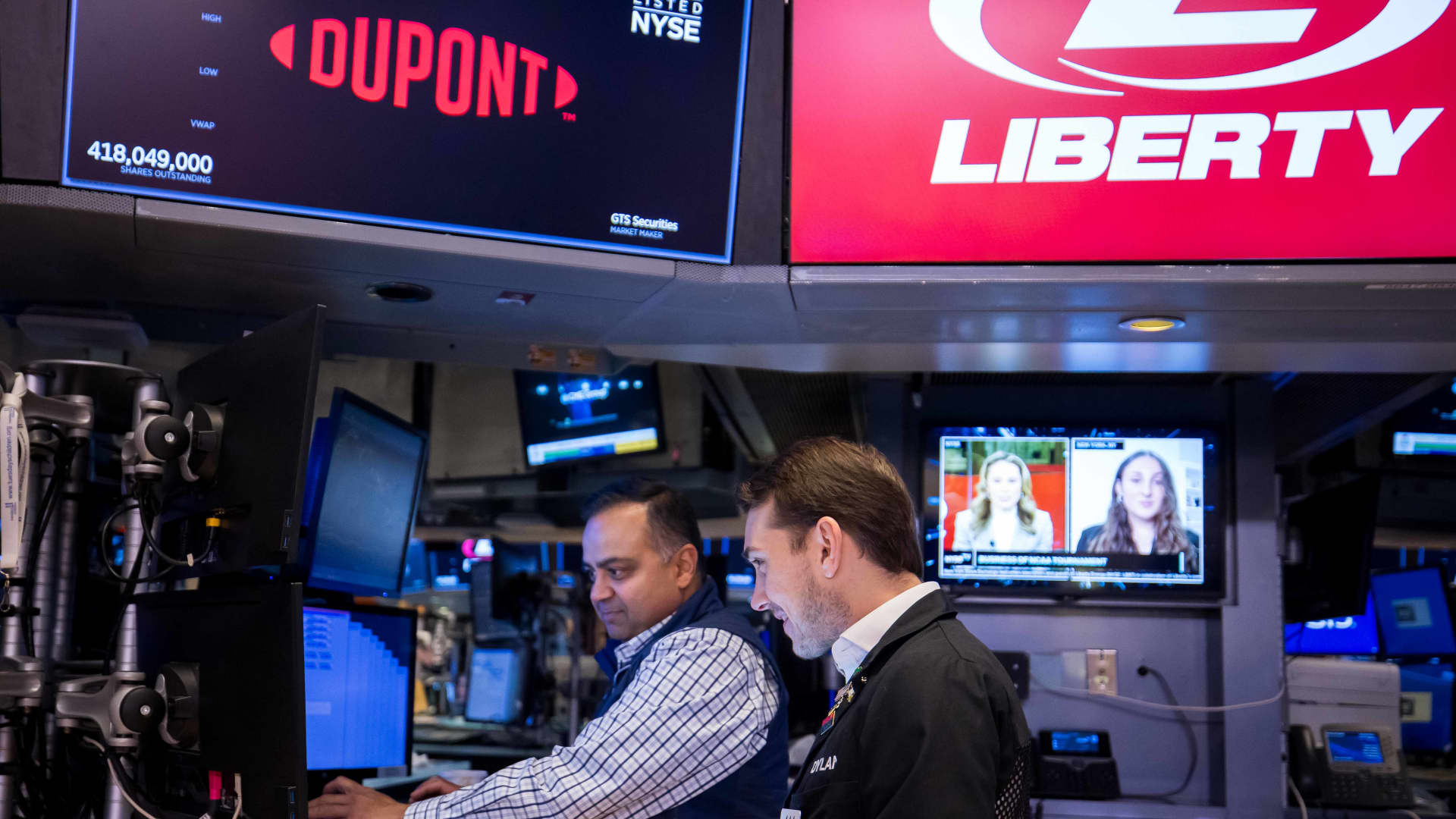
Every weekday, the CNBC Investing Club with Jim Cramer releases the Homestretch — an actionable afternoon update, just in time for the last hour of trading on Wall Street. Stocks are trading lower on Tuesday, but are well off their session lows . The S & P 500 and Nasdaq are headed for back-to-back down sessions as the AI and data center buildout trade cools off. The move looks more like profit-taking after a big move than thesis changing, but Micron will need to signal that demand continues to outstrip supply for the foreseeable future when the memory maker reports earnings on Wednesday after the bell. DuPont’s 1-for-3 reverse stock split goes into effect Wednesday morning. This is purely a cosmetic change and will have no impact on the value of our investment. Unlike a traditional stock split, which increases the number of shares outstanding while lowering the share price proportionally, a reverse stock split reduces the number of shares outstanding and raises the share price proportionally. It’s important to note that DuPont isn’t implementing a reverse stock split to meet an exchange listing requirement. Management said the move will better align DuPont’s share price and per-share metrics, such as earnings per share, with those of its U.S. multi-industry peers, following the spin-off of Qnity last year. For example, 3M is a reasonable peer comparison given its exposure to health care, water, and industrial markets. Shares of 3M currently trade around $162, and the company is expected to earn roughly $8.70 per share this year, according to FactSet. By comparison, DuPont trades at roughly $47 per share and is expected to earn $2.66 per share this year. While the businesses are not identical, the gap in share price and EPS can make direct comparisons more difficult to evaluate. Following the 1-for-3 reverse split, DuPont should trade at roughly $141 per share and earn between $7.02 and $7.16 per share based on the company’s current guidance. We’re generally not the biggest fans of reverse splits, but when we lay out the numbers, it does make sense to make DuPont’s per-share metrics more comparable to those of its industrial peers. By the way, Honeywell Technologies will also do a reverse split immediately after the completion of the Aerospace separation on June 29. FedEx reports after the close on Tuesday , and the company is expected to report revenue of $24.04 billion and EPS of $5.96, according to LSEG. Those figures include FedEx Freight , which was spun out earlier this month. The print could be noisy as we previewed Sunday, so we’ll be emphasizing CEO Raj Subramaniam’s comments and the earnings trajectory of the slimmed-down company. KB Home also reports on Tuesday. Paychex reports before the opening bell on Wednesday, followed by the May new home sales report later in the morning. (See here for a full list of the stocks in Jim Cramer’s Charitable Trust.) As a subscriber to the CNBC Investing Club with Jim Cramer, you will receive a trade alert before Jim makes a trade. Jim waits 45 minutes after sending a trade alert before buying or selling a stock in his charitable trust’s portfolio. If Jim has talked about a stock on CNBC TV, he waits 72 hours after issuing the trade alert before executing the trade. THE ABOVE INVESTING CLUB INFORMATION IS SUBJECT TO OUR TERMS AND CONDITIONS AND PRIVACY POLICY , TOGETHER WITH OUR DISCLAIMER . NO FIDUCIARY OBLIGATION OR DUTY EXISTS, OR IS CREATED, BY VIRTUE OF YOUR RECEIPT OF ANY INFORMATION PROVIDED IN CONNECTION WITH THE INVESTING CLUB. NO SPECIFIC OUTCOME OR PROFIT IS GUARANTEED.