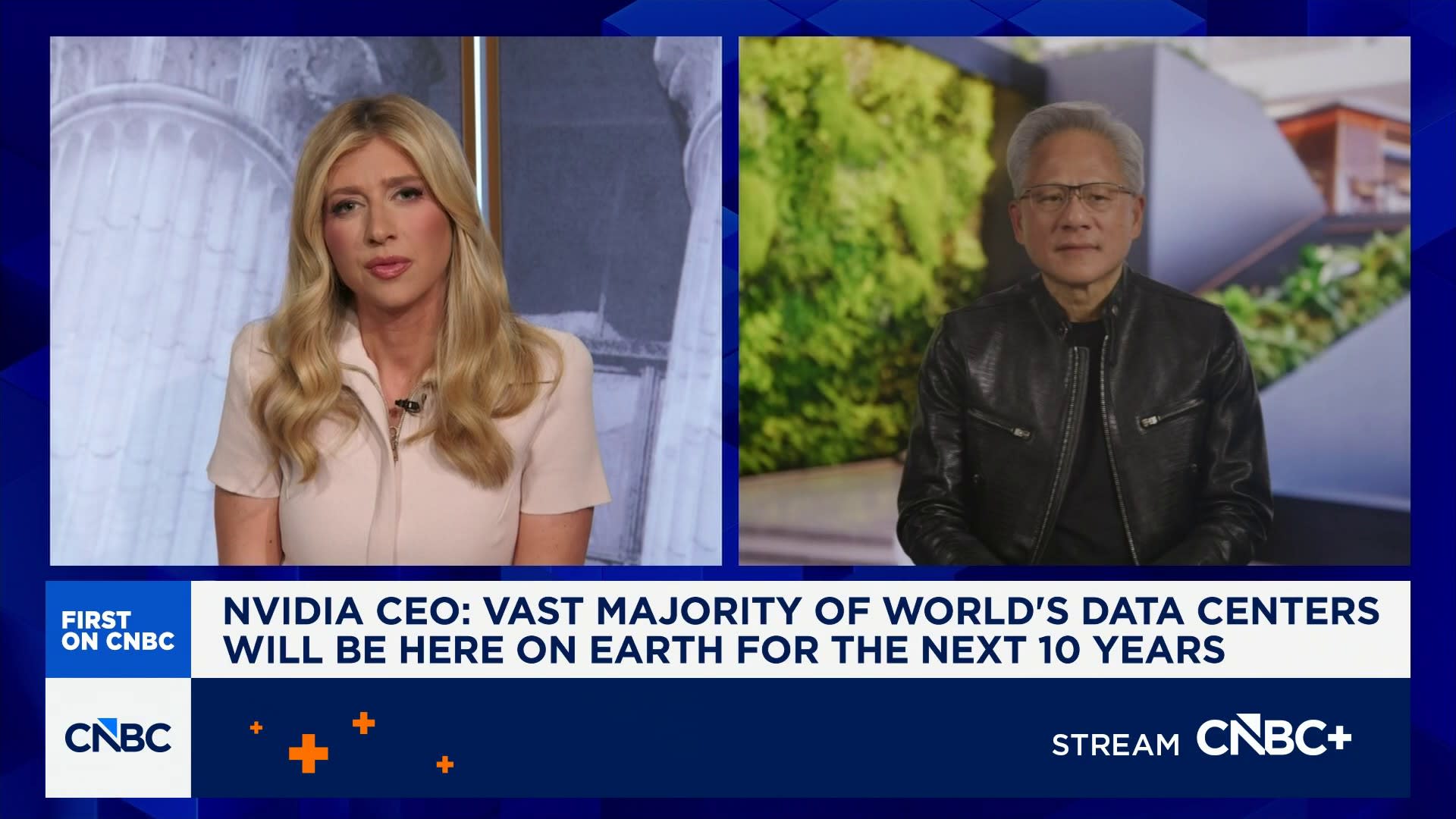
Jensen Huang, CEO of NVIDIA, arrives at a Korean barbecue restaurant for a dinner meeting with SK Group Chairman Chey Tae-won, LG Group Chairman Koo Kwang-mo, and Naver Chairman Lee Hae-jin in Seoul, South Korea, on June 5, 2026.
Chris Jung | Nurphoto | Getty Images
Nvidia CEO Jensen Huang told shareholders on Wednesday that if a commercial opportunity conflicts with U.S. national security, the company would prioritize American interests.
“National security comes first,” Huang said in a session shortly after the company’s annual stockholder meeting concluded.
He added that if a company wanted to smuggle Nvidia’s chips or systems into countries with export restrictions — such as China — they would have challenges getting it working because Nvidia wouldn’t provide support or repairs.
“Advanced AI data centers are massive integrated systems that require trusted hardware, software, networking, and continuing support,” Huang said. “Trying to cobble together data centers with some smuggled products is a dead end.”
Huang’s remarks come as Washington regulators and the Trump administration are increasingly wary that exporting AI software and hardware to China and other nations is a threat to national security.
Earlier this month, Anthropic, which uses Nvidia chips, shut down Fable 5 and Mythos 5 after the U.S. government ordered it to disable access to its most advanced models.
Nvidia’s chips have had export controls placed on them since 2022, which forced the company to produce China-specific chips for the region that complied with U.S. government benchmarks. But last year, the U.S. cleared the company’s H200 chip — the same model used by U.S. companies — for export to the region.
Huang said that the U.S. government approved those licenses, but Nvidia has yet to generate any revenue from the chips and that Nvidia doesn’t know whether China will allow imports of its products. About 9% of Nvidia’s fiscal 2026 revenue came from China, including Hong Kong, a smaller proportion than in 2025 and 2024.
Huang told stockholders during the meeting that the question of AI return-on-investment “has been answered.”
He said that when AI output is useful, such as generating code, then operating an Nvidia system to generate tokens, or bits of AI output, becomes profitable and means companies need more computing power. He noted that GitHub saw pull requests nearly triple this year because of AI.
“Nvidia systems may not be the cheapest to purchase, but Nvidia generates the lowest cost tokens, the highest token throughput, and the most revenues,” Huang said.
He reiterated that Nvidia plans to return 50% of the company’s free cash flow to investors through share repurchases and dividends over the next few years.
Nvidia generated over $96 billion in free cash flow in its fiscal 2026.
“Nvidia offers investors a unique combination of exceptional growth, strong margin, and free cash flow execution, and rising capital returns,” Huang said.
At the annual meeting, shareholders approved the company’s executive compensation plan in an advisory capacity and re-elected all 10 board members. One outside shareholder proposal to change company bylaws so that all shareholder votes would win with a simple majority passed.

About The Author