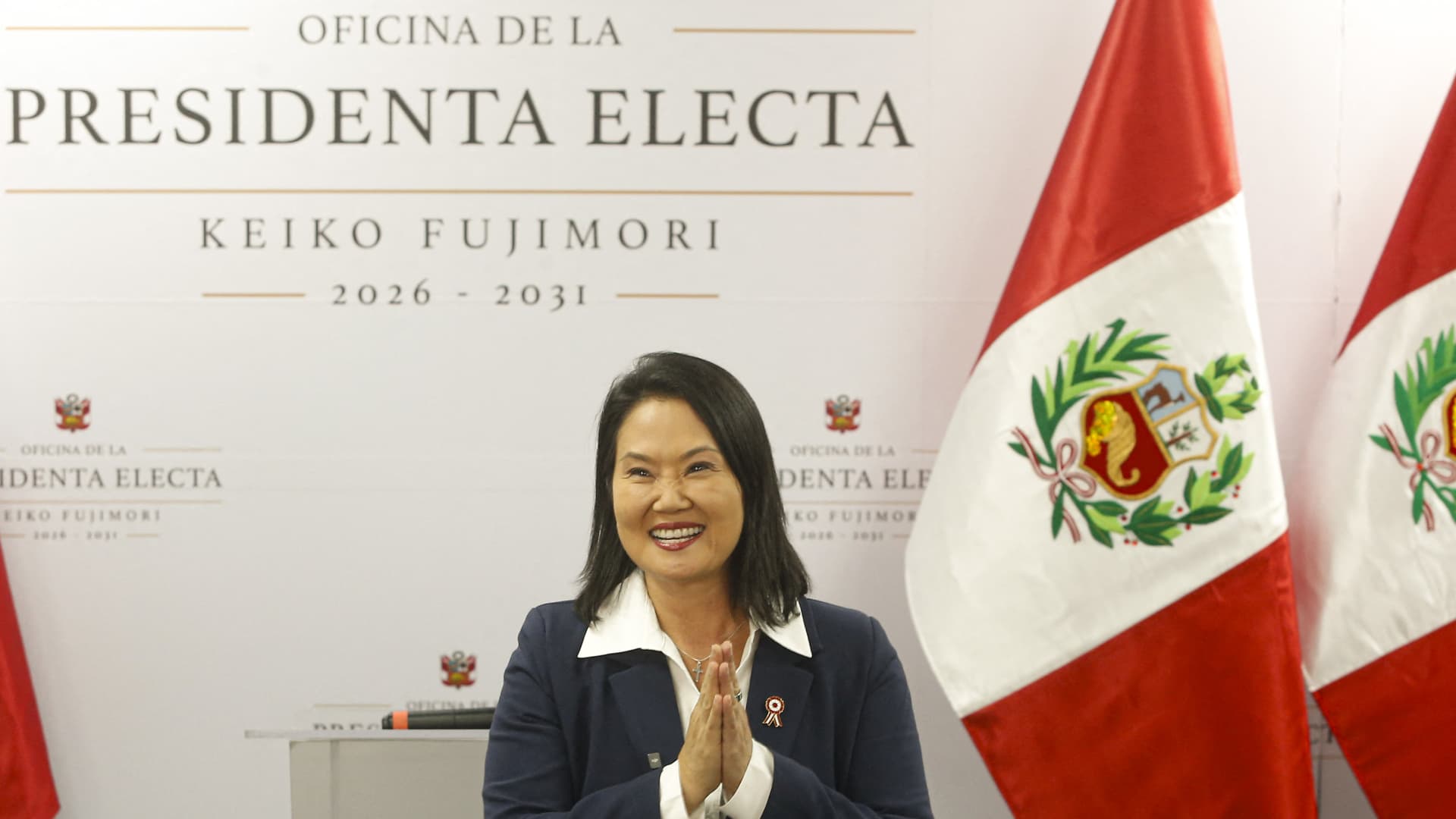
Peru’s president-elect for the Fuerza Popular party, Keiko Fujimori, gestures as she gives a statement at her campaign headquarters in the San Borja district of Lima on July 3, 2026. (Photo by AFP via Getty Images)
Stringer | Afp | Getty Images
After weeks of protests, fraud accusations and review of contested ballots in a razor-thin race, conservative KeikoFujimoriwas officially declared the winner of Peru’s presidential race by the country’s electoral office on Friday.
Fujimoriwon 50.135% of the vote in the June 7 runoff to clinch the nation’s top office in her fourth run for the presidency, just ahead of leftist congressman Roberto Sanchez’s 49.865%, a difference of about 50,000 votes out of 18 million.
“We’re going to identify all the best practices, initiatives, and projects that have yielded results so that they can continue,”Fujimorisaid at her party headquarters alongside her staff, adding that “today marks the beginning of a new era for Peru — an era of responsibility, dialogue, and results to restore confidence in our institutions.”
The slim margin is a reversal from the narrow lossFujimorisuffered in 2021, when she fell short by about 45,000 votes to former leftist President Pedro Castillo. Castillo wasimpeached and jailedfor trying to dissolve Congress in 2022.
Sanchez is widely seen as Castillo’s political heir and has said he willnot recognizeFujimori’s governmentafter claiming, without providing evidence, electoral fraud. Sanchez, boosted by voters from Peru’s rural regions,led the race earlier in the countand also won votes cast within the country by a slim margin. He has led marches contesting the vote and filed a complaint with the Inter-American Commission on Human Rights challenging the elections.
Fujimoriwas boosted by voters in the capital region of Lima and also led votes cast by overseas ballot by a wide margin, pushing her to victory.
The tight, drawn-out race has highlighted the country’sdeep polarizationand political instability that led to the ousting of several presidents over the last decade.
Conservative leaders congratulate Fujimori
WhenFujimoriassumes power on July 28, she will be the 10th president since 2016. She will succeed interim President Jose Balcazar, whotook over in Februaryafter a series of presidential dismissals over accusations of corruption or abuse of power.
Fujimori’s win reaffirmsLatin America’s rightward shift, and other conservative leaders in the region, including Argentina’s Javier Milei, Chile’s Jose Antonio Kast and El Salvador’s Nayib Bukele, have already congratulated the president-elect.
U.S. Secretary of State Marco Rubio also congratulatedFujimoriin a statement on Tuesday, saying that PresidentDonald Trump’s administration looks forward to deepening cooperation on security, investment and trade.
Her victory was also welcomed by markets, which had been rattled by the prospect of a Sanchez win. On Thursday,Moody’s issued a reportsaying aFujimorigovernment will preserve policy continuity, bolster investor confidence and help the country sustain growth.
The report added that this could help unlock delayed mining projects in Peru, which is the world’s third-largest copper producer.
A divisive dynasty
Fujimori, 51, is the daughter of late President AlbertoFujimori, who governed the country with an iron fist from 1990 to 2000 and was credited with defeating Maoist insurgents and taming runaway hyperinflation.
But theFujimoris are still acontroversial dynastyin Peru. Alberto served 16 years in prison for human-rights abuses and Keiko spent years under investigation over campaign financing allegations, which weredropped last year. She was imprisoned multiple times between 2018 and 2020 during the investigation, spending nearly a year and a half in jail.
Fujimoriwill now be tasked with uniting a polarized nation with a fragmented Congress prone to ejecting presidents. The country also faces a vast economic divide between the capital of Lima and rural areas, where heavy protests and clashes with security forceskilled over 60 peopleafter Castillo was removed from office.
Those areas were also Sanchez’s bastion of support and his party, Together for Peru, holds the second-largest bloc in Congress, withFujimori’s party holding the most seats.
About The Author