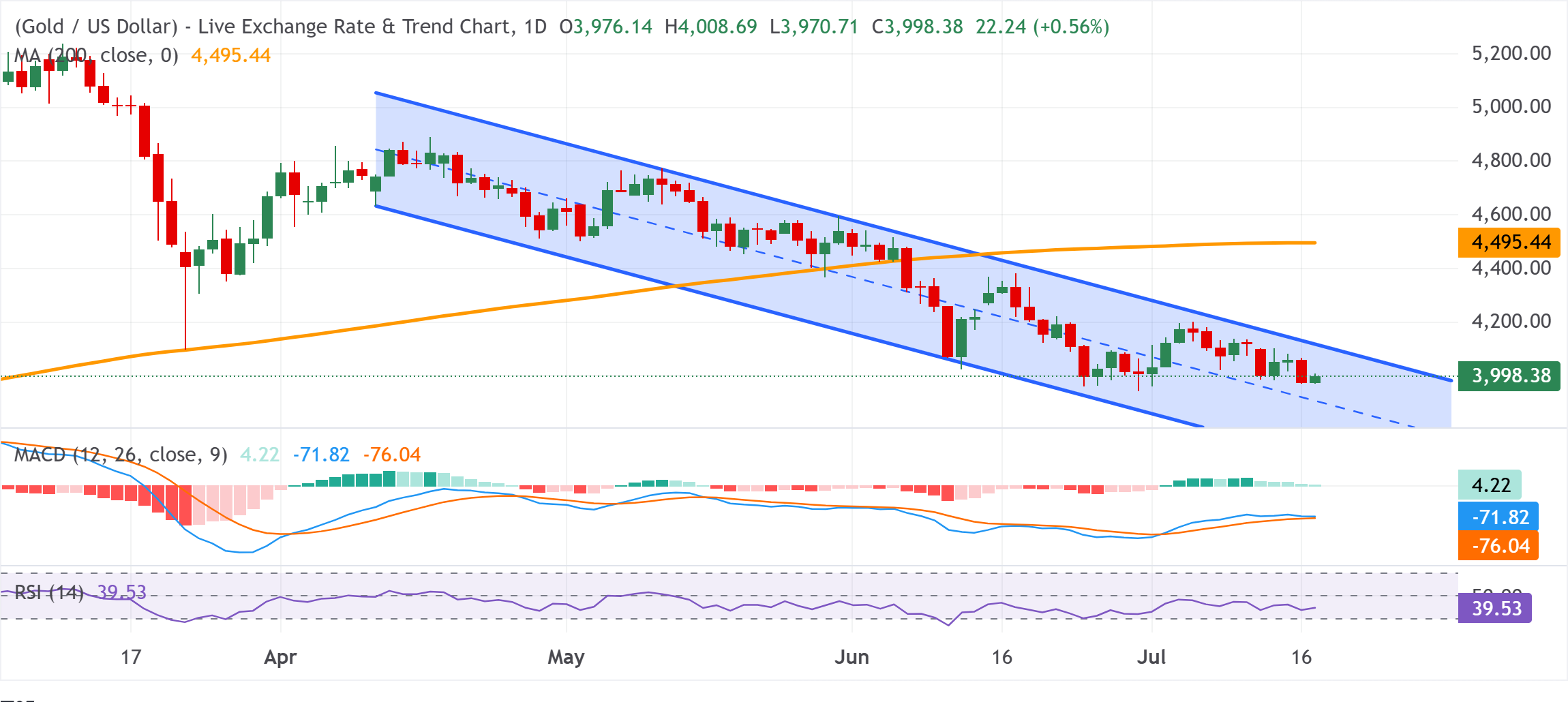
Gold (XAU/USD) struggles to capitalize on its modest intraday recovery beyond the $4,000 psychological mark and remains within striking distance of the monthly trough. Moreover, the bearish fundamental backdrop suggests that the path of least resistance for the precious metal remains to the downside. Crude oil prices have jumped over 10% this week as renewed US-Iran clashes stoked supply concerns, reviving inflation fears and lifting expectations that the US Federal Reserve (Fed) will keep rates higher for longer. This is seen as a key factor supporting the US Dollar (USD) and capping the non-yielding bullion.
The US-Iran conflict is entering a dangerous new phase as both sides exchanged intensifying fire on Thursday, with the latter expanding its military campaign beyond conventional military targets. In fact, officials in southern Iran’s Bandar Abbas reported that civilian infrastructure – including power facilities and a train station – has been hit. Iran retaliated with missile and drone attacks targeting US-allied Gulf nations. Tensions have also escalated around the Strait of Hormuz, with the US intercepting commercial vessels attempting to breach its naval blockade around Iran.
Meanwhile, Iran’s Islamic Revolutionary Guard Corps had threatened to expand the conflict by targeting additional regional energy supply routes. In fact, Reuters reported that Iran has asked Yemen’s Houthis to stand ready to close the Red Sea oil route. This helps crude oil prices in preserving the recent gains at a one-month high, reviving concerns about energy-driven inflation. Adding to this, the upbeat US macro data and hawkish comments from influential Fed officials reinforced expectations that the US central bank will raise borrowing costs at least once by the end of this year.
The US Labor Department reported on Thursday that the number of Americans filing new applications for unemployment benefits dropped to a seasonally adjusted 208 K for the week ended July 11. The reading was below consensus estimates and underscored the resilience of the US labor market. Separately, the Philadelphia Fed Manufacturing Index surged from 10.3 to 41.4 in July, hitting its highest level since November 2021 and indicating a rapid acceleration in regional factory activity. Further details revealed that both price indicators continued to signal rising prices.
Furthermore, Dallas Fed President Lorie Logan said that the positive news this week on consumer and wholesale prices still wasn’t good enough to signal real help for US households. She called for modestly higher interest rates to win a battle the central bank has been losing for the past five years. Apart from this, Fed Vice Chair Philip Jefferson said that he would be open to raising rates if inflation does not show near-term improvement. According to the CME Group’s FedWatch Tool, traders are currently pricing in a nearly 75% chance of a 25-basis-point (bps) Fed rate hike by December.
The aforementioned factors favor the USD bulls, suggesting that any subsequent recovery in the Gold price is more likely to be sold into and fizzle out rather quickly. Traders now look forward to Friday’s US economic docket – featuring Building Permits, Housing Starts, Industrial Production data, and the prelim University of Michigan Consumer Sentiment Index and Inflation Expectations. This, along with Fed speak, would drive the USD and provide some impetus to the Gold price, which remains on track to register losses for the second consecutive week.
XAU/USD daily chart
Gold is likely to attract fresh sellers at higher levels amid bearish setup
From a technical perspective, the XAU/USD pair has been trending lower along a downward-sloping channel and remains below the very important 200-day Simple Moving Average (SMA). This reaffirms the near-term bearish outlook for Gold and suggests that rallies are likely to remain capped within the broader corrective phase. Meanwhile, the Moving Average Convergence Divergence (MACD) indicator has turned modestly positive, while the Relative Strength Index (RSI) near 40 hints at only a tentative stabilization rather than a sustained recovery.
Hence, any further move up could face an initial hurdle at the channel top near $4,082.74, with stronger structural resistance at the 200-day SMA clustered around $4,495.44. On the downside, the lower boundary of the descending channel at $3,661.05 acts as key support, and a decisive break below this zone would reinforce the prevailing bearish structure and expose further downside within the current trend.
(The technical analysis of this story was written with the help of an AI tool. Know more.)
Gold FAQs
Gold has played a key role in human’s history as it has been widely used as a store of value and medium of exchange. Currently, apart from its shine and usage for jewelry, the precious metal is widely seen as a safe-haven asset, meaning that it is considered a good investment during turbulent times. Gold is also widely seen as a hedge against inflation and against depreciating currencies as it doesn’t rely on any specific issuer or government.
Central banks are the biggest Gold holders. In their aim to support their currencies in turbulent times, central banks tend to diversify their reserves and buy Gold to improve the perceived strength of the economy and the currency. High Gold reserves can be a source of trust for a country’s solvency. Central banks added 1,136 tonnes of Gold worth around $70 billion to their reserves in 2022, according to data from the World Gold Council. This is the highest yearly purchase since records began. Central banks from emerging economies such as China, India and Turkey are quickly increasing their Gold reserves.
Gold has an inverse correlation with the US Dollar and US Treasuries, which are both major reserve and safe-haven assets. When the Dollar depreciates, Gold tends to rise, enabling investors and central banks to diversify their assets in turbulent times. Gold is also inversely correlated with risk assets. A rally in the stock market tends to weaken Gold price, while sell-offs in riskier markets tend to favor the precious metal.
The price can move due to a wide range of factors. Geopolitical instability or fears of a deep recession can quickly make Gold price escalate due to its safe-haven status. As a yield-less asset, Gold tends to rise with lower interest rates, while higher cost of money usually weighs down on the yellow metal. Still, most moves depend on how the US Dollar (USD) behaves as the asset is priced in dollars (XAU/USD). A strong Dollar tends to keep the price of Gold controlled, whereas a weaker Dollar is likely to push Gold prices up.
About The Author