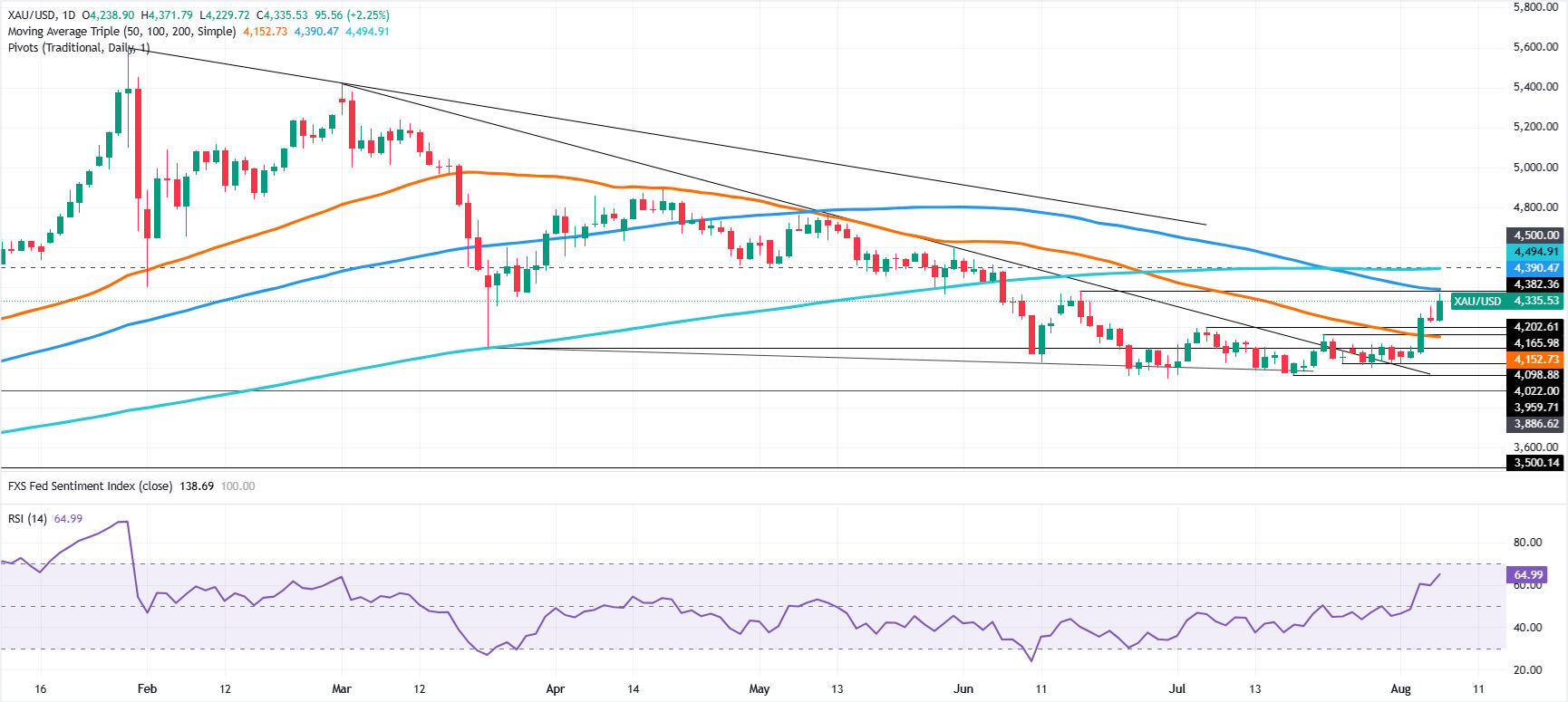
Gold (XAU/USD) skyrockets on Friday, gaining over 2.30% in the day and more than 7% in the week after US jobs data was mixed, with a softer Nonfarm Payrolls print while the Unemployment Rate remained steady. At the time of writing, the XAU/USD pair trades at $4,340 after hitting $4,371 earlier in the day, its highest level since June 17.
XAU/USD surges over 7% for the week on weak NFP, lower US yields
US jobs data disappointed investors after July Nonfarm Payrolls showed that the economy shed 23K jobs, missing forecasts for an 80K job gain. Payrolls for May and June were also downwardly revised, combined, slashing 103K people from the workforce, lower than previously reported. Even though the data justifies the Federal Reserve’s (Fed) reluctance to increase interest rates to tackle inflation, the Unemployment Rate also ticked lower, from 4.2% to 4.1%.
The data pushed US Treasury yields lower and the Greenback as well. The US 10-year Treasury yield is down two basis points at 4,687%, a tailwind for bullion prices.
As of writing, the US Dollar Index (DXY), which measures the performance of the American currency against six other currencies, is down 0.42% to 99.54.
The Richmond Fed President Thomas Barkin said that “jobs data was very consistent with a sector in weak balance.” He added that the report depicts the labor market as being in a “low hire, low fire” scenario.
Dip in energy prices hurts Fed hike bets
Geopolitics continued to play a role in the financial markets, which turned moderately optimistic about the potential reopening of the Strait of Hormuz. US President Donald Trump said that he believed that the war with Iran could be over soon.
Despite this, Iran says the proposed agreement with Oman, which reportedly would ban US and Israeli vessels from passing through the Strait, would only establish a temporary shipping route and would not amount to a full reopening of the waterway.
West Texas Intermediate (WTI), the US Oil benchmark, is flat during the day around $78 per barrel, but is down almost 9.9% for the week.
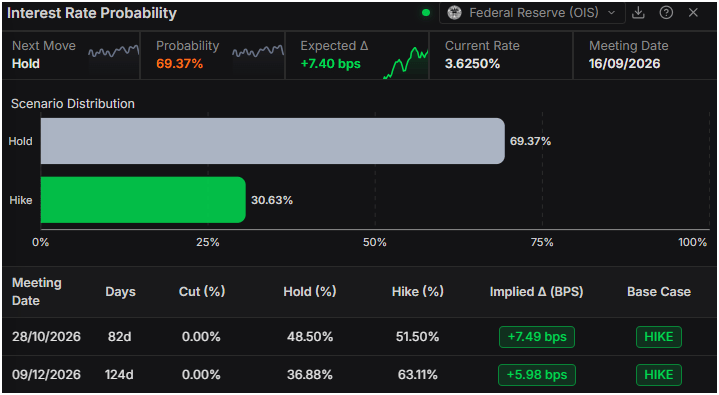
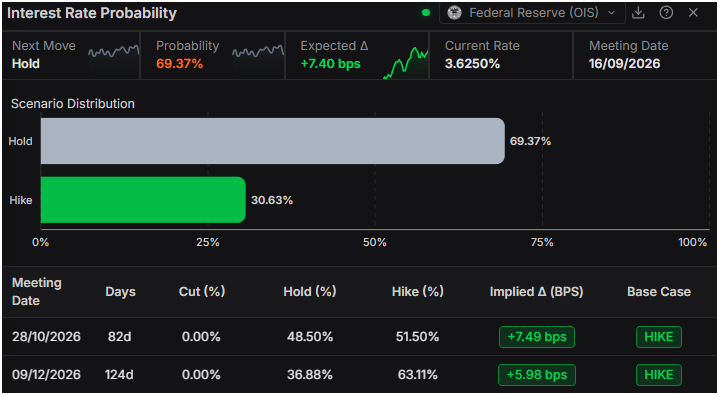
The swaps market had priced in a lower probability that the Federal Reserve would raise rates at its September meeting. The odds stand at 30%, down from 58% a day ago, while there’s a 70% chance the central bank will keep rates unchanged, according to Prime Terminal data.
Traders will be watching the US Consumer Price Index (CPI) release for July on Wednesday. Economists expect inflation to decrease slightly from 3.5% to 3.4% YoY, with Core CPI also dipping from 2.6% to 2.5% YoY.
On Thursday, the Producer Price Index (PPI), a key input to the Fed’s preferred inflation measure, the Core Personal Consumption Expenditures (PCE) Price Index, will be released.
XAU/USD technical analysis: Gold challenges 100-day SMA as bulls target the 200-day SMA
Gold price seems poised to turn bullish as the yellow metal surpassed the 50-day Simple Moving Average (SMA) at $4,152, and it is on its way to challenge the 100-day SMA at $4,390. Momentum has turned bullish, as depicted in the Relative Strength Index (RSI). With that said, the path of least resistance is upwards.
The next area of interest would be the 200-day SMA at $4,390. If breached, the next key resistance is $4,450, followed by the $4,500 mark.
Downwards, bullion’s first support level is the July 6 high, now turned support at $4,202. If this level is broken, the next targets are the 50-day SMA at $4,152 and $4,100. Below that, the August 3 daily low of $4,019 acts as further support.
Gold FAQs
Gold has played a key role in human’s history as it has been widely used as a store of value and medium of exchange. Currently, apart from its shine and usage for jewelry, the precious metal is widely seen as a safe-haven asset, meaning that it is considered a good investment during turbulent times. Gold is also widely seen as a hedge against inflation and against depreciating currencies as it doesn’t rely on any specific issuer or government.
Central banks are the biggest Gold holders. In their aim to support their currencies in turbulent times, central banks tend to diversify their reserves and buy Gold to improve the perceived strength of the economy and the currency. High Gold reserves can be a source of trust for a country’s solvency. Central banks added 1,136 tonnes of Gold worth around $70 billion to their reserves in 2022, according to data from the World Gold Council. This is the highest yearly purchase since records began. Central banks from emerging economies such as China, India and Turkey are quickly increasing their Gold reserves.
Gold has an inverse correlation with the US Dollar and US Treasuries, which are both major reserve and safe-haven assets. When the Dollar depreciates, Gold tends to rise, enabling investors and central banks to diversify their assets in turbulent times. Gold is also inversely correlated with risk assets. A rally in the stock market tends to weaken Gold price, while sell-offs in riskier markets tend to favor the precious metal.
The price can move due to a wide range of factors. Geopolitical instability or fears of a deep recession can quickly make Gold price escalate due to its safe-haven status. As a yield-less asset, Gold tends to rise with lower interest rates, while higher cost of money usually weighs down on the yellow metal. Still, most moves depend on how the US Dollar (USD) behaves as the asset is priced in dollars (XAU/USD). A strong Dollar tends to keep the price of Gold controlled, whereas a weaker Dollar is likely to push Gold prices up.
About The Author