
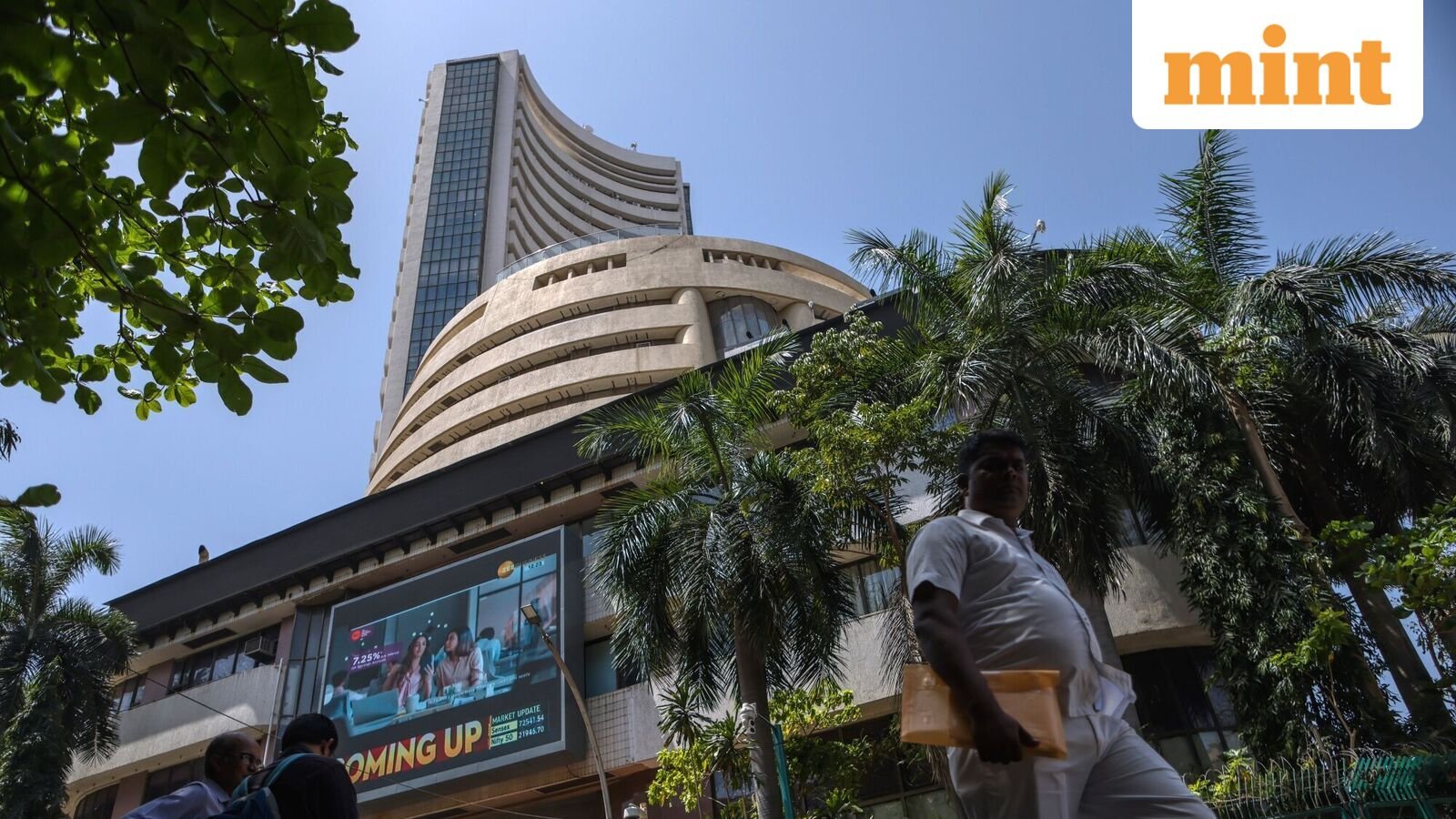
Indian stock market: The Indian stock market closed the week on a weaker note, weighed down by elevated crude oil prices, renewed geopolitical tensions and mixed global signals. Volatility remained high as investors assessed the final phase of the Q1 FY27 earnings season and gauged the possible impact of rising energy costs on inflation, the rupee and corporate profitability.
For the week, the Sensex fell 0.62% to 78,009.25, while the Nifty declined 0.83% to 24,366. In the broader market, performance was mixed, with the MidCap index advancing 0.50%, whereas the SmallCap index slipped 0.66%.
Stock Market Outlook next week
According to Ponmudi R, CEO – Enrich Money, investor attention in the coming week is likely to remain firmly focused on developments surrounding the Strait of Hormuz and the broader US–Iran standoff.
Ponmudi noted crude oil is therefore expected to remain one of the most important variables for Indian markets. WTI crude ended the week around the $82–83 per barrel range, while Brent remained elevated near $88–89, as geopolitical risks outweighed concerns over softer global demand and rising U.S. inventories.
He further added that investor focus will also turn to the release of the minutes from the Federal Reserve’s July policy meeting on August 19.
“Beyond global developments, investors will closely watch foreign institutional flows and shifts in sectoral leadership for evidence that the market is broadening beyond selective buying into a more sustained recovery,” he said.
Top 5 triggers for the Indian stock market
1] US Fed meeting minutes
The minutes of the Federal Open Market Committee (FOMC) meeting held on July 28–29, 2026, are scheduled to be released by the Federal Reserve Board on August 19, 2026. The minutes will provide details of the deliberations that led to the 9–3 decision to keep the federal funds rate unchanged in the 3.50%–3.75% range.
“The minutes will be closely scrutinised after the Fed’s last meeting revealed one of the sharpest policy divisions in recent years, with the central bank holding interest rates unchanged in a 9–3 vote as three policymakers dissented in favour of an immediate rate hike. Markets will look for greater clarity on how policymakers are balancing easing inflation against persistent upside risks and whether the committee’s internal debate has shifted ahead of the September meeting,” Ponmudi said.
2] US-Iran war
Iranian Deputy Foreign Minister Kazem Gharibabadi has reaffirmed Tehran’s position on the Strait of Hormuz, stating that the strategic waterway “has been Iranian, is Iranian, and will remain Iranian.” He further asserted that any decision to close or reopen the strait would be made solely by Iran.
Gharibabadi made the remarks on Saturday after US President Donald Trump said he would soon announce that the Strait of Hormuz is part of US territory.
Last week, senior Iranian official Mohammad Bagher Zolghadr outlined several conditions for reopening the strait. These included an end to what he described as “war and aggression” against Iran and its allies in Lebanon, Palestine, Yemen and Iraq.
Zolghadr also called for the removal of sanctions that have severely affected Iran, the unfreezing of Iranian assets and compensation for damage caused during the conflict.
“Developments surrounding the Strait of Hormuz and the trajectory of Brent crude will remain critical market drivers in the near term,” said Ajit Mishra – SVP, Research, Religare Broking.
3] Crude oil prices
Crude oil futures rose by more than $1 a barrel on Friday, driven by attacks on tankers and the absence of any significant progress toward a peace deal between the Trump administration and Iran’s leadership.
Brent crude settled at $88.52 a barrel, gaining $1.45, or 1.67%, while U.S. West Texas Intermediate (WTI) futures ended at $82.40 a barrel, up $1.15, or 1.42%.
For the week, Brent and WTI were headed for gains of 6.0% and 5.4%, respectively.
“With the earnings season behind us, the coming week will be relatively data-light, with investors likely to focus on global monetary policy expectations, crude oil prices and geopolitical developments,” Mishra added.
4] FII flows
Foreign institutional investors (FIIs) turned net buyers of Indian equities on August 14, while domestic institutional investors (DIIs) also maintained their buying momentum, according to provisional exchange data.
FIIs purchased shares worth ₹12,854.44 crore and sold equities valued at ₹12,346.32 crore, resulting in net purchases of ₹508.12 crore. Meanwhile, DIIs bought shares worth ₹14,295.49 crore and sold shares worth ₹13,939.09 crore, leading to net buying of ₹356.40 crore.
So far in August, FIIs have stayed on the buying side, with broader FPI data indicating net inflows of ₹9,836 crore through August 11. DIIs have also remained strong buyers, recording net purchases of ₹38,449 crore during the month. Despite the recent inflows, foreign buying remains relatively limited compared with the ₹3.37 lakh crore in net FII selling recorded so far this year. DIIs, on the other hand, have more than offset the foreign outflows to some extent, with year-to-date net purchases of ₹4.98 lakh crore.
5] Gold prices
Gold prices rose on Friday and were on track to post a weekly gain, supported by a weaker US dollar after inflation data released this week came in broadly as expected, strengthening expectations that the Federal Reserve may keep interest rates unchanged next month.
Spot gold gained 0.7% to $4,379.95 an ounce. The precious metal had fallen 1.3% in the previous session as investors booked profits after prices climbed to their highest level since June 5. Gold was up about 0.9% for the week. Meanwhile, US gold futures ended 0.4% higher at $4,437.30.
Disclaimer: This story is for educational purposes only. The views and recommendations above are those of individual analysts or broking companies, not Mint. We advise investors to check with certified experts before making any investment decisions.
About The Author
