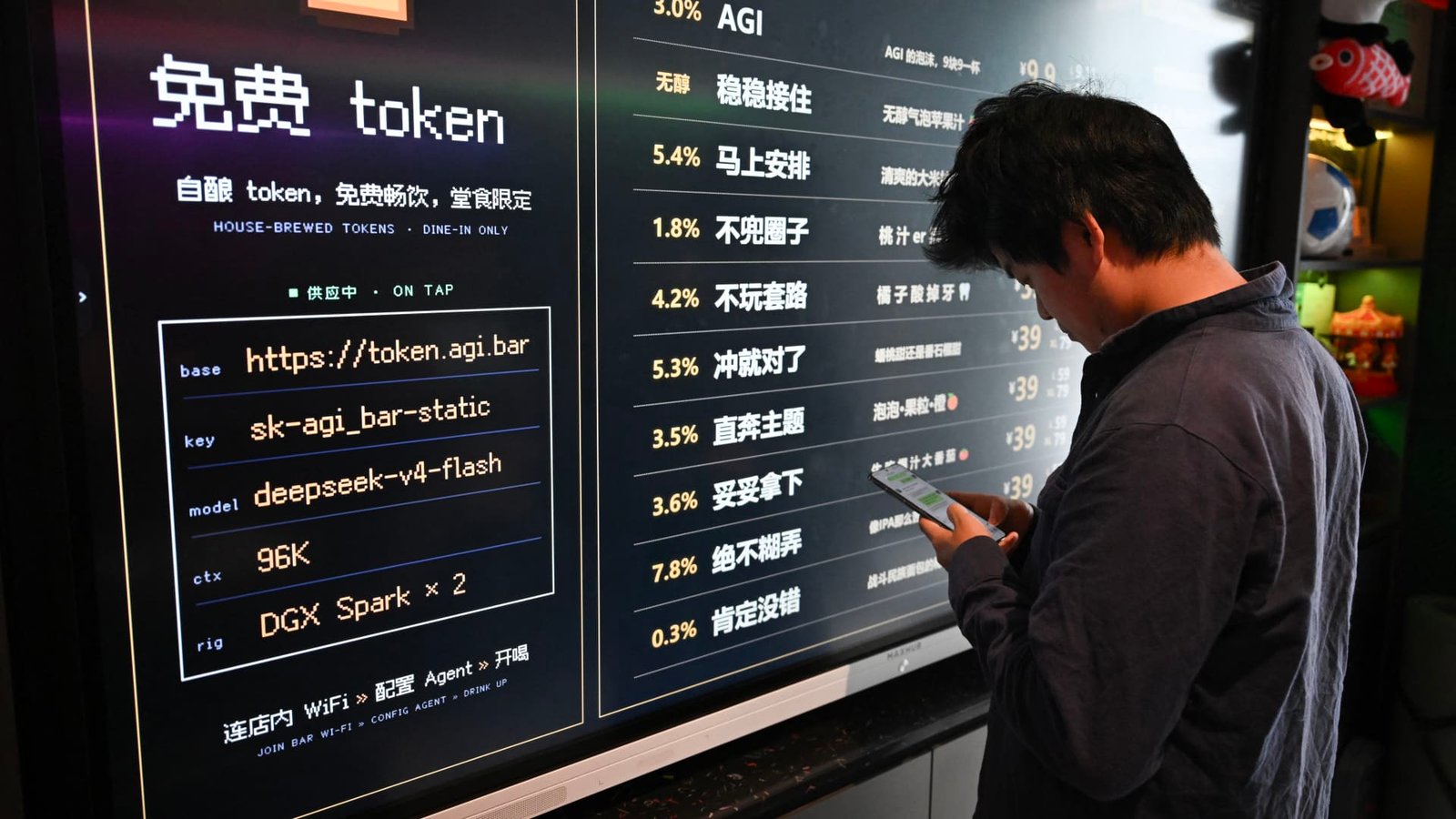
An AI-themed ‘AGI Bar’ in Beijing’s tech-focused Zhongguancun district on Aug. 9, 2026.
Pedro Pardo | Afp | Getty Images
Hi, this is Evelyn, writing to you from Beijing. Welcome to the latest edition of The China Connection — a snapshot of what I’m seeing and hearing from local businesses.
Is the AI race about who can spend the most (the U.S.), or whose price is cheaper (China) thanks in part to state-controlled power costs? It may be neither.
The big story
For Beijing, the artificial intelligence race is a story of resolve.
If China has one dollar left, “that dollar is going to be spent on AI rather than real estate,” said Bruce Liu, CEO of Esoterica Capital.
The goal is to be self-sufficient in AI, without relying on the U.S., he said. “They don’t need to have the best AI in the world.”
Everything from China’s national policy to district-level subsidies underscores those ambitions. So far, China’s made strides in advanced chips for powering AI. But they still fall short of Nvidia’s.
Now Nvidia has gathered Wall Street titans to support $500 billion in financing for AI development, demonstrating the U.S. advantage in capital.
Private sector AI investment in the U.S. is around 23 times more than in mainland China, according to Alexander Kheder, TMT analyst, at BMI, a unit of Fitch Solutions.
Unless Beijing makes it easier for Chinese AI firms to tap external, non-state capital, “this financing asymmetry will remain one of the most durable structural explanations for US leadership,” Kheder said.
That hasn’t stopped Chinese companies from releasing AI models with similar capabilities — at lower prices, even with DeepSeek’s weekend price hike. Businesses globally are keen to try them.
But running the models still requires chips — a capability that Beijing lacks compared with the U.S.
China “could announce even more financial support,” said Clifford Kurz, director at S&P Global Ratings. “But if they don’t have the chips, what’s the point of support? There’s nothing to finance.”
Huawei only offers roughly one-eighth the computing capacity that Nvidia has, mostly outside China, Kurz said. He noted each of Huawei’s most advanced Ascend 950 chips has around 13% the computing power of one Nvidia GB300 chip.
Nvidia has an even more powerful Vera Rubin chip coming out this year. And for now, Huawei has compensated by piling more chips together.
But Kurz pointed out the Chinese company is expected to produce just 1.35 million advanced AI chips this year — far less than even the most conservative estimate of 6 million Nvidia chips.
Chasing returns
The story could change quickly. Huawei and other Chinese companies along the AI supply chain have narrowed the gap with global rivals in just a few years. China’s also courting AI talent, and has low electricity costs.
For investors such as Raffles Family Office, China’s domestic semiconductor push creates a “parallel” opportunity, rather than competition for capital headed for U.S. tech, said William Chow, deputy group CEO of the Hong Kong- and Singapore-based firm.
Clients care far more this year about the entry price for investing in AI, he said. Chow noted that Nvidia’s financing plan shifts more of the risk to credit from equity, which means investment diversification is more important.
Here again the story diverges from the U.S.
When it comes to AI projects in China, “we have not observed any significant plans for large-scale debt issuance by leading domestic companies,” said Zhu He, senior fellow at the CF40 Institute, a Beijing-based economic think tank. That’s according to a CNBC translation of Mandarin.
Zhu said most companies use equity financing and internal funds for AI spending, and that telecommunications giants as well as internet companies are investing in the tech.
China in June released a three-year plan for building infrastructure to support faster computing power, and last month said it expects the buildout of computing power networks in the country will attract 4 trillion yuan in capital through 2030.
Whether in China or the U.S., the scale of money needed for AI reflects a shift away from asset-light models that had helped businesses win over the past two decades, said Esoterica’s Liu. “Hyperscalers need to spend to get ahead.”
Ultimately, AI still faces a commercialization test. U.S. companies have spent heavily to develop the smartest models, while China’s aim is AI integration across industries.
“The AI rivalry is about applications based on the full AI stack,” said Winston Ma, adjunct professor of law at New York University.
Whoever finds the right formula is poised to win.
Need to know
Beijing is said to move to clarify tax rules stoking confusion among China’s ultra-wealthy
China’s State Taxation Administration is conducting training for local tax officers to align technical details on how the levy on offshore trusts should be applied, several tax advisors say.
Manus to return as independent company
Manus said it will “soon resume operating as an independent company,” after Chinese regulators in April demanded Meta unwind its $2 billion acquisition of the artificial intelligence startup.
China’s answer to Boeing and Airbus makes first international flight
The China-made C919 kicked off a commercial flight route between Beijing and Ulaanbaatar, Mongolia.
Tencent sees spending surge, defends potential ‘superior’ AI returns
The Chinese tech giant said capital expenditures for the June quarter rose 65% as it continues to invest in AI infrastructure. Tencent added that domestic game revenue jumped 17% year-on-year, accelerating from the first quarter.
Coming up
Unitree IPO expected this week
Aug. 18: Pony.ai earnings
Aug. 19 – 23: World Robot Conference in Beijing
Aug. 20: People’s Bank of China monthly decision on benchmark loan prime rate
Aug. 20: Alibaba earnings
Aug. 22 – 26: World Humanoid Robot Games in Beijing
About The Author