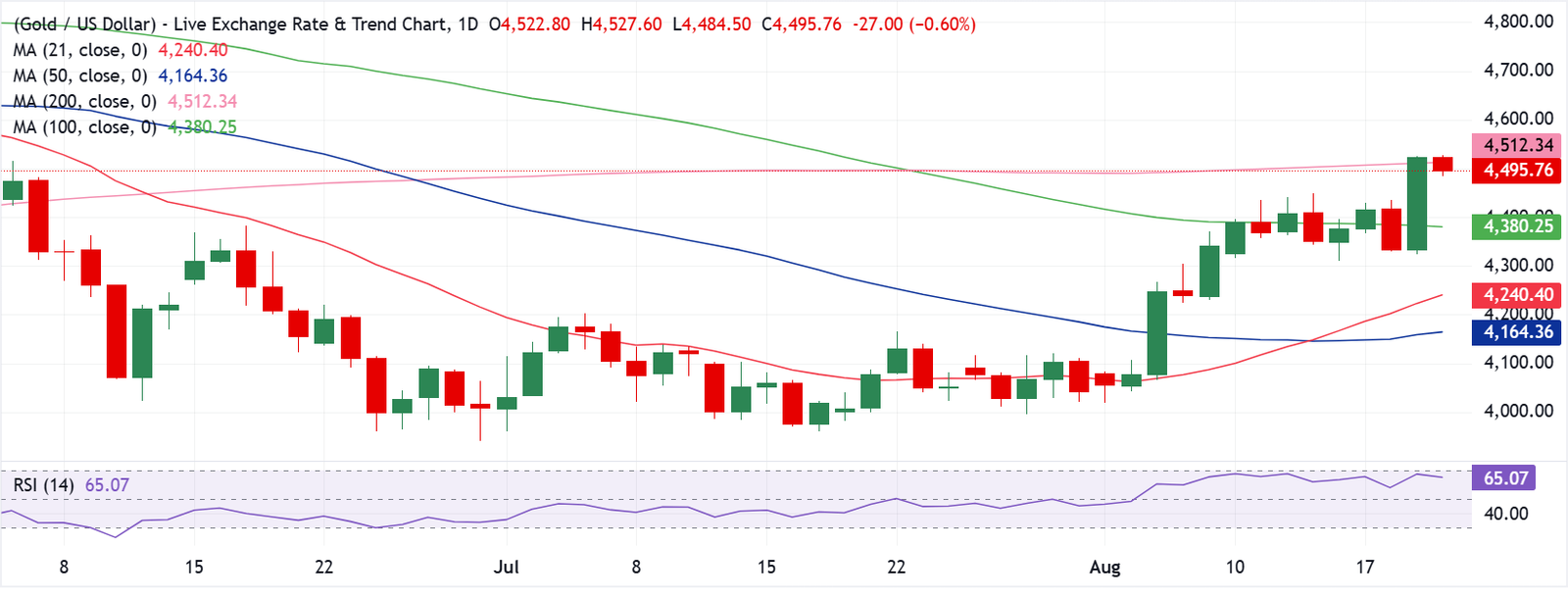
Goldis struggling around the $4,500 level in Asia on Thursday after reaching the highest level in 11 weeks at $4,528 in early dealings.
Gold’s bullish bias remains intact ahead of US jobs data
Gold refreshed two-month highs above $4,500 as Asian traders returned to their desks and reacted positively to the United States (US) Treasury’s rescue plan announced on Wednesday, after longer-dated Treasury yields shot through the roof and roiled the bond markets.
The US Treasury announced that it will double buyback sizes for 10- to 30-year Treasury debt securities to at least $4 billion per operation.
The increase from the previously planned $2 billion buybacks will apply to the 10-year to 20-year sector and the 20-year to 30-year sector and will be effective September 9 through November 4, the department said in a statement.
The announcement offered much-needed relief to the global markets, driving yields and the US Dollar (USD) sharply lower, while providing a fresh boost to non-yielding assets such as Gold.
However, the uptick in Gold was quickly reversed, with the bullion down over 0.50% as of writing, as the USD stalls its overnight slump, drawing support from the Minutes of the US Federal Reserve (Fed) July policy meeting and the US-Iran stalemate.
Minutes showed growing concern over persistent inflation. Several policymakers were open to raising interest rates, while many said a rate hike could be necessary if inflation fails to move back toward the Fed’s 2% target.
Meanwhile, US President Donald Trump threatened in a post on Truth Social on Thursday that the US will launch the “most crushing economic operation ever taken against any country”, declaring economic warfare and isolation on an “unprecedented scale” against Iran.
Calling the campaign an “economic D-Day”, Trump urged US allies to join efforts to isolate Iran.Despite the fresh US warning and fading hopes of the reopening of the Strait of Hormuz, Oil prices remain in an upside-consolidative phase.
Looking ahead, traders await the US Jobless Claims data release for fresh insight into the health of the labor market, following the July Nonfarm Payrolls debacle. Fedspeak and geopolitical headlines will also remain in play.
Only a convincing leg up in Oil prices and/ or a shift in the hawkish sentiment around the Fed could negate the near-term bullish outlook for Gold.
Gold price technical analysis: Daily chart
In the daily chart, XAU/USD trades at $4,495.76, holding a bullish near‑term bias as spot prices remain above the 21‑day, 50‑day and 100‑day simple moving averages (SMAs), clustered between roughly $4,164 and $4,380 and reinforcing a supported undertone. However, the 200‑day SMA at $4,512.34 sits just overhead as immediate resistance, hinting at a potential cap on further gains unless decisively reclaimed, while the Relative Strength Index (14) around 65 suggests firm but not yet extreme upside momentum.
On the downside, initial support is seen at the 100‑day SMA near $4,380.25, followed by the 21‑day SMA at $4,240.40 and then the 50‑day SMA at $4,164.36, which together define a broad demand band that could attract dip‑buying in case of a pullback. On the topside, a clear break above the 200‑day SMA resistance at $4,512.34 would open the door for a continuation of the advance, keeping the bullish bias intact while placing the focus on higher psychological levels above the $4,500 region.
(The technical analysis of this story was written with the help of an AI tool. Know more.)
Gold sentiment brightens as US Treasury support and stagflation risks bolster demand
According to TD Securities, the precious metals complex is showing “renewed upside” as policy developments and shifting investor flows revive interest in gold. The bank notes that the announcement that the US Treasury is increasing the size of “liquidity support buyback operations” has “given metals a jolt of life,” reinforcing the appeal of bullion in particular.
For gold, TD Securities highlights that “ETF accumulation has also picked back up,” with the recent “string of daily outflows from Chinese ETFs” now having “ended with a return to inflows.” While the “fierce bid has faded in recent days,” the strategists argue that these flows “could quickly return amid Treasury liquidity support, a Fed willing to look through an energy shock, and a growing stagflation narrative, which should all ultimately see lower real rates.”
About The Author