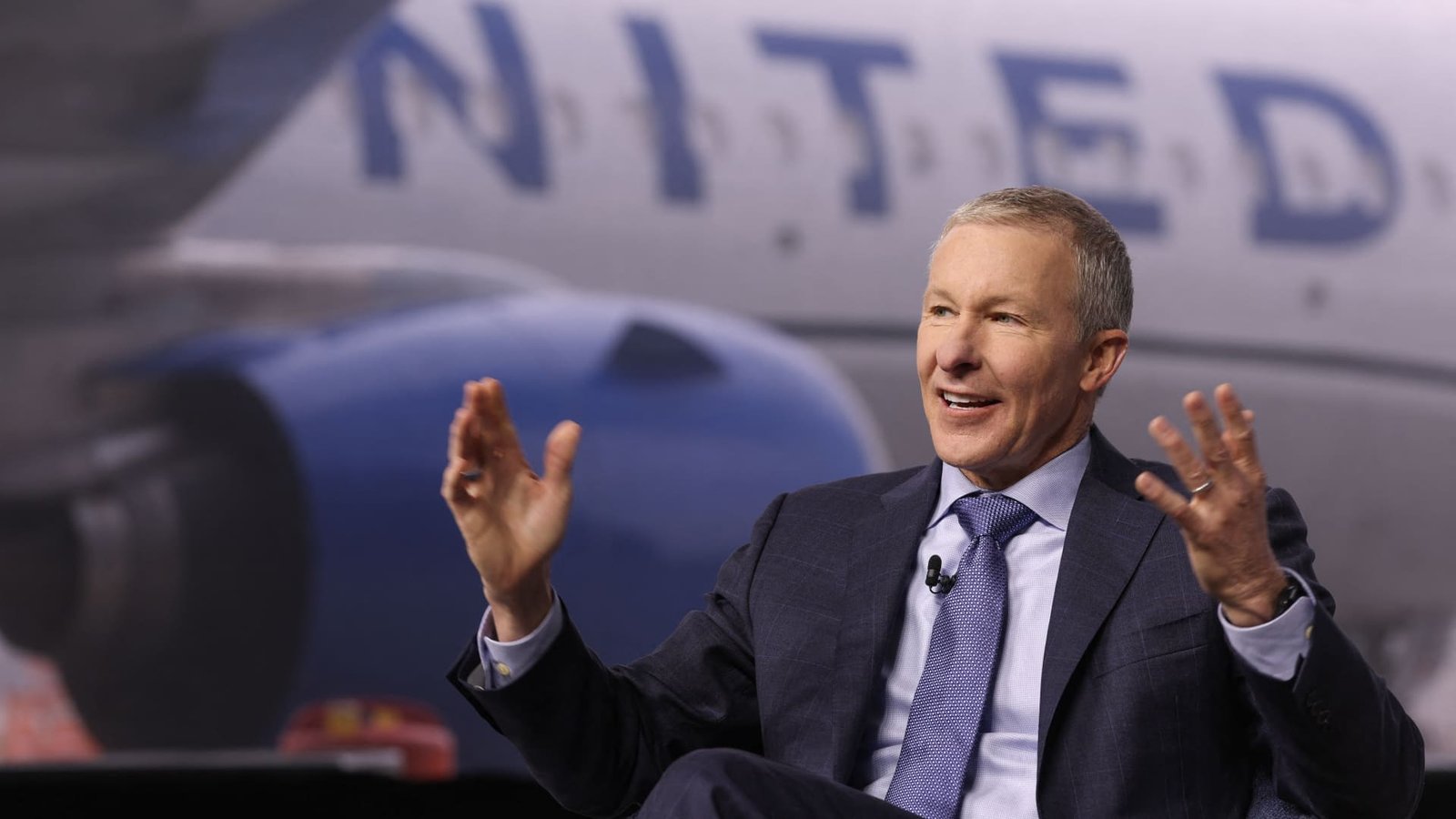
United Airlines CEO Scott Kirby speaks during a media event showcasing the airline’s new premium “Elevated” aircraft interior at Los Angeles International Airport, March 24, 2026.
Patrick T. Fallon | AFP | Getty Images
NEWARK, New Jersey — Scott Kirby says he doesn’t believe in revenge.
“Everyone thinks I do, but no, I don’t,” said the United Airlines CEO, whom American Airlines fired 10 years ago, when he was president of that carrier. “I compete aggressively.”
United announced it had hired him as president on Aug. 29, 2016, a blink after American disclosed his departure. Now, Kirby is running the second-most profitable U.S. airline after Delta Air Lines. And his former employer, American, is a distant third of the big, more-than-century-old, U.S. carriers, though it’s working to ramp up revenue through a host of upgrades, including bringing back seatback screens.
Kirby floated the idea of megamergers with both Delta and American in the past year, combinations that would bring together some of the biggest airlines in the world. He’s so far been rebuffed, and antitrust experts were skeptical about the possibility.
He’s thinking bigger than he has before as the industry faces ever-higher costs, limited airport infrastructure and a population that’s ready to shell out more to fly — often in the expensive seats — to the next “it” destination.
Eyeing JFK from EWR
United Airlines planes sit on the tarmac at Newark Liberty International Airport in Newark, New Jersey, on March 18, 2026.
Kena Betancur | AFP | Getty Images
CNBC rode with Kirby from the west side of Midtown Manhattan to United’s hub at Newark Liberty International Airport in New Jersey earlier this month, where the 59-year-old executive outlined his vision for the carrier before his flight.
Kirby said he wants to expand United’s footprint at New York’s John F. Kennedy International Airport after his airline returns to the congested airport through a partnership with American’s former partner, JetBlue Airways, as early as next year.
“We got a bunch of irons in the fire to try to find ways to do it,” he said, adding that United could at some point acquire slots from carriers that aren’t flying profitable routes out of the airport.
And while United already holds the crown among U.S. airlines for international flights, which are in high demand among U.S. tourists, he wants to expand the carrier’s footprint abroad even more. This week, United is set to announce a host of new international routes, the carrier’s annual splash that has previously included new dots on the map like Ulaanbaatar, Mongolia and Bilbao, Spain.
United has been touting its international expansion for years, saying its vast network acts as a driver for customer loyalty and sign-ups for lucrativetravel rewards credit cards. Its route announcements typically come with much fanfare.
Kirby, a three-decade airline executive, is the United States’ most outspoken airline CEO. His team knows this, and they’ve stopped telling him well in advance what will be on tap for the next batch of Instagram-friendly routes.
“They no longer tell me in advance because they’re afraid I’ll spill the beans, which is fair,” he said.
While Delta has still had a lead on profits, CEO Ed Bastian doesn’t want to give up ground to United. It is starting to expand flights over the Pacific, a United stronghold.
“People say, ‘Well, when is it someone else’s turn?’ Well, I’m never going to let that be someone else’s turn. It’s always our turn,” Bastian told students at Columbia Business School in April 2024. “We always get a chance to prove it every single day. … Yesterday really doesn’t matter. It’s only today and tomorrow that you can think about.”
1 minute break
United Airlines CEO Scott Kirby speaks during a joint press event with Boeing at the Boeing manufacturing facility in North Charleston, South Carolina, on December 13, 2022.
Logan Cyrus | AFP | Getty Images
It’s been a decade since Kirby started at United. He joined the airline in August 2016 after he was let go by American when he was president and didn’t have a path to eventually becoming CEO.
United dropped a securities filing just after American disclosed Kirby’s departure, saying he would be taking the president role at the Chicago airline. American promoted then-Chief Operating Officer Robert Isom to president that day, Kirby’s old role. Isom was named American’s next CEO in late 2021.
“I joke that most people take a few weeks, a couple months between jobs. I took 60 seconds,” Kirby said.
United promoted Kirby to CEO from president in May 2020, while the industry was reeling from Covid, its worst-ever crisis.
The executive ranks at the tops of United and American trace their roots back to America West and other airlines, before a wave of mergers over the past two decades left four carriers holding more than three-quarters of U.S. flight capacity.
“One of the things also I learned at American: There’s only so much change you can make as the No. 2,” he said. “You can push too hard and you get fired.”
United was in the midst of upgrading its cabins when Kirby joined in 2016, including with its highest-end Polaris pod seats for long-haul business class. But he said his first order of business was going through money-losing routes with a highlighter to figure out what was working and what wasn’t.
The company considered closing its bases at Los Angeles International Airport and Washington Dulles International Airport in Virginia. Kirby said he stopped that idea, and both stayed open.
The airports are critical for United. LAX is one of the airline’s most important hubs, though no carrier has a handle on that airport like they do others. And Kirby took a day trip from his son’s soccer camp in Brazil last month to fly up to meet with President Donald Trump to unveil a $22.5 billion revamp of Dulles in the Oval Office.
AI, mergers and the future of travel
Stock analysts and legal experts were highly skeptical about a merger between United and one of the other U.S. giants.
People familiar with the matter said Kirby approached Delta but was turned down, as The Wall Street Journal first reported last month. The people spoke on the condition of anonymity to discuss the talks. Delta declined to comment. The carrier’s president, Peter Carter, told CNBC at an industry conference in June that he doesn’t see a merger or acquisition in Delta’s future.
American, meanwhile, publicly rejected a merger offer from United this spring.
“At the end of the day, we spend time looking at things that have a chance of happening. We don’t spend a lot of time pursuing impossibilities,” Isom told CNBC in an interview in late June.
Kirby told CNBC that he hasn’t changed his stance and he’s not interested in acquiring a smaller airline, like JetBlue. “That’s still the case,” he said.
“Everything I say would require a willing partner,” Kirby said.
When asked about antitrust concerns and likely pushback from state attorneys general, he said, “All of the objections are … based on a premise that the airline industry is a commodity.”
And Kirby said the industry has since evolved and that Delta and United have differentiated themselves, with their routes, onboard cabins and other products.
He said he wants United to grow in South America and in the Southeast U.S., but there’s a lack of places to build out new hubs that make sense.
“Those are two places that are holes for United that are hard to fix on a stand-alone basis,” Kirby said.
The best place for serving South America is Miami International Airport, he added. American had a more than 60% share of passenger enplanements in the 2025 fiscal year, according to airport data.
Putting mergers aside, Kirby said artificial intelligence tools for both employees and customers will make traveling easier and improve reliability, a tall order for any airline that is susceptible to weather, constrained airports and a host of other daily surprises from mechanical problems.
He wants delays expressed in clear English to customers.
“I firmly believe in no excuses, and so we don’t make excuses,” he said.
Even still, in the first half of the year, United ranked behind Delta and Alaska Airlines, which recently merged with Hawaiian Airlines, for on-time arrivals, according to the Transportation Department.
Kirby said outside factors or outright crises will always challenge the industry and said he is focused on the long-term future of the airline.
“Our employees often ask me like, ‘What keeps you awake at night,’ and I tell them, ‘nothing,'” he said. “My job is to set the company up so none of you ever have to have a sleepless night worrying about your jobs.”
He said his goal is to never have another furlough at the airline.
When asked if he would retire eventually, Kirby said, “I hope I will know when to retire and do it gracefully with a great transition with great people.”
About The Author