- The Japanese Yen attracts buyers for the second straight day amid reviving safe-haven demand.
- A modest USD downtick drags USD/JPY further away from a multi-week high touched on Friday.
- The BoJ’s dovish pause might cap JPY gains as the focus shifts to the FOMC meeting this week.
The Japanese Yen (JPY) retains its positive bias for the second straight day, which, along with the emergence of fresh US Dollar (USD) selling, drags the USD/JPY pair to the 144.00 mark during the Asian session on Monday. Against the backdrop of the uncertainty surrounding US President Donald Trump’s tariffs, renewed geopolitical risks overshadow signs of easing US-China trade tensions and benefit the safe-haven JPY.
However, the Bank of Japan’s (BoJ) dovish pause last Thursday might hold back the JPY bulls from placing aggressive bets. Investors might also refrain from positioning for deeper USD losses and opt to move to the sidelines ahead of the crucial two-day FOMC policy meeting starting on Tuesday. This, in turn, warrants some caution before positioning for an extension of the USD/JPY pair’s pullback from a multi-week top.
Japanese Yen bulls retain intraday control as geopolitical risks underpin safe-haven assets
- China said last week it was evaluating the possibility of trade talks with the US, fueling hopes for the potential de-escalation of tensions between the world’s two largest economies. US President Donald Trump announced on Sunday a 100% tariff on all foreign-produced movies.
- Israeli Prime Minister Benjamin Netanyahu vowed to retaliate against Yemen’s Iran-aligned Houthi rebels firing a missile that landed near the Ben-Gurion Airport. In response, Iran’s Defence Minister Aziz Nasirzadeh said that Tehran would strike back if the US or Israel attacked.
- Russian President Vladimir Putin said in remarks published on Sunday that Russia had sufficient strength and resources to take the war in Ukraine to its logical conclusion. This keeps the geopolitical risk in play and drives safe-haven flows toward the Japanese Yen on Monday.
- The Bank of Japan surprised with dovish guidance last Thursday and forced investors to scale back their bets for a rate hike in June or July. However, the broadening inflation in Japan and prospects of sustained wage hikes keep the door open for further policy tightening by the BoJ.
- The US Dollar struggles to capitalize on Friday’s modest bounce that followed the upbeat US jobs data, which showed that the economy added 177K new jobs in April against 130K expected. Other details of the report showed that the Unemployment Rate remained unchanged at 4.2.
- The data pointed to a still resilient US labor market despite heightened economic uncertainty on the back of Trump’s tariffs and concerns about renewed price pressures. Traders pushed back their expectations about the resumption of the Federal Reserve’s rate-cutting cycle to July from June.
- This, however, still marks a big divergence in comparison to expectations for additional rate hikes by the BoJ in 2025 and should act as a tailwind for the lower-yielding JPY. The market focus now shifts to a two-day FOMC monetary policy meeting starting on Tuesday.
USD/JPY could accelerate the downfall once 143.75-143.70 immediate support is broken decisivel
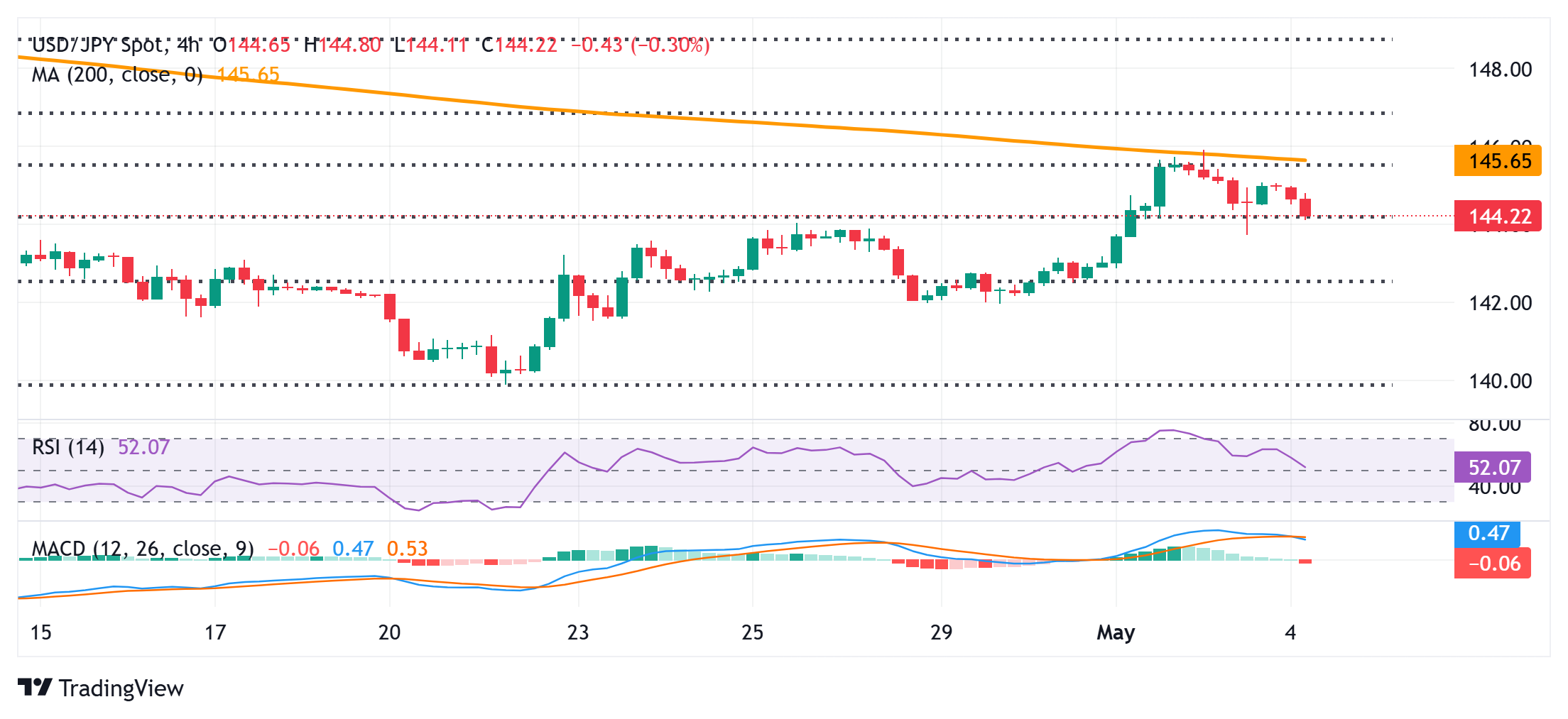
From a technical perspective, the USD/JPY pair last week struggled to find acceptance above the 50% Fibonacci retracement level of the March-April downfall and faced rejection near the 200-period Simple Moving Average (SMA) on the 4-hour chart. This makes it prudent to wait for some follow-through buying beyond the 146.00 mark before positioning for an extension of the recent goodish recovery move from a multi-month low. Spot prices might then climb to the 146.55-146.60 intermediate resistance before aiming to test the 61.8% Fibo. level, around the 147.00 neighborhood.
Meanwhile, oscillators on the daily chart still hold in positive territory, suggesting that any subsequent fall below the 144.00 mark might still be seen as a buying opportunity. This should help limit the downside near Friday’s swing low, around the 143.75-143.70 region, which if broken could make the USD/JPY pair vulnerable. The subsequent slide could drag spot prices to the 143.30 intermediate support en route to the 143.00 round figure and the 23.6% Fibo., around the 142.65 region.
Risk sentiment FAQs
In the world of financial jargon the two widely used terms “risk-on” and “risk off” refer to the level of risk that investors are willing to stomach during the period referenced. In a “risk-on” market, investors are optimistic about the future and more willing to buy risky assets. In a “risk-off” market investors start to ‘play it safe’ because they are worried about the future, and therefore buy less risky assets that are more certain of bringing a return, even if it is relatively modest.
Typically, during periods of “risk-on”, stock markets will rise, most commodities – except Gold – will also gain in value, since they benefit from a positive growth outlook. The currencies of nations that are heavy commodity exporters strengthen because of increased demand, and Cryptocurrencies rise. In a “risk-off” market, Bonds go up – especially major government Bonds – Gold shines, and safe-haven currencies such as the Japanese Yen, Swiss Franc and US Dollar all benefit.
The Australian Dollar (AUD), the Canadian Dollar (CAD), the New Zealand Dollar (NZD) and minor FX like the Ruble (RUB) and the South African Rand (ZAR), all tend to rise in markets that are “risk-on”. This is because the economies of these currencies are heavily reliant on commodity exports for growth, and commodities tend to rise in price during risk-on periods. This is because investors foresee greater demand for raw materials in the future due to heightened economic activity.
The major currencies that tend to rise during periods of “risk-off” are the US Dollar (USD), the Japanese Yen (JPY) and the Swiss Franc (CHF). The US Dollar, because it is the world’s reserve currency, and because in times of crisis investors buy US government debt, which is seen as safe because the largest economy in the world is unlikely to default. The Yen, from increased demand for Japanese government bonds, because a high proportion are held by domestic investors who are unlikely to dump them – even in a crisis. The Swiss Franc, because strict Swiss banking laws offer investors enhanced capital protection.
About The Author