- Gold price rallies more than 2% on Monday with nervousness towards the Fed interest-rate decision.
- Geopolitical risks coming from Trump and Israel are pushing investors back into Gold.
- Upside risks persist and are squeezing out short sellers of the precious metal.
Gold (XAU/USD) rises by more than 2% on Monday to $3,310 at the time of writing, with traders fleeing to safe assets after an eventful weekend on the geopolitical front. The Houthi attack that hit Ben Gurion airport this weekend and Israel’s promise to retaliate while preparing for a broad ground offensive in Gaza are elevating risks again in the region. Meanwhile, US President Donald Trump said that military action might be an option to consider for the US to seize control of Greenland.
Gold’s appeal increases as traders brace for the Federal Reserve’s rate decision on May 7. Over the weekend, Trump expressed his dislike again of the Fed and its Chairman Jerome Powell. After calling Powell “stiff”, the US President called upon the Federal Open Market Committee (FOMC) members to pressure Chairman Powell to deliver rate cuts.
According to the Chicago Mercantile Exchange (CME) Fedwatch tool, no rate cut is foreseen for this Wednesday. Given the recent Nonfarm Payrolls print and the latest string of data from sectors such as Manufacturing and Services, the US economy is starting to ease, but is not crashing. This could be ammunition for Fed Chairman Powell to push against the political pressure and channel to markets that rates will stay steady for longer until the Fed is comfortable enough to lower them..
Daily digest market movers: Sector consolidation
- Several Asian markets are closed for a public holiday on Monday. The United Kingdom is closed as well.
- In the Gold mining sector, some takeover news with Gold Road Resources agreeing to be bought for $3.7 billion after South African suitor Gold Fields sweetened its offer, concluding a public spat between the joint venture partners, Financial Review reports.
- The CME FedWatch tool shows the chance of an interest rate cut by the Federal Reserve in May’s meeting stands at 5.2% against a 94.6% probability of no change. The June meeting sees a 46.6% chance of a rate cut.
Gold Price Technical Analysis: Washout
Bullion is sprinting higher on Monday, while the Greenback dipped lower at the start of the trading day. The communication vessels synergy between the two assets comes just a few days ahead of the Fed rate decision. Generally, steady or higher rates are bad for Gold as the returns from interests in bonds are more attractive than the return from Gold. However, there might be a breakout in that narrative: if rates remain elevated at current levels, the US economy could weaken further, contract and trigger stagflation or recession, and Gold is a better positioned hedge to withstand that scenario.
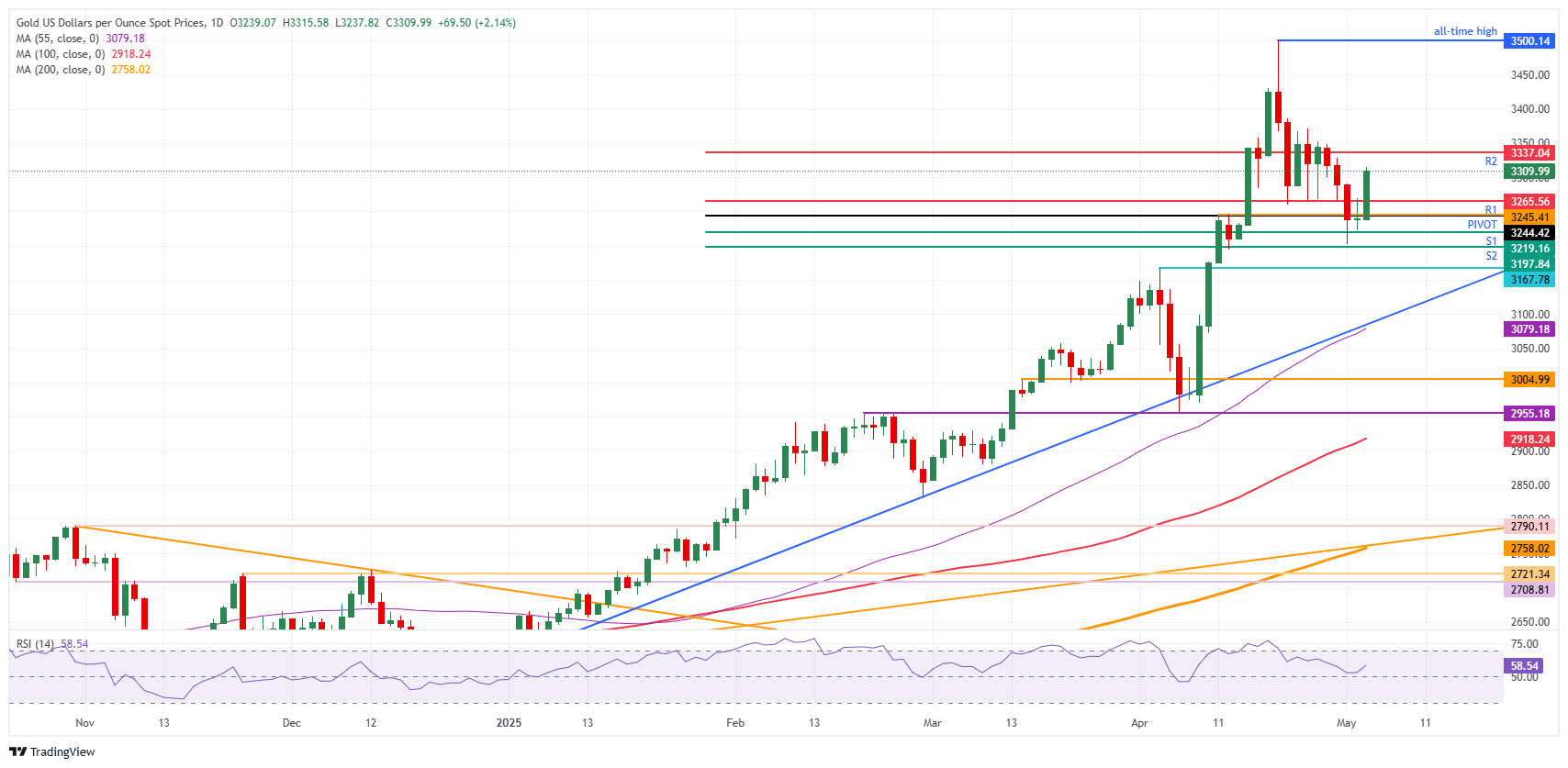
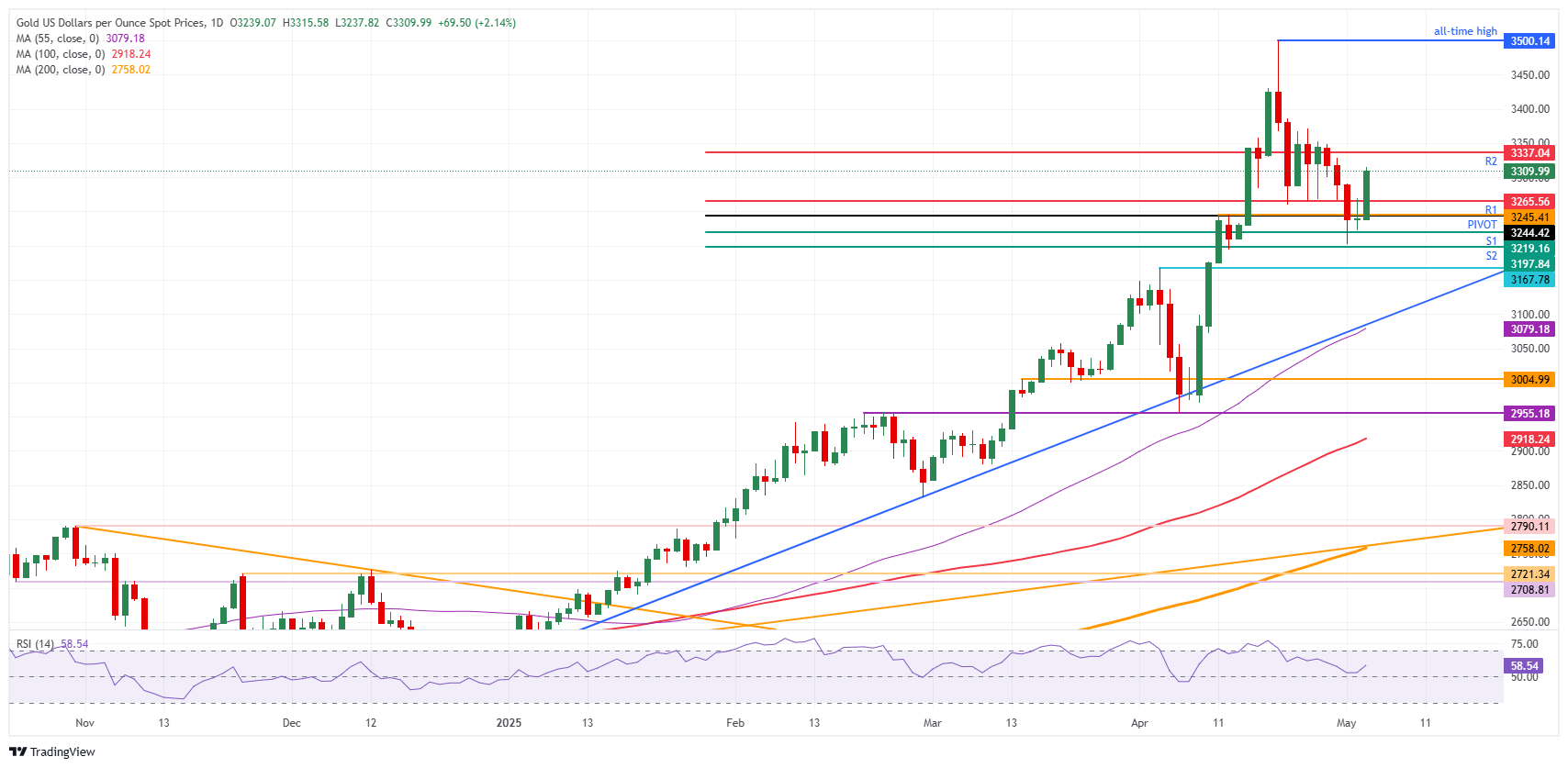
On the upside, the R1 resistance at $3,265 has already been broken in a topside test in early trading this Monday. Should some follow-through come, the R2 at $3,337 might be a bit too far off. Rather look for $3,290 (May 1 high) and $3,320 (April 30 high) as intermediary levels nearby for upside resistance.
On the downside, pivot at $3,244 together with the technical level at $3,245 should do the trick and hold. In case Bullion dips further, very close supports are present near $3,219 S1 intraday support and $3,197 S2 intraday support for Monday.
XAU/USD: Daily Chart
US-China Trade War FAQs
Generally speaking, a trade war is an economic conflict between two or more countries due to extreme protectionism on one end. It implies the creation of trade barriers, such as tariffs, which result in counter-barriers, escalating import costs, and hence the cost of living.
An economic conflict between the United States (US) and China began early in 2018, when President Donald Trump set trade barriers on China, claiming unfair commercial practices and intellectual property theft from the Asian giant. China took retaliatory action, imposing tariffs on multiple US goods, such as automobiles and soybeans. Tensions escalated until the two countries signed the US-China Phase One trade deal in January 2020. The agreement required structural reforms and other changes to China’s economic and trade regime and pretended to restore stability and trust between the two nations. However, the Coronavirus pandemic took the focus out of the conflict. Yet, it is worth mentioning that President Joe Biden, who took office after Trump, kept tariffs in place and even added some additional levies.
The return of Donald Trump to the White House as the 47th US President has sparked a fresh wave of tensions between the two countries. During the 2024 election campaign, Trump pledged to impose 60% tariffs on China once he returned to office, which he did on January 20, 2025. With Trump back, the US-China trade war is meant to resume where it was left, with tit-for-tat policies affecting the global economic landscape amid disruptions in global supply chains, resulting in a reduction in spending, particularly investment, and directly feeding into the Consumer Price Index inflation.
About The Author