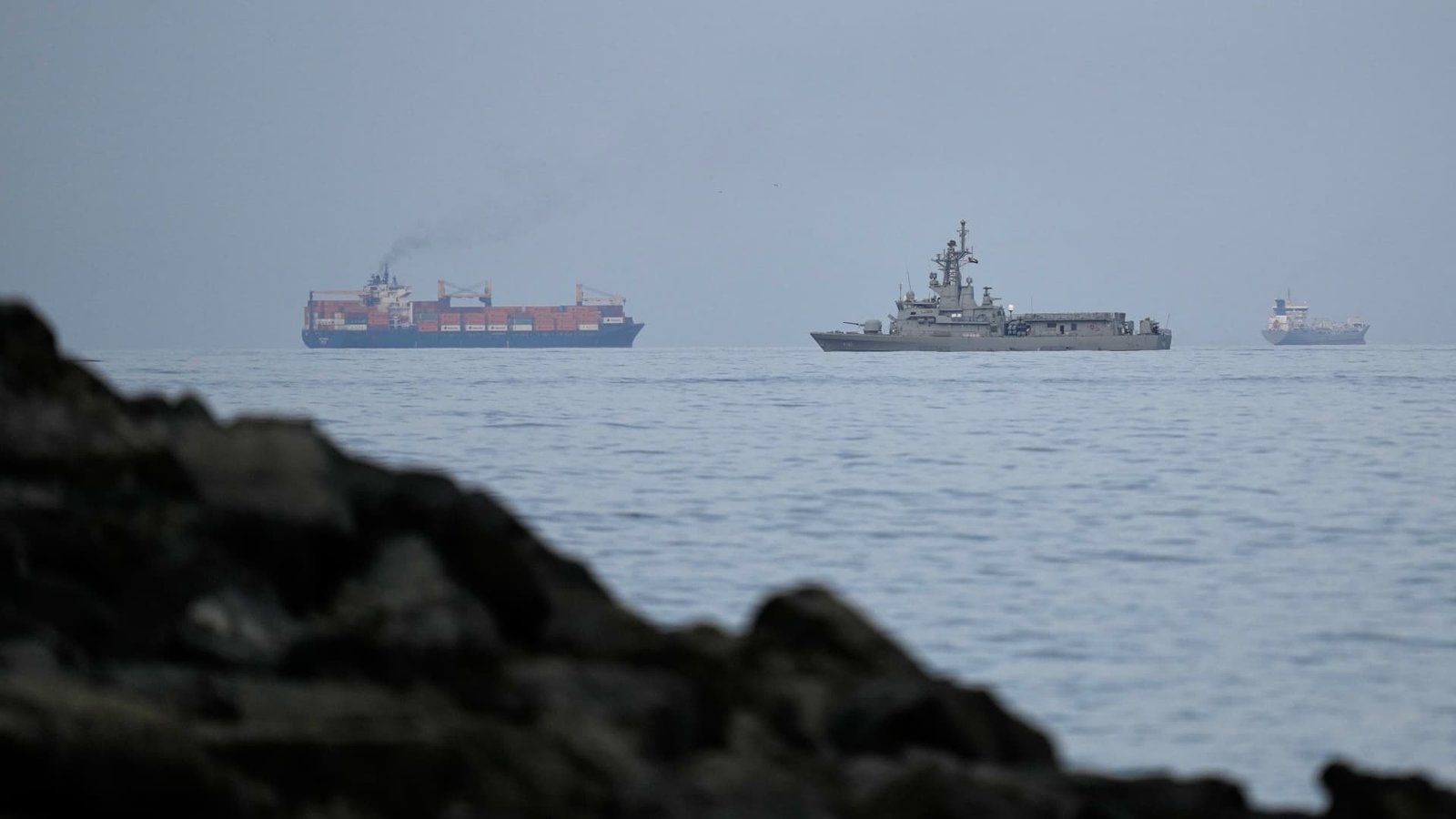
A UAE navy ship sails next to a cargo ship in the Strait of Hormuz as seen from Khor Fakkan, United Arab Emirates, Wednesday, March 11, 2026.
Altaf Qadri | AP
Iranian trade has fallen sharply under U.S. sanctions and a naval blockade, President Masoud Pezeshkian said, as Supreme Leader Mojtaba Khamenei urged a reduction in reliance on the U.S. dollar.
“We have had a decrease of between 25% and 35%. Our exports have decreased, but imports have decreased more,” Iranian President Masoud Pezeshkiansaid in an interview late Friday with state TV and according to a Google translation of a Tasnim News transcript. “The decrease in exports is slightly less than the decrease in imports, and imports have decreased significantly.”
“What do these statistics mean? Then some people say that sanctions have no effect at all! I really don’t know what to tell these people,” Pezeshkian was quoted as saying. “I just want to say this, saying that sanctions have no effect is not consistent with these facts.”
Meanwhile, Supreme Leader Mojtaba Khamenei called for greater economic self-reliance in a written message Friday.
“Equally vital is giving special attention to economic growth, boosting production, gradually phasing out the US dollar from playing a pivotal role, and ultimately, making Resistance Economy the central focus,” Mojtaba Khamenei said in a post on X late Friday.
Toughened sanctions campaign kicks off
On Monday, U.S. Treasury Secretary Scott Bessent launched “Operation Economic Outcast,” asanctions campaignaimed at severing all of Iran’s economic ties worldwide.
In one of its first moves, the Treasury Department on Friday proposed cutting off the UAE operations of Egyptian bank Banque Misr from correspondent banking access to U.S. financial institutions over alleged financial ties to Iran.
Treasury proposed revoking Banque Misr UAE’s correspondent banking access to U.S. financial institutions, the department said in a statement.
Banque Misr UAE processed about $1.8 billion over the past two years for 103 companies that are potentially part of Iran’s shadow banking network, according to Treasury.
US Secretary of the Treasury Scott Bessent speaks during a press conference in Washington, DC on Aug. 24, 2026.
Kent Nishimura | AFP | Getty Images
The bank said in a statement Saturday that it iscooperating with relevant authoritiesand added that the regulatory action is limited to its branch in the UAE, which continues to serve its customers.
Iranian crude oil exports are down sharply as the U.S. intensifies economic pressure on Tehran through sanctions and its naval blockade.
Iranian crude oil loaded for export plunged in August, according to data shared Thursday by trade intelligence firm Kpler. The U.S. has increasingly emphasized economic pressure through sanctions and its naval blockade to coerce Tehran into a deal to fully reopen the Strait of Hormuz.
Tehran has loaded about 260,000 barrels per day for export at its ports so far this month, down more than 80% from 1.7 million bpd in August 2025, Kpler reported.
PresidentDonald Trumpreimposed the blockade on July 14 in retaliation for Iran attacking oil tankers transiting the Hormuz Strait. Tehran’s crude loadings are down about 70% in August from 893,000 bpd last month.
Iranian oil reserves
U.S. Central Command said Saturday that as of Aug. 28, its forces have “redirected 82 commercial vessels, disabled 3 and boarded 2 to ensure compliance.”
The Trump administration believes Iran will eventually run out of money and have to capitulate, said Bob McNally, president of Rapidan Energy.
The blockade has been “very effective,” said Matt Smith, director of commodity research at Kpler. It has “walloped Iran’s crude export loadings,” he said. The crude Tehran can load on tankers probably doesn’t make it past the blockade, Smith added.
But Iran’s Ministry of Petroleum said it has enough oil reserves for sale to meet its 2026-2027 budget requirements while bypassing maritime blockades, according to a post on Telegram translated by Google.
It said it has transferred $7.5 billion in proceeds from oil sales over a four-month period to the country’s central bank, enough to cover foreign currency expenditures through early January 2027.
Friday marked six months since the U.S. and Israel launched “major combat operations” in Iran, promptingretaliatory strikeson targets across the Gulf and sparking a new war in the Middle East.
What was initiallyto be a weeks-long conflict has evolved into a standoff that geopolitical analysts say has no end in sight.
The conflict has dragged on for six months, despite early expectations that major fighting would last only weeks, while efforts to reopen the Strait of Hormuz remain unresolved.
About The Author