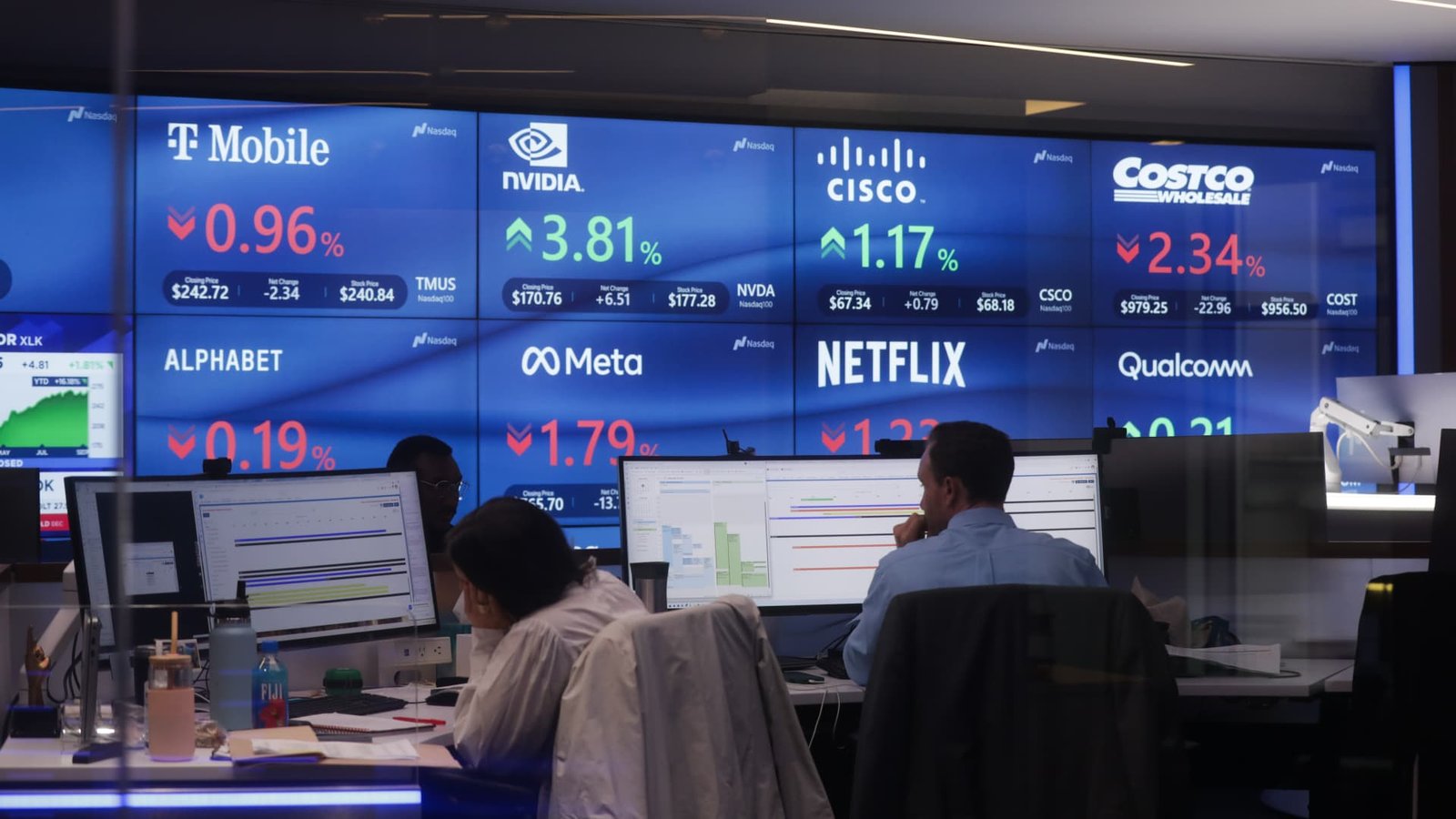
Big Tech is having its worst year since 2022. A recent rise in yields could add even more pressure to the cohort, if history is any indication, according to Barclays. The swath of stocks has underperformed the S & P 500 for 92% of the year to date, Stefano Pascale, Barclays head of U.S. equity derivatives strategy, said Tuesday in a note to clients. At that rate, Big Tech is on pace for one of its worst 12-month periods since 2013, second only to 2022, the strategist found. “Indeed, Big Tech (Mag7 ex-Tesla) has lagged the S & P through the vast majority of 2026,” Pascale said in the note, referring to Alphabet , Amazon , Apple , Meta Platforms , Microsoft and Nvidia . “Our analysis suggests that multiple compression has been the primary driver of Big Tech’s underperformance this year.” The Invesco QQQ Trust was down more than 1% on Tuesday. By comparison, the S & P 500 has shed less than 1% on the day. Megacap tech stocks are once again lagging the overall market as yields climb to their highest levels in years, threatening to compress equity valuation multiples. The key U.S. 10-year Treasury note yield climbed to a session high of 4.8% on Tuesday. Meanwhile, the yield on the 30-year Treasury surged north of 5.2%. US10Y mountain 2025-01-01 The yield on the 10-year Treasury hit a 20-month high on Tuesday. Yields for longer-dated bonds are jumping as the U.S. carried out new strikes in Iran , catapulting energy prices and keeping traders on their toes. In addition, some key U.S. economic data recently came in weaker than expected , contributing to the market jitters. Those conditions have led some investors to predict the Fed will raise rates at its meeting in September , creating a similar setup to that which caused big technology stocks to lag the overall market in 2022, per Barclays. “Importantly, in 2022 Big Tech was viewed as one of the main losers from aggressive Fed tightening and the post-pandemic multiple compression,” Pascale said in his note. However, it is also possible that new AI-linked financing could “ease capital expenditure concerns” that have put pressure on technology stocks, including those of hyperscalers, according to Barclays. “The core thesis is that, over time, this should alleviate concerns around hyperscaler CapEx running ahead of cash flow, while also unlocking demand that otherwise could not be founded,” Pascale said, noting that such a development would be positive for hyperscalers and semiconductors.