Musk warns of overregulation, predicts 20%-30% boom from AI
Elon Musk, chief executive officer of Tesla Inc., speaks virtually during the G20 Innovation Ministerial in Chapel Hill, North Carolina, US, on Tuesday, Sept. 1, 2026.
Cornell Watson | Bloomberg | Getty Images
Elon Musk, the CEO of Tesla and SpaceX, said Tuesday that governments should seek to “make things default legal, not default illegal” to help foster growth, likening new companies to saplings in a forest.
“What most countries tend to do is they tend to provide too much support to the large existing trees in the forest, and not enough to the small saplings,” he said, adding that the regulatory environment “should be generally biased towards supporting” the small trees.
Musk, the world’s richest person, also made several bold predictions on the potential for AI growth and robotics.
“AI will probably increase the global economy by 20% to 30%” he said, adding that in 10 years he expects over a billion humanoid robots out in the world.
—Chris Eudaily
David Sacks says local communities can benefit from data centers

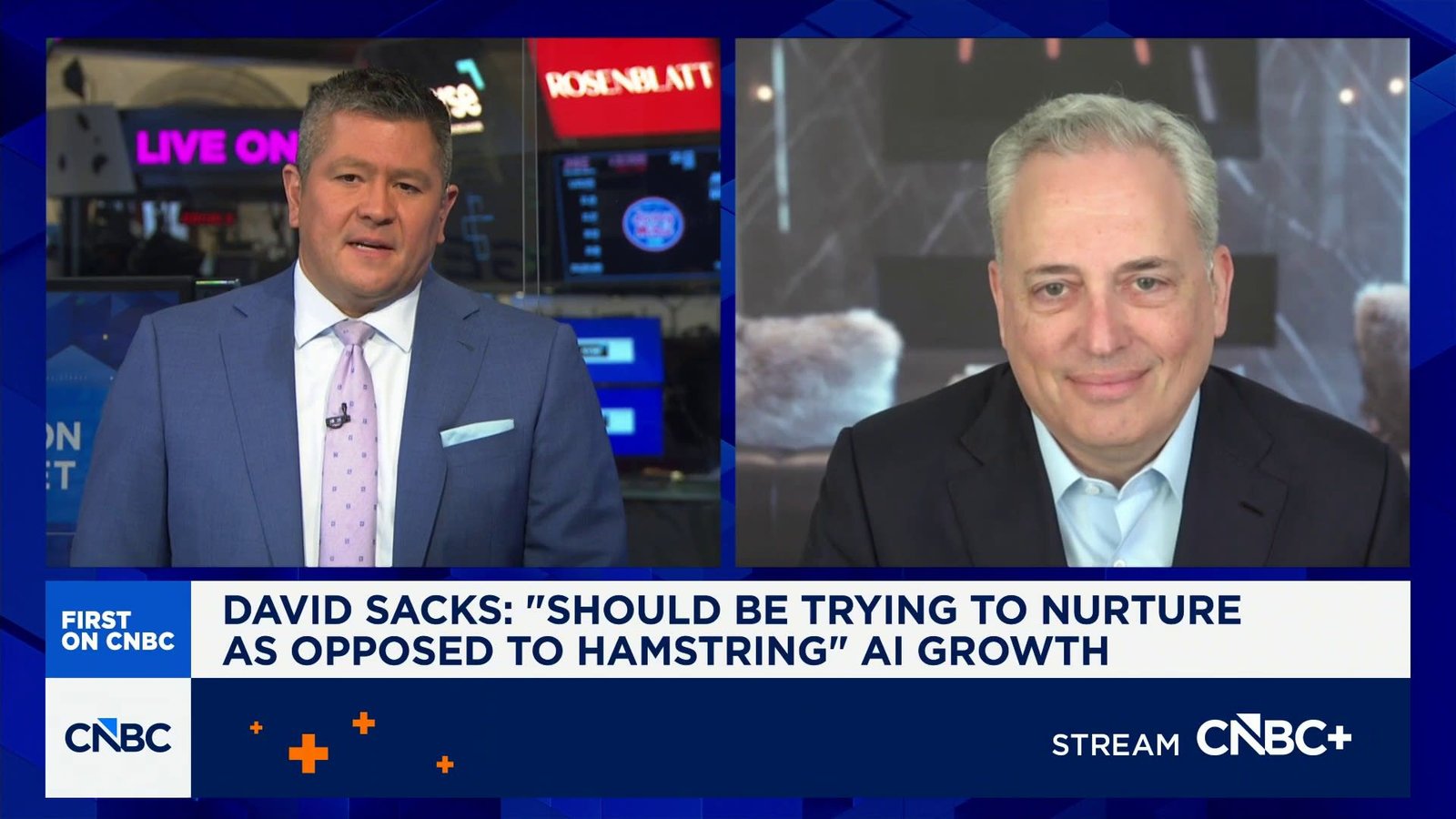
Former White House AI czar David Sacks addressed blowback against the AI data center buildout on Tuesday and said local communities can benefit from the construction projects.
“Data centers, if done right, they bring electricity costs down, not up, because the AI companies will generate net new power generation,” he said. “That’s really the key.”
Sacks, a venture capitalist who is co-chair of the President’s Council of Advisors on Science & Technology, said if the companies are allowed to generate their own power, then excess can be sent back to the grid, bringing costs down. He also said companies can help pay for grid upgrades.
President Donald Trump on Monday blasted opposition to data centers, posting on Truth Social that any locale stonewalling the buildout must “want to end up being backwards and poor.”
Sacks insisted that it’s still a local decision.
“The federal government should not preempt the decision of states with respect to data centers,” he said. “It is fundamentally a local decision, and we respect that and have done nothing to change that.”
—Chris Eudaily
About The Author