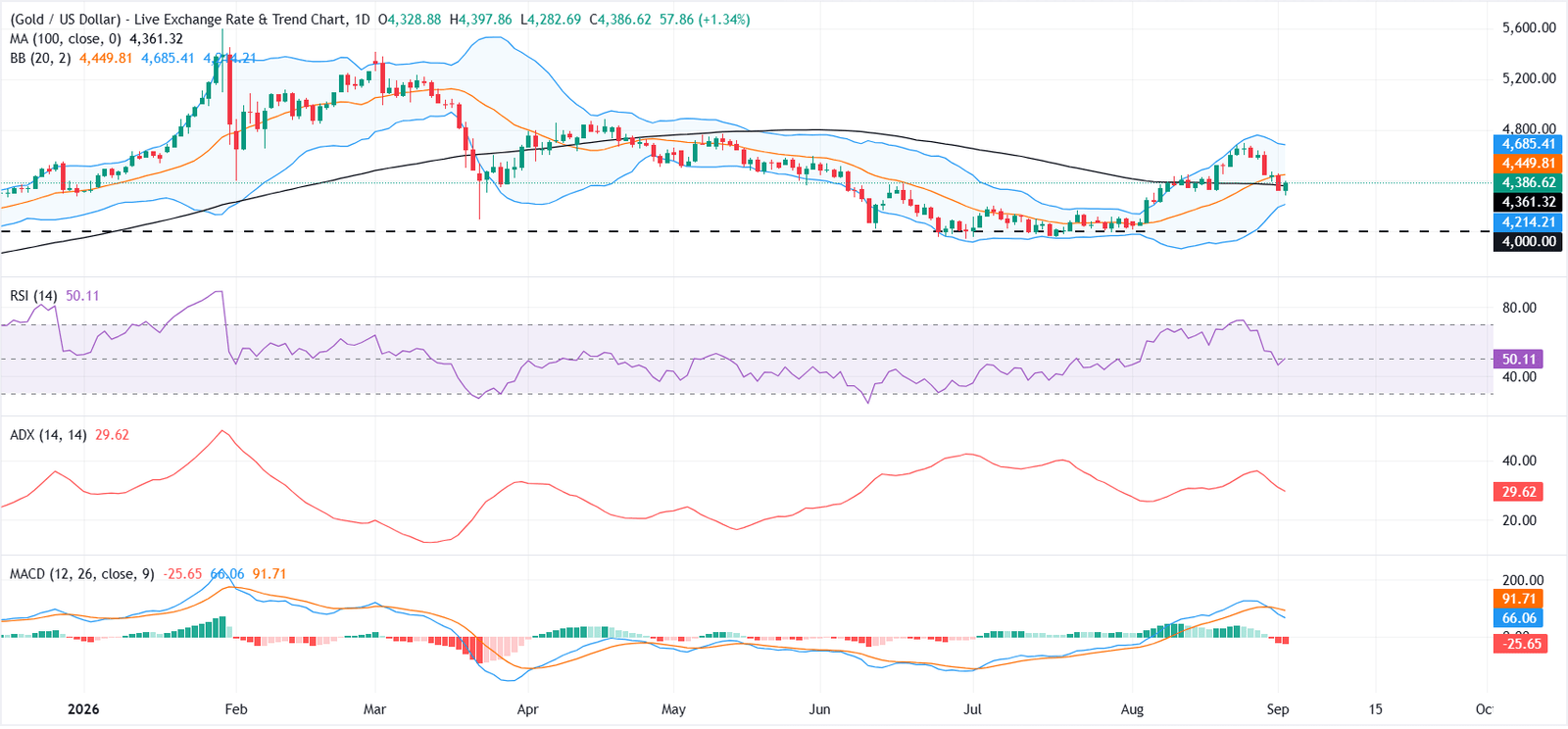
Gold (XAU/USD) stages a sharp rebound on Wednesday, reversing all its earlier losses as a sudden rise in the Japanese Yen (JPY) triggers broad selling pressure on the US Dollar (USD). A pullback in US Treasury yields provides additional support to the precious metal. At the time of writing, XAU/USD trades around $4,386, up nearly 1.34% on the day after hitting an intraday low of $4,282, its lowest level since August 7.
USD/JPY dropped sharply during American trading hours after flirting with the 160 threshold and was last down nearly 0.95% on the day, raising speculation that Japanese authorities may have intervened in the foreign exchange market again. The move was also visible across other Yen pairs, with EUR/JPY, GBP/JPY and AUD/JPY falling sharply. However, there is no official confirmation of intervention.
Weaker-than-expected United States (US) labour market data also weighs on the US Dollar. The ADP Employment Change showed that private-sector payrolls increased by 38K in August, below the 47K forecast and the previous increase of 46K.
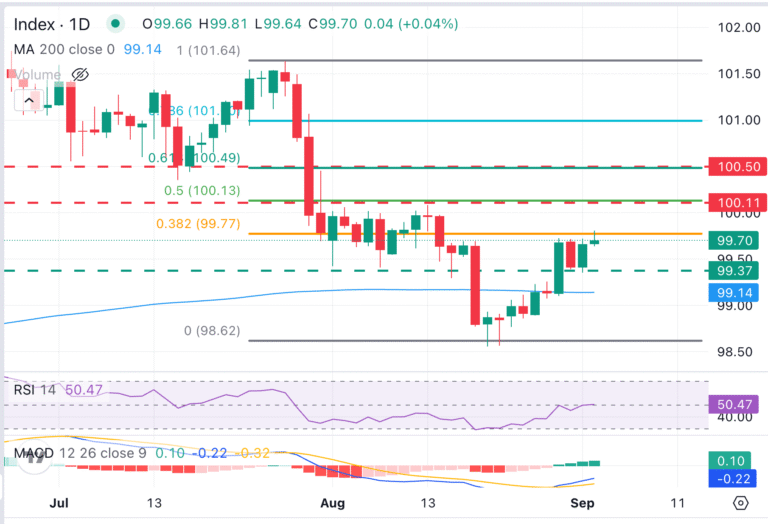
The US Dollar Index (DXY), which tracks the Greenback’s value against a basket of six major currencies, trades around 99.55, down 0.15% after reaching 99.86, its highest level since August 14.
Even so, Gold’s broader outlook remains challenging as the resumption of hostilities in the Middle East after several quieter weeks has sent Oil prices higher, fuelling inflation concerns and a sell-off in global bonds.
Although US Treasury yields ease across the curve on Wednesday, they remain close to recent highs. The benchmark 10-year yield trades around 4.78% after briefly touching 4.81%, its highest level since October 2023. Elevated yields increase the opportunity cost of holding non-yielding Gold.
On the monetary policy front, traders have increased bets that the Federal Reserve (Fed) could raise interest rates as soon as September, particularly after Fed Chair Kevin Warsh adopted a tougher stance on inflation at the Jackson Hole Symposium last week. According to the CME FedWatch tool, the probability of a rate hike at the September 15-16 meeting stands at around 70%, up from 36% a week ago.
Against this backdrop, Gold could retain its recovery in the near term if selling pressure on the US Dollar persists. However, hawkish Fed expectations, elevated Treasury yields and inflation risks linked to the Middle East conflict could limit additional gains. Traders now await Friday’s Nonfarm Payrolls (NFP) report, which could influence Fed rate expectations and drive the next move in the US Dollar, Treasury yields and Gold.
Technical analysis: Bears struggle to break the 100-day SMA support
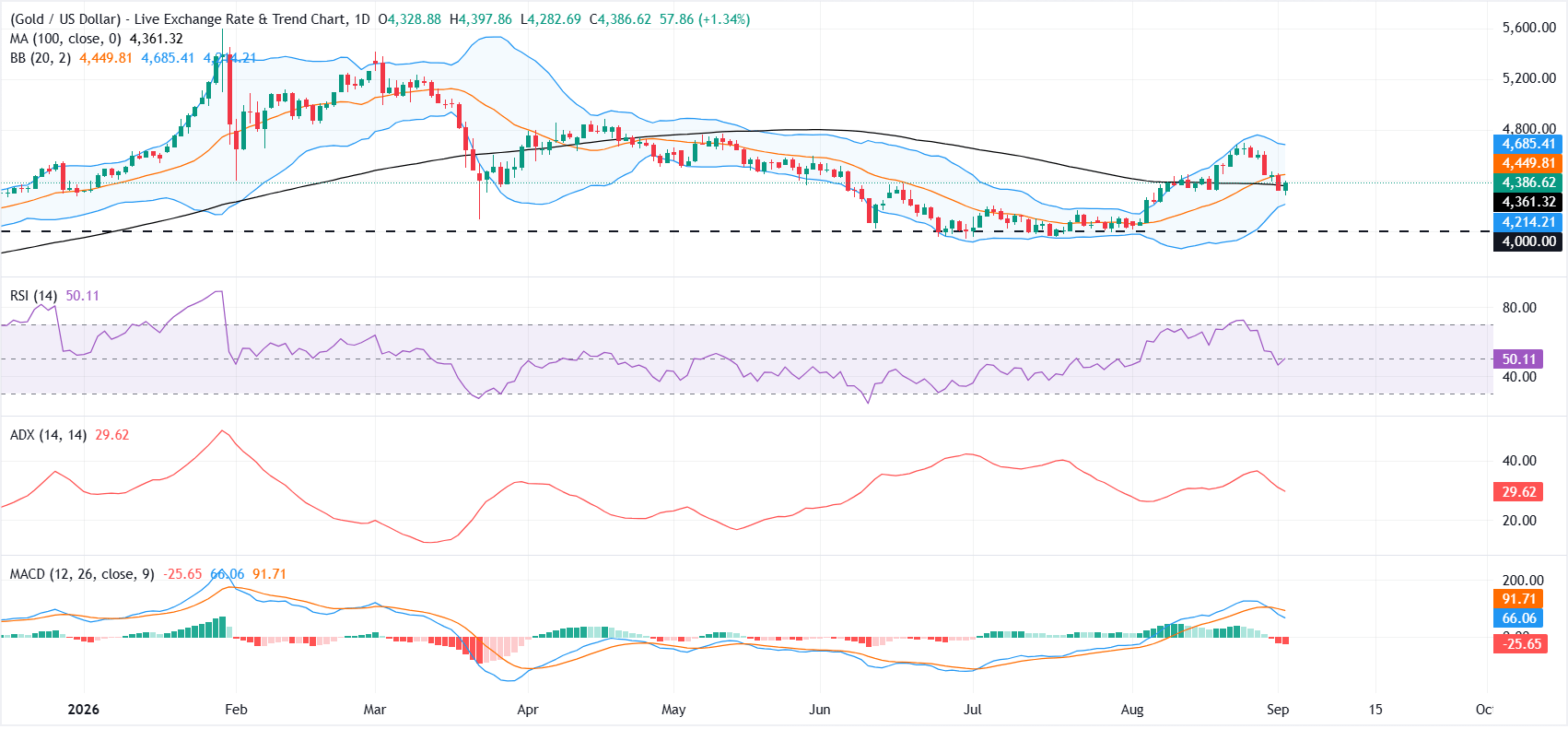
XAU/USD holds just above the 100-day Simple Moving Average (SMA) near $4,361, keeping a fragile downside buffer, while remaining below the Bollinger middle band around $4,450.
The Relative Strength Index (RSI) on the daily chart hovers close to the 50 line, and the Moving Average Convergence Divergence (MACD) histogram sits in negative territory, together suggesting a loss of bullish momentum and reinforcing a broadly neutral, range-bound bias around the current level.
On the topside, initial resistance emerges at the Bollinger 20-period SMA near $4,450, with the upper Bollinger band around $4,685 as the next hurdle if buyers regain control. On the downside, the 100-day SMA at about $4,361 offers immediate support, followed by the lower Bollinger band near $4,215; a deeper slide would expose the more distant horizontal support zone around $4,000 if selling pressure accelerates.
(The technical analysis of this story was written with the help of an AI tool. Know more.)
Gold FAQs
Gold has played a key role in human’s history as it has been widely used as a store of value and medium of exchange. Currently, apart from its shine and usage for jewelry, the precious metal is widely seen as a safe-haven asset, meaning that it is considered a good investment during turbulent times. Gold is also widely seen as a hedge against inflation and against depreciating currencies as it doesn’t rely on any specific issuer or government.
Central banks are the biggest Gold holders. In their aim to support their currencies in turbulent times, central banks tend to diversify their reserves and buy Gold to improve the perceived strength of the economy and the currency. High Gold reserves can be a source of trust for a country’s solvency. Central banks added 1,136 tonnes of Gold worth around $70 billion to their reserves in 2022, according to data from the World Gold Council. This is the highest yearly purchase since records began. Central banks from emerging economies such as China, India and Turkey are quickly increasing their Gold reserves.
Gold has an inverse correlation with the US Dollar and US Treasuries, which are both major reserve and safe-haven assets. When the Dollar depreciates, Gold tends to rise, enabling investors and central banks to diversify their assets in turbulent times. Gold is also inversely correlated with risk assets. A rally in the stock market tends to weaken Gold price, while sell-offs in riskier markets tend to favor the precious metal.
The price can move due to a wide range of factors. Geopolitical instability or fears of a deep recession can quickly make Gold price escalate due to its safe-haven status. As a yield-less asset, Gold tends to rise with lower interest rates, while higher cost of money usually weighs down on the yellow metal. Still, most moves depend on how the US Dollar (USD) behaves as the asset is priced in dollars (XAU/USD). A strong Dollar tends to keep the price of Gold controlled, whereas a weaker Dollar is likely to push Gold prices up.
About The Author