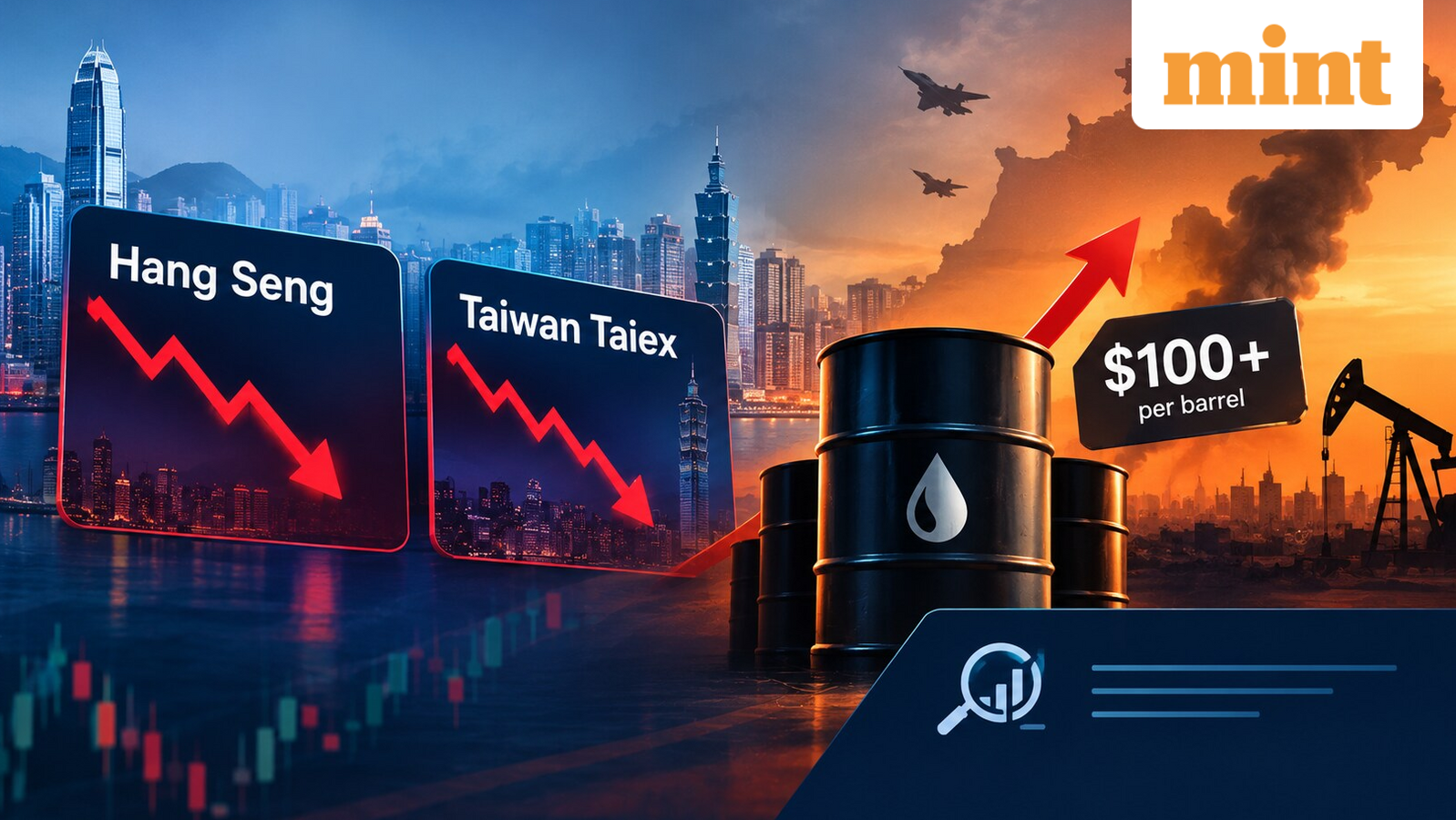
Hong Kong’s Hang Seng index recovered much of its intraday losses during Wednesday’s trade, September 9, but still ended the session in negative territory as rising crude oil prices stoked fears of deeper disruptions to energy supplies amid escalating tensions in the Strait of Hormuz.
Extending its losing streak to a third straight session, the index slipped 0.17% to close at 25,274. For the week so far, it has declined 1.47%. Investors’ attention has now shifted to upcoming major central bank meetings, including the US Federal Reserve’s policy decision, amid concerns over how policymakers could respond to rising energy costs and renewed inflationary pressures.
Oil prices and central bank concerns weigh on sentiment
At the stock level, Hong Kong-listed hotpot chain Haidilao slumped 9% after Bloomberg reported that its co-founder was selling 259 million shares through a family trust holding vehicle. Meanwhile, Lenovo rose 2.1%, MiniMax gained 1.9%, and Kingboard Laminates advanced 3.3%.
The sharp rise in energy costs, driven by supply risks stemming from the Middle East conflict, is also making analysts increasingly cautious about the outlook for China. BofA Securities lowered its growth forecasts for China to 4.2% for 2027 and 4.0% for 2028, while retaining its 2026 growth forecast at 4.5%, Reuters reported.
The impact of higher costs is also beginning to show up in economic data. China’s factory-gate inflation gathered pace in August, while consumer price growth accelerated, even as underlying domestic demand remained subdued.
China’s annual inflation rate rose to 0.8% in August from 0.5% in July. Producer prices also increased 3.8% year-on-year, accelerating from a 3.5% rise in July, partly driven by higher food and energy costs.
Meanwhile, Taiwan’s Taiex also ended 0.47% lower at 47,105 after retreating from its intraday highs, during which it touched a more than two-month high. Taiwanese equities have emerged as among the top performers in Asian markets in 2026, supported largely by strong gains in chip stocks.
Brent crude surges above $100 as Middle East supply risks escalate
International benchmark Brent crude surged past $100 per barrel for the first time in almost six weeks after attacks on oil facilities and ships in the Middle East threatened to further disrupt an already strained global supply chain.
The US military reportedly struck five Iranian tankers in response to attempted missile attacks on a Navy warship, while attacks by an Iranian-backed Houthi rebel group ignited fires at oil facilities in Saudi Arabia, AP reported.
Brent crude futures were last seen trading 2.57% higher at $100.44 a barrel, while US benchmark West Texas Intermediate crude jumped 2.03% to $94.92 a barrel.
Crude oil prices have remained highly volatile since Israel and the United States initiated a war with Iran more than six months ago. The conflict has disrupted most shipping through the Strait of Hormuz, a narrow waterway through which around a fifth of the world’s oil supply passed before the war began.
Brent crude rose from around $70 to $100 a barrel for much of March, April, and May. In July, prices again swung between $72 and $102 a barrel, reflecting shifting hopes that the United States and Iran could reach an agreement that would allow stranded tankers to safely move oil out of the Persian Gulf, according to an AP report.
Disclaimer: We advise investors to check with certified experts before making any investment decisions.
About The Author