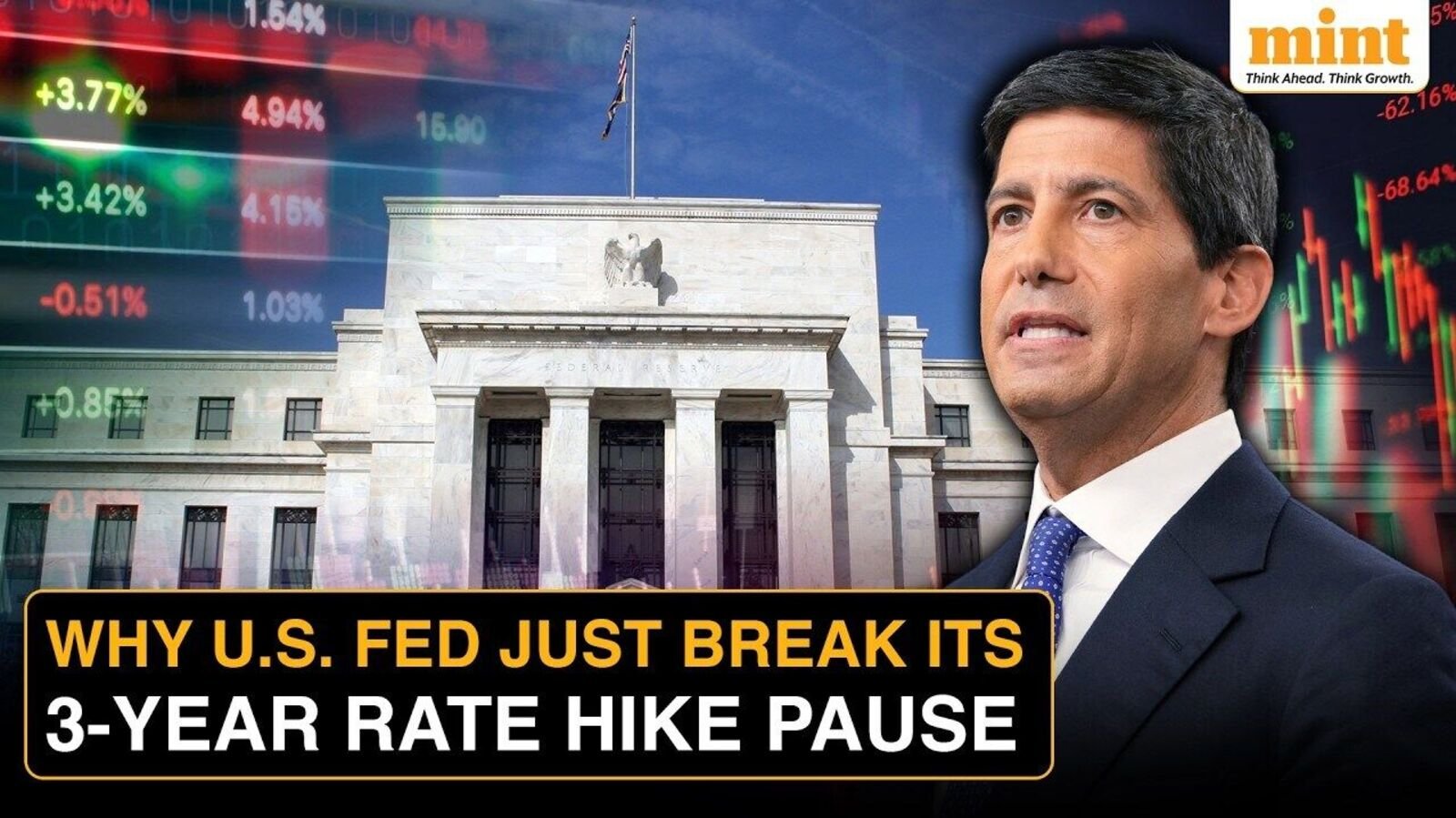
US Fed rate hike impact on Indian banking stocks: The Federal Reserve’s latest interest-rate decision is expected to have implications for Indian markets, with the FOMC’s policy outcome likely to influence the performance of Indian banking stocks.
The US Federal Reserve raised its benchmark interest rate by 25 basis points on Wednesday, taking the federal funds rate to a target range of 3.75%–4%. Policymakers also signalled the possibility of another rate hike later this year.
The rate increase came against the backdrop of persistent inflation, partly fuelled by continuing tensions in the Middle East, while the labour market remained relatively stable. The move marked the central bank’s first rate hike in more than three years.
Market experts believe that the Federal Reserve’s recent 25 basis point rate hike, coupled with a hawkish dot plot signaling another hike in 2026 and a higher long-run neutral rate of 3.25%, delivers an unmistakable message that the higher-for-longer policy regime is here to stay.
US Fed policy impact on RBI
When the US Federal Reserve changes its policy rates, the Reserve Bank of India (RBI) assesses the potential impact on the interest-rate differential, capital flows and currency markets. However, the RBI’s monetary policy decisions are primarily guided by domestic factors, including inflation, economic growth and overall macroeconomic conditions.
According to Seema Srivastava, Senior Research Analyst at SMC Global Securities, the RBI will likely keep domestic rates elevated for longer, pushing any rate-cut cycle into Q2 or Q3 of 2026 to impact consumption and capex sentiment, while growth sectors and premium-valued midcaps face de-rating pressure from global risk-off sentiment.
“Fortunately, India’s domestic structural story remains insulated by robust monthly SIP inflows exceeding ₹22,000 crore, which cushion against foreign selling, alongside continued government capex supporting corporate earnings,” said Srivastava.
US Fed policy impact on Indian banking stocks
Anuj Gupta, SEBI Registeted Research Analyst, said that while the FOMC’s 25-basis-point rate hike is broadly negative for equities in the near term, the sharp rise in the dollar index and bond yields could keep pressure on the broader market.
Gupta further explained that higher rates can also support the banking sector by improving lending yields and margins. Therefore, banking stocks are likely to find some support even as volatility remains elevated across the market.
Meanwhile, Srivastava believes that within this macro landscape, the impact on Indian banking is double-edged yet net positive for large private lenders over the medium term. On the downside, elevated bond yields, tight system liquidity, and expensive external commercial borrowings will trigger mark-to-market losses on treasury portfolios—especially for PSU banks with large HTM or AFS books—while moderating credit offtake slightly.
“On the upside, prolonged higher interest rates will keep net interest margins elevated, allowing tier-1 institutions with expansive CASA bases and floating-rate loan books, such as HDFC Bank, ICICI Bank, and SBI, to reprice loans faster than deposits,” she added.
She further highlighted that resilient global capital investment signals that growth is not collapsing, which supports export-led credit demand and overall asset quality, even though a tail-risk scenario of further Fed hikes and sustained crude above $100 could force RBI action and strain vulnerable unsecured retail and MSME segments. Ultimately, this monetary cycle favors large, well-capitalized banks with strong deposit franchises to act as defensive compounders in a volatile market, while heavily penalizing smaller institutions reliant on wholesale funding.
Disclaimer: This story is for educational purposes only. The views and recommendations above are those of individual analysts or broking companies, not Mint. We advise investors to check with certified experts before making any investment decisions.
About The Author