Most bullion coins celebrate national symbols: eagles, maple leaves, kangaroos. The Austrian Philharmonic draws its identity from culture rather than patriotism. Its design centers on the instruments of the Vienna Philharmonic Orchestra, making it one of the most distinctive precious metals series in the world. Introduced in 1989 by the Austrian Mint, the gold Philharmonic was named the world’s best-selling gold coin by the World Gold Council multiple times and has remained a cornerstone of European bullion investing ever since its debut. Today the series spans gold, silver, and platinum, all sharing the same iconic design. This article will explain the Philharmonic’s design, available sizes across metals, how its premiums compare to competing coins, and why investors worldwide continue to choose it.
The Vienna Philharmonic Orchestra Connection
The Philharmonic coin’s identity is rooted in a deliberate choice to represent Austria through culture rather than politics or monarchy.
A Cultural Institution, Not a Political Symbol
When the Austrian Mint was developing its gold bullion program in the late 1980s, it needed a symbol that was distinctly Austrian but universally appealing. Many sovereign mints default to national emblems (eagles, heads of state, royal imagery etc.) but these carry political connotations that date and localize a coin. The Vienna Philharmonic Orchestra, founded in 1842 and considered one of the finest ensembles in the world, offered something different. Classical music transcends borders and politics in a way that national symbols rarely do, and the orchestra’s global reputation meant the coin’s identity would carry meaning far beyond Austria’s borders.
The Orchestra’s Global Reach

The Musikverein concert hall in Vienna, home of the Vienna Philharmonic Orchestra.
Source: Salute to Vienna
The Vienna Philharmonic has performed at its permanent home, the Musikverein’s Golden Hall in Vienna, since 1870. Its annual New Year’s Concert is broadcast live to more than 90 countries, reaching over 50 million viewers. That level of global recognition gave the Austrian Philharmonic coin an inherent cultural authority from the outset.
Why the Design Works for Bullion
Chief engraver Thomas Pesendorfer designed both sides of the coin around this cultural connection. The obverse features the Great Organ of the Musikverein’s Golden Hall. The reverse depicts an arrangement of orchestral instruments, i.e. the Vienna horn, cello, violins, bassoon, and harp. The design has remained unchanged since 1989, which has become a deliberate part of the coin’s identity. Unlike series that rotate annual designs, the Philharmonic’s consistency means the coin is instantly recognizable regardless of year, an important quality for a liquid bullion product traded across international markets.
Austrian Gold Philharmonic Design and Specifications
The gold Philharmonic’s design tells a complete story across both sides of the coin, and its technical specifications place it among the purest mainstream bullion coins available.
Obverse and Reverse Design
The front of the Austrian gold Philharmonic coin is anchored by the Great Organ of the Musikverein’s Golden Hall, i.e. the ornate pipe organ that has been central to the Vienna Philharmonic’s home venue since 1870. Surrounding the organ, the inscriptions identify the coin as a product of the Republic of Austria and display its weight, purity, face value, and year of issue. The reverse takes the musical theme further, arranging the orchestra’s instruments across the coin’s surface: a cello at center, flanked by four violins, a Vienna horn, a harp, and a bassoon, with “WIENER PHILHARMONIKER” running around the edge. Both sides were designed by chief engraver Thomas Pesendorfer and have been consistent across every year of production since 1989.
For a rare look inside the Austrian Mint’s production facility, watch this CoinWeek video to see how Gold Philharmonic coins are struck, inspected, and packaged from start to finish.
Purity, Face Value, and Legal Tender Status
All gold Philharmonics are struck in .9999 fine gold regardless of size, making them 24-karat coins and among the purest bullion options in mainstream production. That purity level also meets IRS requirements for precious metals IRA inclusion. The Austrian Philharmonic gold coins carry euro face values that correspond to their weight – €100 for the one-ounce, €50 for the half-ounce, €25 for the quarter-ounce, and €10 for the tenth-ounce – giving them legal tender status in Austria and making the Philharmonic one of the few major bullion coins denominated in euros. Prior to 2002, denominations were issued in Austrian schillings, marking the only change to the series since its 1989 debut. As with all bullion coins, the face value is largely symbolic, and the coin’s actual market value is determined by its gold content, which far exceeds its stated denomination.
Austrian Gold Philharmonic Sizes and Weights
The gold Philharmonic launched in 1989 as a one-ounce coin and has expanded steadily since, now offering five options that share identical design and purity across the range.
The 1 oz Austrian Gold Philharmonic
The one-ounce coin is the flagship of the series and the format most investors default to. It offers the lowest percentage premium within the range, the deepest secondary market liquidity, and the most straightforward resale path. For anyone whose primary goal is accumulating gold efficiently, the one-ounce is the logical starting point.
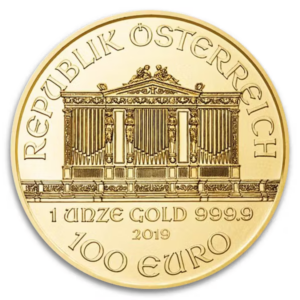
Obverse of the 2019 Austrian Gold Philharmonic one-ounce coin.
The 1/2 oz Gold Philharmonic
Introduced in 1994, the half-ounce provides a middle ground between the full 1 oz gold Austrian Philharmonic and the smaller fractional sizes. It appeals to investors who want meaningful gold content without committing to a full ounce at a time, and works well as part of a diversified size strategy.
The 1/4 oz Gold Austrian Philharmonic
Added in 1991, the quarter-ounce is a practical entry point for newer investors and a popular choice for incremental accumulation. The higher percentage premium relative to the one-ounce is the trade-off for lower upfront cost, a consideration common to all fractional bullion.
The 1/10 oz Gold Austrian Philharmonic
Also introduced in 1991, the tenth-ounce is the most accessible size in terms of outright cost. It is frequently purchased as a gift, used to introduce new buyers to physical gold, or held as a small emergency reserve. The premium per ounce is the highest in the standard range, but for buyers prioritizing flexibility over cost efficiency it remains a practical choice.
The 1/25 oz Gold Philharmonic
Introduced in 2014 as a 25th anniversary Austrian gold Philharmonic coin and appearing in subsequent issues since, the 1/25-ounce is the smallest format in the series. At roughly 1.24 grams of gold, it is primarily a gifting and collector coin rather than an accumulation vehicle. Its appeal lies in the combination of the Philharmonic’s recognized design at an ultra-accessible price point.
Special and Limited Editions [
The Austrian Mint has also produced notable special editions outside the standard range. For the coin’s 15th anniversary in 2004, it struck just 15 examples of a 1,000-ounce “Big Phil” with a face value of €100,000. A 20-ounce version followed for the 20th anniversary in 2009, limited to just over 6,000 pieces. These collector pieces sit well outside the mainstream market but illustrate the cultural weight the series carries within Austrian numismatics.

Chief engraver Thomas Pesendorfer with the 2004 Big Phil commemorative gold coin.
Source: Coins Weekly
Austrian Philharmonic Silver Coins
Nearly two decades after the Austrian Philharmonic gold coin’s debut, the Austrian Mint expanded the series into silver, bringing the same iconic design to a significantly more accessible price point.
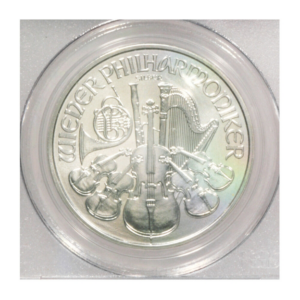
Reverse of the Austrian Silver Philharmonic coin showing orchestral instruments.
Source: PCGS
Specifications and Design
Introduced in February 2008, the Austrian silver Philharmonic is struck in one troy ounce of .999 fine silver and carries a face value of €1.50, making it legal tender in Austria. The design is identical to the gold version, featuring the Musikverein pipe organ on the obverse and the orchestral instruments on the reverse, with “SILBER” added to the inscription to distinguish it from the gold and platinum coins. Unlike the gold series, the Austrian silver Philharmonic coin is produced in a single size only.
Market Reception and Popularity
The Austrian silver Philharmonic found its audience quickly. In its first year alone, the Austrian Mint struck nearly 7.8 million coins, and over the five-year period from 2008 to 2012, total sales reached approximately 54 million coins. It has since established itself as one of the most widely sold silver bullion coins in continental Europe, competing directly with the American Silver Eagle and Canadian Maple Leaf in the global market.
Why Investors Choose the Austrian Silver Philharmonic
For new investors, the Silver Austrian Philharmonic coin offers the most accessible entry point into the series: the same recognized design and Austrian Mint quality at a fraction of the cost of gold. European buyers in particular tend to favor it as a domestic product, and its strong regional distribution means it is widely available through local dealers with competitive premiums. The coin is also IRA eligible in the United States, meeting the .999 fine silver purity requirement, which extends its appeal beyond the European market to American investors building precious metals retirement accounts.
Austrian Platinum Philharmonic (Limited Production)
The platinum Philharmonic is the most recent addition to the series, introduced in 2016 as the Austrian Mint’s first platinum bullion coin.
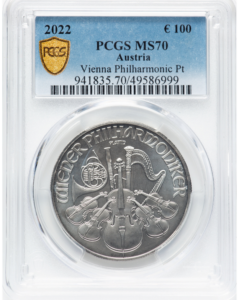
2022 Austrian Platinum Philharmonic coin graded PCGS MS70.
Specifications and Availability
The platinum Philharmonic is produced in one troy ounce of .9995 fine platinum and carries a face value of €100, the same denomination as the one-ounce Austrian Philharmonic gold coin. The design is identical to the gold and silver versions, with “PLATIN” added to the reverse inscription. Production varies year to year based on demand, and availability is generally more limited than the gold and silver coins. For investors specifically seeking platinum exposure within a recognized sovereign bullion framework, the Philharmonic is one of the few options that combines government backing, euro denomination, and an established international distribution network.
Premium Analysis and Pricing
The Philharmonic competes directly with the world’s most liquid sovereign bullion coins, and its premium structure reflects that positioning.
Gold Philharmonic Premiums
For the one-ounce gold Philharmonic, premiums typically run in the range of 3 to 6 percent over spot at major dealers, placing it broadly in line with the Canadian Maple Leaf and South African Krugerrand. The American Gold Eagle generally carries a slightly higher premium in the U.S. market due to stronger domestic recognition, meaning the Philharmonic often represents a marginally more cost-efficient option for investors who are not tied to American-origin coins. As with all bullion coins, fractional sizes carry progressively higher percentage premiums: the tenth-ounce commands meaningfully more per gram than the full ounce, which is a consistent feature across the entire sovereign bullion market rather than specific to the Philharmonic.
European Market Dynamics
In Europe, where the Philharmonic is most deeply distributed, its pricing advantage over North American alternatives is more pronounced. Local dealer networks mean lower distribution costs and tighter spreads, and the euro denomination removes any currency conversion friction for buyers operating in eurozone countries. In most European countries, gold bullion coins including the Philharmonic are traded VAT-free, while the Austrian Philharmonic silver coin is subject to a reduced VAT rate – a tax consideration that affects the effective cost of ownership and is worth understanding before making a purchase decision.
Global Pricing and Availability
Outside Europe, the Philharmonic is widely available through international bullion dealers and recognized in major markets including Japan, North America, and Asia more broadly. Its global distribution network, established through the Austrian Mint’s long-standing dealer relationships, means the Austrian Philharmonic coin is generally liquid in any major market. That said, in the United States it is less commonly stocked than the American Gold Eagle or Canadian Maple Leaf, which can occasionally result in slightly wider spreads on the secondary market for buyers and sellers operating outside Europe.
Investment and Collecting Strategies
The Philharmonic’s consistent design, high purity, and strong liquidity make it a versatile holding that works across different approaches to precious metals ownership
Bullion Accumulation
For investors focused on maximizing gold content per dollar spent, the one-ounce coin is the logical starting point. It carries the lowest percentage premium in the series and the tightest dealer spreads on resale. Buying in tube quantities of ten reduces per-coin costs further and is the standard approach for serious accumulators. Dollar-cost averaging with annual purchases also works naturally with the Philharmonic given its uninterrupted yearly production since 1989.
Fractional Strategy
Owning coins across multiple sizes adds practical flexibility to a position. Smaller denominations make it possible to liquidate a portion of a holding without selling a full ounce, useful during periods of rising prices or when cash flow needs arise. Fractional coins also work well for gifting and as entry-level positions for new buyers adding precious metals exposure gradually.
Date Collecting
Because the Philharmonic’s design never changes, date collectors focus on assembling year sets, i.e. one coin from each year of production since 1989. Condition matters considerably in this context, with collectors typically pursuing Mint State examples. Lower-mintage years attract particular interest since annual production varies considerably with market demand, and certain years are meaningfully scarcer than others in high grades.
Special Editions and Proof Strikes
The Austrian Mint does not emphasize proof versions of the Philharmonic to the same extent as some other series, such as the American Eagle, which offers widely marketed annual proof releases. However, special collector pieces have been produced for significant anniversaries, most notably the 1,000-ounce Big Phil in 2004 and the 20-ounce anniversary coin in 2009. The 25th anniversary in 2014 saw the introduction of the 1/25-ounce format alongside a limited run of proof sets. These pieces command premiums beyond their metal content and appeal to collectors seeking something outside the standard annual issue.
IRA Eligibility and Tax Considerations
The Philharmonic series qualifies for precious metals IRA inclusion across all three metals, making it one of the more versatile sovereign coin programs for U.S. retirement accounts.
IRA Eligibility
Gold Philharmonics meet the IRS minimum purity requirement of .995 fine gold and are eligible for inclusion in precious metals IRAs. The Austrian silver Philharmonic coin qualifies under the .999 fine silver standard, and the platinum Philharmonic meets the .9995 fine threshold for platinum. All three must be held by an IRS-approved custodian and stored in an approved depository. Home storage of IRA-held metals is not permitted and would constitute a taxable distribution.
Tax Considerations [
Outside of an IRA, profits from selling physical precious metals are subject to capital gains tax. The IRS classifies bullion as a collectible, meaning the maximum long-term capital gains rate applicable is 28% rather than the lower rates that apply to most other investment assets. The specific rate an investor pays depends on their overall tax bracket. Inside a traditional IRA, gains are tax-deferred until distribution; inside a Roth IRA, qualified distributions are tax-free. Investors should consult a tax professional regarding their specific situation, as state tax treatment varies considerably.
Conclusion
The Austrian Philharmonic is one of the few bullion series that has built genuine cross-market appeal: strong enough in Europe to be one of the continent’s leading gold bullion coins and also recognized widely enough globally to trade with confidence in major markets worldwide. Its .9999 fine gold, consistent design, euro denomination, and IRA eligibility across gold, silver, and platinum combine to make it a straightforward choice for investors who want a sovereign coin with proven liquidity and cultural weight behind it. Explore Blanchard’s selection of Austrian Philharmonic gold and silver coins to add one of the world’s most recognized bullion series to your precious metals portfolio.
FAQs
1. What is an Austrian Philharmonic coin?
The Austrian Philharmonic is a sovereign bullion coin produced by the Austrian Mint, available in gold, silver, and platinum, featuring designs inspired by the Vienna Philharmonic Orchestra and carrying euro face values as legal tender in Austria.
2. Are Austrian Philharmonic coins a good investment?
Austrian Philharmonic coins are widely recognized, competitively priced relative to other major sovereign bullion coins, IRA eligible, and liquid across major global markets, particularly in Europe, making them a practical choice for precious metals investors.
3. What sizes do Austrian Philharmonic gold coins come in?
Gold Philharmonics are available in five sizes ranging from one ounce down to 1/25 ounce, all struck in .9999 fine gold with identical design across the range.
4. How much is a silver Austrian Philharmonic worth?
The Austrian Philharmonic silver coin value is determined primarily by the current silver spot price plus a dealer premium, as it is a bullion coin rather than a numismatic piece.
5. Are Austrian Philharmonics IRA eligible?
Yes, gold, silver, and platinum Philharmonics all meet IRS purity standards for inclusion in a self-directed precious metals IRA, though the metals must be held by an approved custodian at an IRS-approved depository.
About The Author