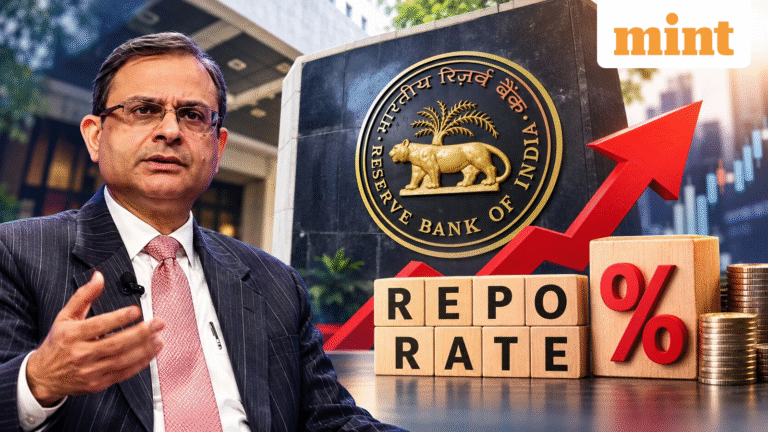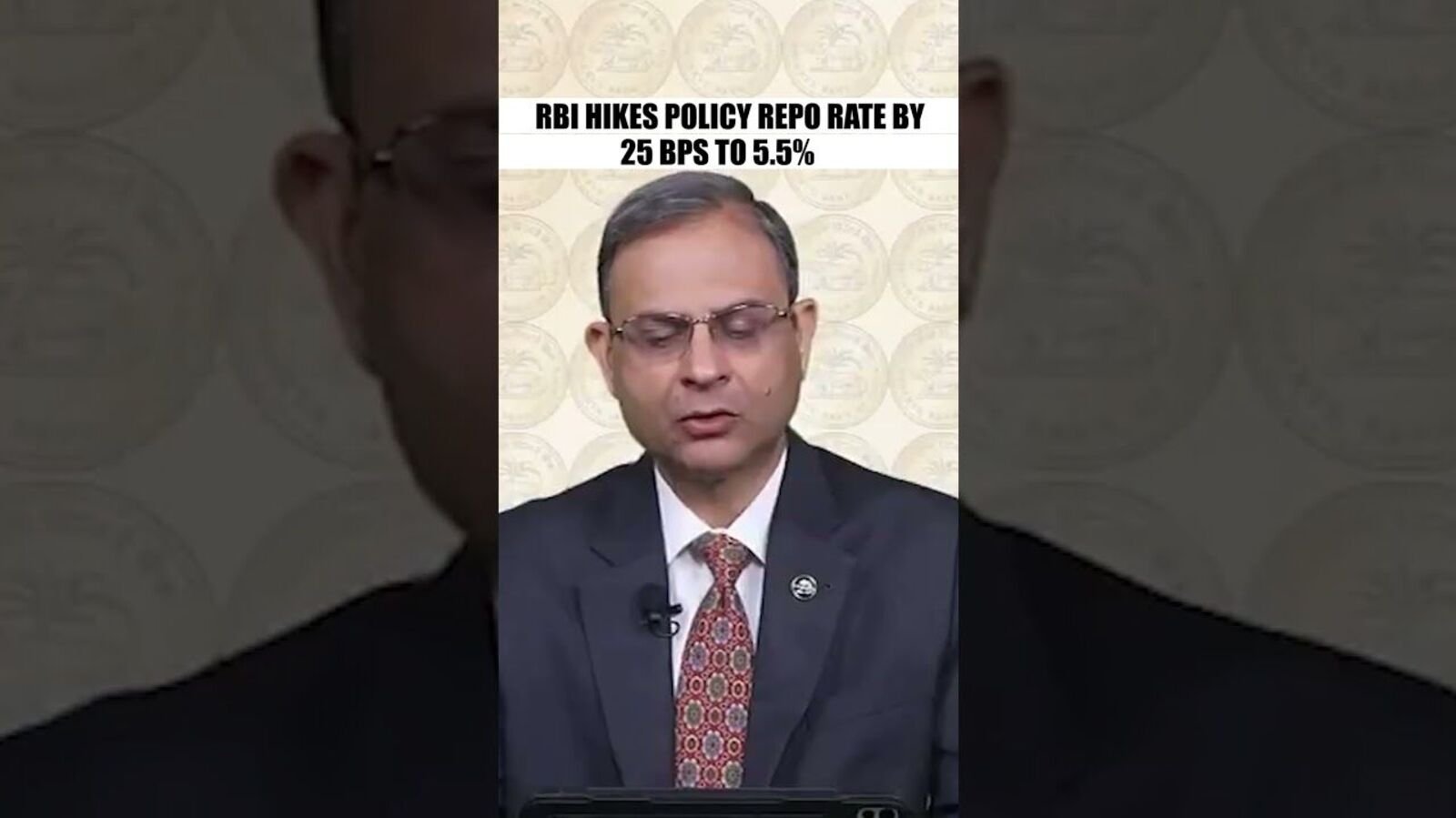
Indian stock markets trimmed losses on Wednesday, October 7, after the Reserve Bank of India’s (RBI) Monetary Policy Committee (MPC) unanimously raised the repo rate by 25 basis points to 5.5% from 5.25%, in line with expectations. This marks its first rate hike in four years amid price pressures.
The recovery came after the RBI raised its real GDP growth forecast for FY27 by 40 basis points to 7.1%. RBI Governor Sanjay Malhotra said domestic economic activity had shown resilience despite global volatility. The central bank also raised its Consumer Price Index-based inflation projection for FY27 to 5.2%, the Governor said.
The Sensex recovered around 450 points or 0.6% from the day’s low to hit an intraday high of 72,969.57, whereas, Nifty recovered 123 points or 0.5% to day’s high of 22,701.6.
At 10:40 am, Nifty was trading 0.5% lower at 22,776.10 and Sensex was down 0.4% at 72,792.29.
Earlier, the Sensex had fallen as much as 547 points, or 0.7%, to an intraday low of 72,520.73, while the Nifty 50 declined 198 points, or 0.8%, to 22,578.25.
At its October 5-7 policy meeting, the MPC also changed its stance to ‘calibrated tightening’. The RBI raised the Standing Deposit Facility rate to 5.25%, while the Marginal Standing Facility rate and bank rate remained unchanged at 5.75%.
In his statement, RBI Governor, Sanjay Malhotra said, “After a detailed assessment of the evolving macroeconomic and financial conditions, developments and the outlook, the MPC voted unanimously to increase the policy repo rate by 25 basis points.”
RBI Governor Sanjay Malhotra indicated that rate cuts were unlikely in the near term, adding to pressure on equities.
Why are Sensex, Nifty falling?
The market reaction was also influenced by global factors. Brent crude prices rose more than 1% to around $102 a barrel after attacks by Yemen’s Iran-backed Houthis on Saudi Arabia amid concerns over crude supplies from the Middle East.
Meanwhile, the US 10-year bond yield rose to 5.31% from 5.27% in the previous session, weighing on investor sentiment. US President Donald Trump also reiterated his claims about US control over maritime traffic through the Strait of Hormuz.
V K Vijayakumar, Chief Investment Strategist at Geojit Investments Limited, said the 25-basis-point rate hike itself had already been factored into market prices, with the RBI’s stance and its assessment of growth and inflation likely to have a greater impact.
“A 25 bp hike in policy rates is inevitable and already discounted by the market. What is not discounted is the monetary stance and the central bank’s view on the emerging growth-inflation dynamics.”
Vijayakumar also pointed to the narrow interest-rate differential between India and the US. He said the combination of rising US yields and a stronger dollar made a rate hike important for limiting further capital outflows and supporting the rupee.
Stocks and sectors
The market breadth recovered but remained weak. On the Sensex, Kotak Mahindra Bank, Bharti Airtel, Bajaj Finance, Eternal and IndiGo were the top gainers, while, Titan was the biggest loser, followed by BEL, Asian Paints, UltraTech Cement, Power Grid and Bajaj Finserv.
Among sectors, Nifty Bank and Nifty Financial Services turned green to trade around 0.2% higher. Nifty Metal was the biggest sectoral drag, falling 1.3%, followed by Nifty Auto, which declined 1%. Nifty FMCG, Nifty Realty and Nifty IT also fell around 0.5% each.
What should investors do now?
Vijayakumar comments suggest that investors should focus beyond the widely expected rate hike and assess the RBI’s stance, the growth-inflation outlook, US bond yields and currency movements. These factors could determine how Indian equities respond to the tighter monetary environment.
Meanwhile, Nishchal Jain, Quant Researcher, Share.Market by PhonePe suggests that investors should avoid panic selling or aggressively chasing sharp rallies. Instead, investors should adopt a disciplined strategy by prioritizing quality large-cap stocks in Banking, FMCG, Auto, and IT while maintaining cash reserves to deploy into high-conviction opportunities on dips near major support levels.
According to Rishabh Nahar, Partner and Fund Manager at Qode Advisors, the real message from today’s MPC is not the 25 bps hike, but the RBI’s willingness to change its reaction function. Moving to calibrated tightening suggests the RBI is no longer comfortable treating inflation as merely a transient oil shock.
“For equity markets, this marks a subtle but important shift: the easy valuation tailwind from lower rates is beginning to fade, and earnings will increasingly have to justify valuations. In such an environment, I would expect the market to reward genuine earnings compounding and pricing power rather than broad-based liquidity-driven expansion,” he noted.
Disclaimer: The views and recommendations made above are those of individual analysts or broking companies, and not of Mint. We advise investors to check with certified experts before making any investment decisions.
About The Author