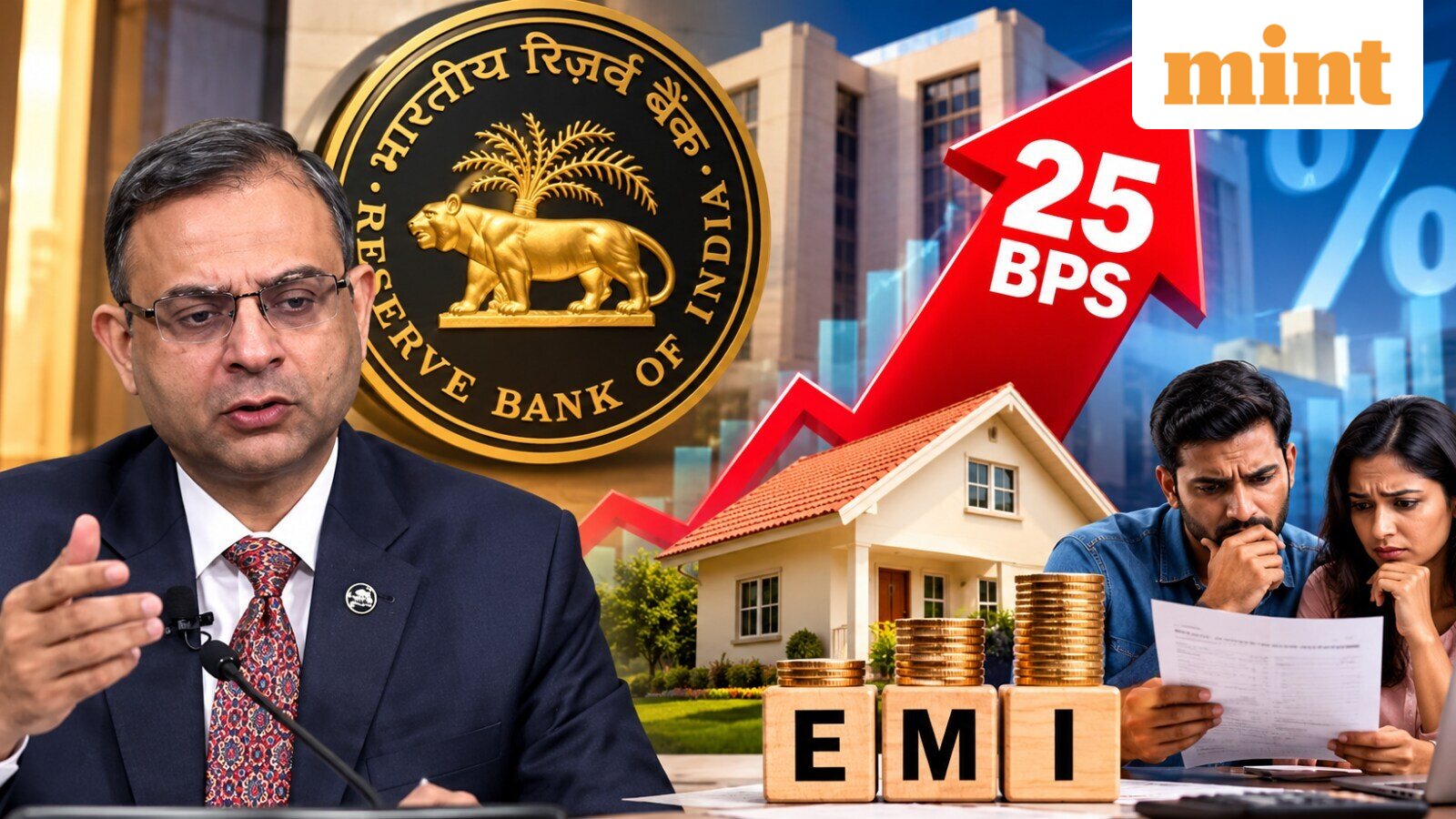
RBI MPC Meeting Highlights: As expected, the RBI MPC raised the repo rate by 25 bps to 5.50%. RBI Governor Sanjay Malhotra announced this in this regard after the three-day Monetary Policy Committee (MPC) concluded on Wednesday. The RBI has raised the repo rate after nearly a three-year gap. RBI Governor Sanjay Malhotra also announced that the MPC stance has shifted from neutral to calibrated tightening.
Following the repo rate increase, the standing deposit facility (SDF) rate stands at 5.25 per cent, while the marginal standing facility (MSF) rate and Bank Rate are at 5.75 per cent. The MPC stance was changed to a calibrated tightening by a majority.
RBI raises GDP guidance by 40 BPS to 7.10%
Governor Sanjay Malhotra on Wednesday raised the country’s real GDP growth projection for the current financial year 2026-27 by 40 basis points to 7.1 per cent, citing the strength of economic activity despite global headwinds.
Announcing the outcome of the RBI Monetary Policy Committee meeting, Malhotra said geopolitical tensions, elevated international commodity prices, additional frictions in global trade and tightening global financial conditions could weigh on India’s growth outlook.
“Taking all these factors into consideration, real GDP growth for this year is projected at 7.1 percent, with Q2 at 7.2 percent, Q3 at 6.9, and Q4 at 6.8 percent,” Malhotra said.
He said the 40 basis points upward revision reflected the strength of economic activity despite the significant global challenges.
Top factors that dictated RBI MPC meeting outcome
The 25 bps rate hike is mainly driven by rising inflation risks, elevated global yields, and resilient domestic growth, which strengthened the case for tighter monetary policy.
The decision by the Monetary Policy Committee marks a shift from its August policy, when it kept the repo rate unchanged at 5.25 per cent and retained a neutral stance while seeking greater clarity on the inflation outlook and growth-inflation balance.
Home loan EMI to rise?
We expect the impact on housing demand to remain measured, particularly in the mid and premium segments, where underlying demand remains healthy. A 25-basis-point increase in the repo rate will push borrowing costs up slightly, but we expect the sector to hold up. The current inflationary environment, driven by the West Asia conflict, high crude prices and supply chain disruptions, is somewhat reminiscent of what we saw in 2022 after the Russia-Ukraine conflict. India’s growth fundamentals, though, are relatively strong, and that gives housing demand a supportive backdrop. What matters from here is where inflation and interest rates go, and whether this increase stays a calibrated response rather than the start of a long tightening cycle.
— Anshuman Magazine, Chairman & CEO – India, South-East Asia, Middle East & Africa, CBRE
RBI Repo Rate Hike: How it will impact your monthly home loan EMI
To put the impact on borrowers in perspective, on a standard ₹50 lakh home loan with a 30-year tenure, a 25 bps rate increase lifts the monthly EMI by ₹852 at a PSU bank, from ₹34,109 to ₹34,961, and by ₹867 at a private bank, from ₹35,821 to ₹36,688. Over the full 30-year tenure, this translates into an additional interest outgo of approximately ₹3.07 lakh for a PSU bank and ₹3.12 lakh for a private bank, assuming the loan runs for the full tenure.
— Atul Monga, CEO & Co-Founder, BASIC Home Loan
About The Author