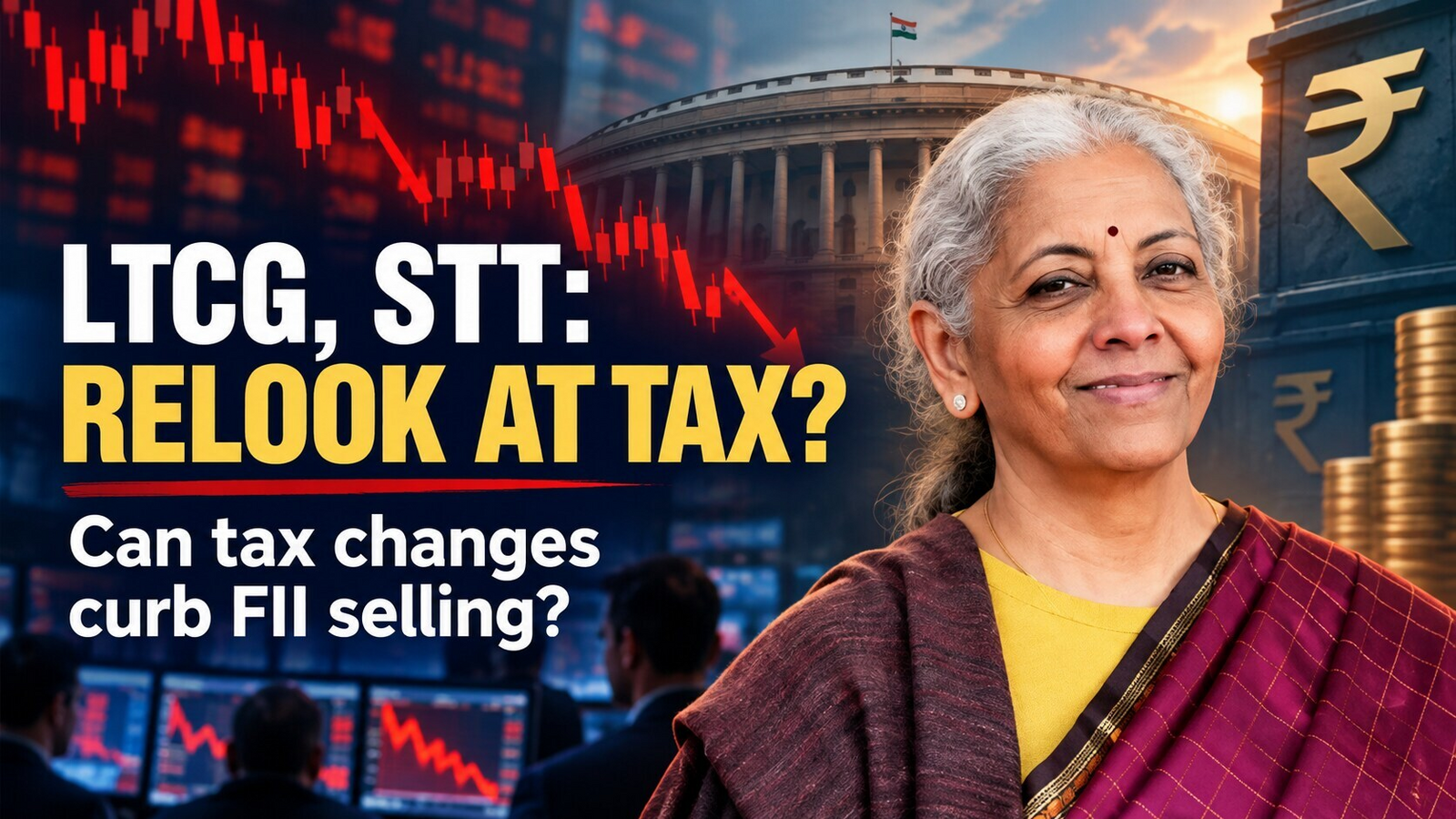
LTCG, STT | FII selling: Amid continuous FIIs’ selling in the Indian stock market, the finance minister Nirmala Sitharaman dropped a hit to relook at the taxation rules for the Indian stock market. Replying to a question at the Bloomberg New Economy Forum 2026, Sitharaman said investors in India and abroad had been debating the taxation of capital gains and different asset classes, adding that the government was open to hearing their views. This has opened the debate, if there will be some relief for the Indian stock market investors coming in the Union Budget 2027?
Should FM announce removal of LTCG, STT?
In its latest Ecowrap report, SBI Research highlighted the need for structural measures by the government to strengthen capital inflows, stating that monetary and foreign exchange interventions by the Reserve Bank of India (RBI) alone may not be sufficient to address the challenges facing the rupee.
“The Government must seriously look into anchoring hot money flows into the equity segment by extending the holding period to say 2-3 years and abolishing the long-term capital gains tax for equity,” the SBI Research report said.
How LTCG, STT impact FIIs?
Highlighting the need for removal of LTCG and STT, Seema Srivastava, Senior Research Analyst at SMC Global Securities, said, “Foreign Institutional Investors (FIIs) evaluate global emerging markets through the prism of net post-tax alpha, ease of operational execution, and macro stability.”
The SMC Global Securities expert said that tax predictability remains the primary lever for reversing FII outflows. The hike in capital gains taxes—short-term capital gains (STCG) to 20% and long-term capital gains (LTCG) to 12.5%—alongside applicable surcharges and the Securities Transaction Tax (STT), creates a friction drag that makes peer markets like South Korea or Taiwan relatively attractive.
Suggesting FM Sitharaman to move one step beyond the LTCG and STT, Seema Srivastava said, “To bring institutional capital back, India needs policy stability: grandfathering commitments to eliminate retrospective surprises, rationalizing high surcharge slabs on non-corporate funds, and extending tax concessions for debt and G-Sec investments under the Fully Accessible Route (FAR). Streamlining withholding tax clearances and double taxation avoidance agreement (DTAA) processes would immediately compress frictional trading costs.”
Is LTCG, STT removal enough to bring FIIs?
Decoding the current taxataion rules and its impact on the FIIs, Seema Srivastava said, “Beyond tax and compliance, market infrastructure and currency dynamics dictate fund flows. Active FIIs seek broader availability of rupee-hedging instruments, higher single-investor stock limits, and deeper corporate bond liquidity.”
Seema said that India’s macroeconomic fundamentals—resilient GDP growth, corporate earnings expansion, and strong domestic liquidity—provide an attractive structural anchor, foreign capital returns durably only when stable post-tax net yields match predictable regulatory boundaries. Treating foreign capital as an integrated partner through competitive, friction-free policies is the fastest catalyst to restore large-scale institutional inflows.
LTCG, STT | What current taxation rules say
Speaking on the taxation rules in the Inian stock market, Avinash Gorakshkar, Founder at Avinash Mentor Research, said, “The LTCG is not a new tax, which is applied on the Indian stock market investors. It was existing during the Vajpayee government also, It was abolished in 2004, when the UPA-1 government came to powr and the then Finance Minister P Chidambaram announced to abolish the LTCG for Indian equity investors, This pumped both DIIs and FIIs, leading to sharp upside in the key benchmark indices and other indices of Dalal Street. However, in the Union Budget 2018, the LTCG was re-introduces, levying 10% tax on stocks with a holding period of 12 months or more.”
Higher STT hitting derivating traders
STT was also increased from 15% to 20% in the July 2024 Union Budget, which alomost broke the backbone of the intraday traders in the derivating segment, said Gorakshkar.
Gorakshkar said that both DIIs and FIIs digested the re-introduction of 10% LTCG tax, but things worsened when it was increased from 10% to 12.50%, and its threshold limit was also increased from ₹1 lakh to ₹1.25 lakh in July 2024 Union Budget.
Disclaimer: This story is for educational and informational purposes only. The views and recommendations above are those of individual analysts or broking companies, not Mint. We advise investors to check with certified financial experts before making any investment decisions.
About The Author