 Imagine cleaning out a relative’s attic and discovering an old gold coin tucked inside a cigar box. It looks different from anything you’ve seen before. A quick online search reveals that similar coins have sold for thousands of dollars. Suddenly, a forgotten family possession could be something much more significant.
But what happens next? How do you determine whether the coin is genuine, what it’s worth, and whether it could be one of the rarest examples known to exist?
In today’s numismatic market, discovering a potentially valuable coin is only the beginning. Authentication, professional grading, historical research, and expert evaluation all help determine what a coin is, why it matters, and what collectors might be willing to pay for it. Blanchard can help collectors navigate these steps and better understand what they have discovered.
Where Rare Coins Are Still Being Found
Important coin discoveries still happen in unexpected places. Inherited collections, estate sales, old safety deposit boxes, and forgotten family possessions can contain coins that have gone unnoticed for generations.
Some discoveries are extraordinary. The Saddle Ridge Hoard, discovered in California in 2013, contained approximately 1,400 gold coins buried in the ground. Many dated to the 19th century, and several were remarkably well preserved. The discovery attracted widespread attention and demonstrated that significant pieces of American numismatic history can remain hidden for decades.
Other discoveries happen when someone finally examines a family collection that has been passed down for generations. The first question is simple: Is the coin actually rare?
Step One: Determining What You’ve Found
Age alone does not make a coin valuable. Its date, mintmark, mintage, survival rate, condition, and demand among collectors all influence its significance and market value.
A small mintmark can make an enormous difference. Two coins produced in the same year may look nearly identical, yet one might be relatively common while the other is exceptionally scarce.
Step Two: Authentication: Is the Coin Genuine?
Counterfeit coins have challenged collectors for centuries, and modern reproductions can be surprisingly convincing. Authentication is particularly important when a coin appears to be exceptionally rare or valuable.
Professional grading services such as the Certified Acceptance Corporation Grading (CACG), Professional Coin Grading Service (PCGS), and Numismatic Guaranty Company (NGC) examine coins for authenticity and condition. For a newly discovered rarity, this process can establish whether the coin is genuine and help identify its specific characteristics.
Step Three: Grading and the Importance of Quality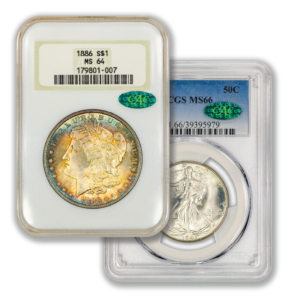
A coin’s condition plays a major role in its value. Professional grading evaluates wear, surface preservation, and remaining detail, but coins with the same numerical grade can still differ in quality and eye appeal.
The importance of looking beyond a coin’s numerical grade helped inspire industry efforts to develop additional quality assessments. John Albanese, who co-founded PCGS and NGC, later founded Certified Acceptance Corporation (CAC) and CAC Grading (CACG), further contributing to how collectors evaluate a coin’s quality.
For a newly discovered rarity, these distinctions can matter. Small differences in preservation and eye appeal can influence collector demand and a coin’s ultimate market value.
Step Four: What Is the Coin Actually Worth?
Once a coin has been identified, authenticated, and evaluated, the next question is value.
Its scarcity, condition, historical significance, collector demand, and comparable auction results all play a role. Past sale prices offer useful benchmarks, but they do not guarantee what a coin will sell for today.
An experienced rare coin dealer can help establish a reasonable valuation range and explain how the coin compares with similar examples. For collectors and families evaluating an inherited collection, this guidance can be particularly useful when deciding which coins deserve further research or professional grading.
Step Five: What Can You Do With a Rare Coin?
Once the research and evaluation are complete, the next step is up to the owner. Depending on the coin and their goals, they have several options:
Keep it: Hold onto the coin as part of a personal or family collection.
Sell it to a dealer: Work with an experienced rare coin dealer like Blanchard to explore its market value and selling options.
Sell it at auction: Offer a particularly rare or desirable coin to collectors through an auction house.
Continue researching: Learn more about the coin’s history, rarity, and potential value before making a decision.
There is no single right choice. Understanding what you have is the first step toward deciding what to do with it.
Not Every Discovery Is Worth Millions
The stories that make headlines often involve multimillion-dollar rarities, but a coin doesn’t need to break an auction record to be significant. It might complete a collector’s set, represent an important moment in American history, or offer a tangible connection to the past.
Even seemingly ordinary coins can hold surprises. A rare mintmark, unusual variety, or exceptional condition can make a coin far more desirable than others of the same issue.
If you discover a potentially valuable coin, avoid cleaning it, as doing so can damage its surfaces and reduce its value. Instead, preserve it as found and consult a reputable numismatic professional.
The Journey Is Just Beginning
Finding a rare coin is only the beginning. Authentication, grading, quality assessments, and historical research help establish what makes a coin significant and what it might be worth.
For anyone who discovers an unfamiliar coin or inherits a collection, working with experienced numismatic professionals can help clarify its history, quality, and market value.
At Blanchard, rare coins offer more than the possibility of a valuable discovery. They provide a connection to the people and events that shaped American history. Sometimes, a coin hidden away for generations is still waiting for its story to be told.
About The Author