

(WO) – Santos produced a record 26.3 MMboe in the third quarter, up nearly 14% from the second quarter and 23% from a year earlier. The gains came as the Barossa gas project reached steady production and the Pikka oil field in Alaska ramped up. Year-to-date production of 71.9 MMboe was about 10% higher than in the same period last year. Santos narrowed its 2026 production guidance to 99–102 MMboe, from 99–105 MMboe. “The inflection point is here, and I expect more to come in the fourth quarter as Barossa continues its journey to high reliability and Pikka gets a full quarter online,” said CEO Kevin Gallagher.
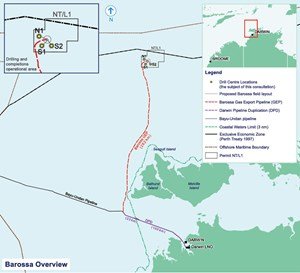
At Barossa, feed gas to Darwin LNG hit a record peak of about 600 MMscf/d. The plant ran at 98.5% reliability and lifted 10 LNG cargoes and two condensate cargoes during the quarter.
At Pikka, seawater injection began, the first oil cargo was lifted in August, and 32 development wells have been drilled so far. Gross production briefly topped 80,000 bpd before the end of the quarter, but it was cut back twice. The first time, a weather event affected the seawater treatment plant, which was still starting up. The second time, the Kuparuk pipeline was shut in after a road accident, and import gas supply to Pikka was suspended during pipeline integrity checks. Production was 69,000 bpd gross at quarter-end. Santos plans to hold output near 70,000 bpd for a short period while water injection replenishes reservoir voidage, then ramp up to 80,000 bpd. “This is a deliberate decision, and part of our disciplined approach to reservoir management,” Gallagher said.
In the Beetaloo sub-basin, Santos drilled the pilot hole of the Jibera South 1 appraisal well to a total depth of 3,457 m in October. The Velkerri A and B shales came in line with pre-drill expectations, and the Velkerri C shales were better than expected. Santos said that supports a “cube” development of all three layers at once. Once wireline logging is complete, it will drill a 3,000-m lateral. Elsewhere, the Halyard 2 well at Varanus Island is producing about 85 TJ per day with no water breakthrough. Construction has also started on the Agogo Production Facility tie-in in Papua New Guinea.
Santos also signed a binding agreement to buy another 3.3% of the Papua LNG project from TotalEnergies, raising its stake to 21% after the state’s back-in. The deal is conditional on regulatory approvals and on a final investment decision, which is planned for the fourth quarter. After the quarter ended, ExxonMobil took over as operator of the project’s upstream component. In Queensland, Santos and its GLNG partners agreed to acquire the Greater Meridian coal seam gas project. Santos will hold 30% and become operator when the deal completes, targeted for late 2026.
About The Author