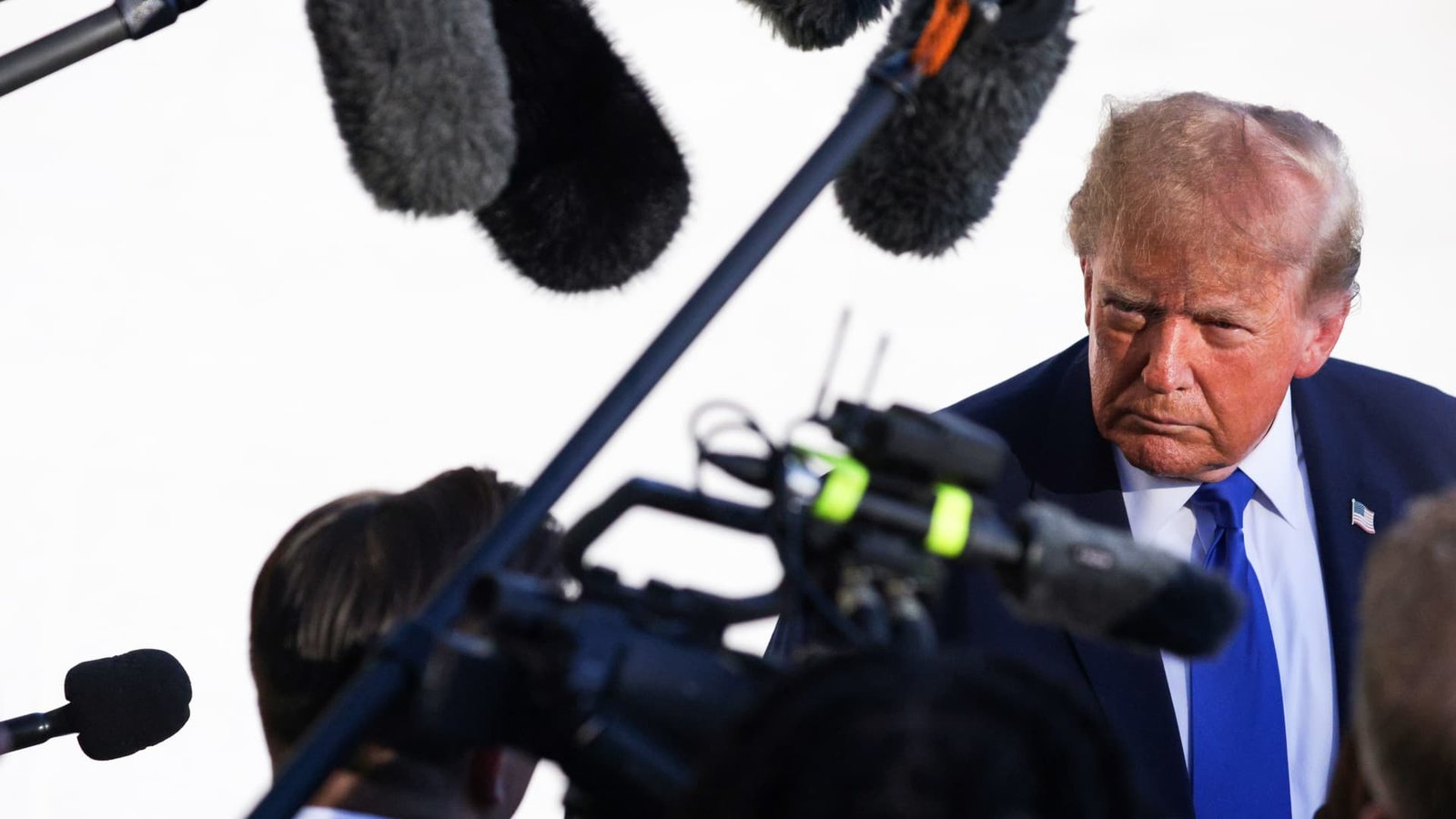
U.S. President Donald Trump stops to speak to members of the media as he departs on the South Lawn of the White House on Oct. 22, 2026 in Washington, DC.
Alex Wong | Getty Images
Three media outlets that President Donald Trump banned from the White House in September, only to have a federal judge’s order restore much of their access, amended their lawsuit Wednesday, seeking to regain full access to serve in a press pool for other reporters in the complex and Air Force One.
The amended civil complaint says that since the judge ordered the White House to allow MS NOW, CNN and Politico journalists into the White House, the White House has blocked those outlets from performing pool functions they long have conducted.
The press pool routinely serves as a key source of information for the public about what a president does or says.
The amended complaint sets the stage for a court fight over whether a president, because of how he or she feels about how a media outlet covers them, can block access to individual media outlets or reporters from areas of the White House that other journalists have access.
“The President’s ban and the White House’s continued exclusion of Plaintiffs from certain [areas] are unlawful retaliation for protected First Amendment activity,” the amended complaint in U.S. District Court in Washington, D.C. says.
The initial ban and subsequent barring of the outlets “from certain White House press areas “brazenly discriminates against Plaintiffs based on their perceived editorial viewpoint; the White House is expressly excluding CNN, MS NOW, and POLITICO because the President dislikes the content of their coverage,” the suit says.
Judge Tim Kelly’s prior orders in the case restoring access for the outlets did not require the White House to restore those outlets’ access to the Oval Office or Air Force One.
Members of the media report from Pebble Beach, the stand-up area for members of the media on the North Lawn of the White House in Washington, DC, US, on Thursday, Sept. 24, 2026.
Al Drago | Bloomberg | Getty Images
Since Trump announced the ban on Sept. 18, “the White House has repeatedly barred CNN from fulfilling its duties as designated television network pooler aboard Air Force One — a role CNN has fulfilled for more than four decades,” the amended suit says.
MS NOW has not participated in the secondary TV pool since that date, and the White House has barred Politico “from two scheduled out-of-town print pool assignments aboard Air Force One,” the suit says.
In pool assignments, journalists agree to share with other media outlets information and images they obtain while acting as a pooler. Pools of White House journalists are arranged daily to cover Trump in locations where space for journalists is limited, such as Air Force One, and other travel outside the White House.
“Defendants have offered no official explanation for any of these exclusions,” the amended complaint says.
“On information and belief, these exclusions reflect an unstated policy to carry out the President’s directive to take his viewpoint-discriminatory and retaliatory ban ‘as far as you can,’ the complaint says.
“Indeed, the President has been explicit that he intends to limit access to the Oval Office to news organizations that cover him favorably, declaring hours after this action was filed that ‘publications that only write negatively . . . shouldn’t be allowed access to the most important Office anywhere in the World,” the suit said.
The suit notes that after Kelly issued a preliminary injunction against Trump’s ban in mid-October, “the White House issued a statement declaring that what it deems the ‘Fake News’ has “no place demanding a spot in the President’s Oval Office.”
President Donald Trump speaks with reporters on the South Lawn of the White House before boarding Marine One en route to Alaska on Tuesday, October 13, 2026.
Tom Williams | Cq-roll Call, Inc. | Getty Images
The amended complaint says the limited ban on pool access violates the Due Process clause of the U.S. Constitution.
“CNN, MS NOW, POLITICO, and their journalists have liberty and property interests in their press credentials and the access those credentials afford to the White House grounds to report on the President and his administration,” the suit says. “That access has long extended to the Oval Office, Air Force One, and other fora that the White House has opened to the press for pool coverage.”
“The ban, and Defendants’ continued exclusion of Plaintiffs from certain White House press areas, deprives Plaintiffs of those interests without meeting the bare minimum requirements of due process: advance notice based on clear standards and an opportunity to be heard,” the suit says.
The suit also said the White House is interfering with CNN’s ability to perform its duties as one of five television networks that “staff, equip, and bear the costs associated with the primary television network pool upon which the American public (and the White House itself) relies for real-time television coverage of the President in the Oval Office, aboard Air Force One, and at the many other presidential events that due to size and other constraints simply cannot accommodate all members of the press corps.”
Trump, when he announced the ban, said he was “sick” of what he called fiction and lies written about him, his administration, and the United States.
On Sept. 19, a day after he announced the ban, journalists from the three media outlets were denied access to the White House grounds and had their passes taken away when they showed up.
Two days later, the outlets sued Trump, White House Communications Director Steven Cheung, Chief of Staff Susan Wiles, and Secret Service Director Sean Curran, seeking to regain access.
District Court Judge Tim Kelly on Sept. 23 issued a temporary restraining order mandating that the White House restore access to the outlets for at least 14 days.
Kelly, whom Trump appointed to the federal bench in 2017, said in his order that the ban appeared to flatly violate two federal appeals court rulings that require advance notice and an opportunity to be heard to journalists whose White House press passes are targeted for revocation.
The White House allowed journalists from the banned outlets in the next day.
On Oct. 13, Kelly issued a preliminary injunction, which indefinitely bars the White House from reinstituting the ban while the outlets’ lawsuit continues in his court.
In issuing that injunction, Kelly not only cited the appeals court decisions, but also said the outlets were likely to succeed on two First Amendment claims in their civil suit, which alleged retaliation and viewpoint discrimination.
Disclosure: CNBC and MS NOW are divisions of Versant Media.
About The Author