A picture shows logos of the Big Tech companies named GAFAM, for Google, Apple, Facebook, Amazon and Microsoft, on June 2, 2023.
Sebastien Bozon | AFP | Getty Images
The tech megacaps are collectively placing a multitrillion-dollar bet that their infrastructure spending will result in many years of profitable growth. But that’s all in the future.
For now, they’re reliant on their legacy businesses — whether it’s online advertising, business software or e-commerce — to fund their artificial intelligence ambitions.
Earnings this quarter revealed new levels of strain on those core businesses and offered an early test of whether these companies can sustain extended bouts of spending. Meta joined Alphabet and Amazon in reporting negative free cash flow, leaving Microsoft as the lone hyperscaler to remain positive in that realm.
Meta posted negative free cash flow of $2.12 billion, while Amazon’s outflows swelled to $42.4 billion and Alphabet’s reached $9.07 billion. Microsoft’s cash generation declined dramatically for a second straight quarter, this time dropping 27% to $18.63 billion, and the company said it will now turn to the bond market as it continues to ramp up AI infrastructure spending.
Hyperscaler earnings over the past two weeks have coincided with intensifying concerns about the overall health and stability of the broader AI sector. Rising interest rates are making it costlier for companies to raise debt, putting pressure on cash-burning neoclouds that have become critical to the global buildout.
While the tech giants have a cushion not afforded to the neoclouds and other players, investors eventually need the historic rates of spending to convert into massive new revenue streams. Nerves are hitting the stocks this week, with Alphabet suffering its steepest drop ever on Thursday and Amazon sliding in extended trading after its report.

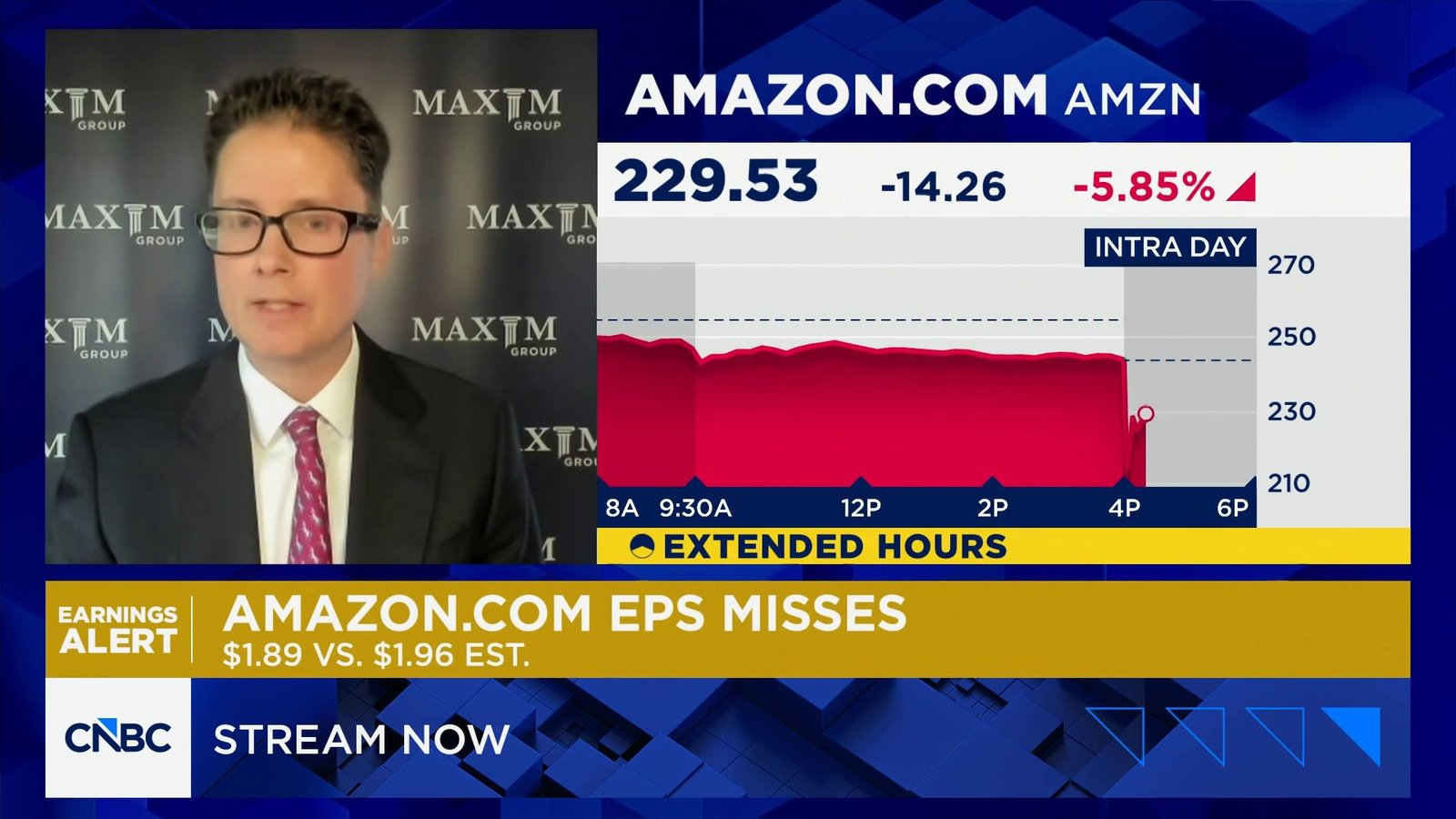
Amazon said growth slowed in both its retail and ad business. Online sales gained 2% year over year, decelerating from 10% a year ago and falling short of analysts’ estimates. The midpoint of Amazon’s revenue guidance came in lower than the $244.5 billion that analysts were expecting, a particularly disappointing figure for the quarter that includes the holiday shopping season.
Meanwhile, Amazon expects capital expenditures this year to reach $220 billion, and analysts project that number will top $280 billion next year, according to FactSet, as the company continues to produce negative free cash flow.
At Meta, investors have responded favorably to the company’s early success with its Muse AI agent app and related foundation models, which present potential new sources of revenue outside of advertising.
But it will take time for these efforts to significantly impact the company’s overall business while it continues spending on data center and computing gear. Capex will reach as high as $145 billion this year, the company says, and analysts see it passing $210 billion in 2027, alongside a deepening cash flow hole.
Investors sent Meta shares down 7% after the earnings report last week even though the company beat on revenue. Meta followed its report by announcing on Monday that it’s planning to raise a total of $95 billion in stock to support its AI investments.
‘Borrowing from the for-now’
Alphabet’s report concerned investors the most.
The company’s core search business saw a third straight quarter of slowing growth and missed analysts’ projections, underscoring the challenges it faces with the rise of ChatGPT, Claude and other AI-powered bots and agents. YouTube-related advertising revenue also came in light.
Mark Mahaney, an analyst at Evercore, told CNBC’s “Closing Bell Overtime” on Wednesday that while Google’s strong cloud revenue was “good news” for the company, its decelerating digital advertising business represented “the overwhelming bad news.”
Forrester analyst Tracy Woo said in an email that “Alphabet’s massive capex investment in infrastructure buildout has been tolerated for now,” but the company “is walking a fine line,” due to the online ad sales misses.
“Weakness in Search and YouTube revenue performance relative to expectations surfaces growing concern about AI displacement of the company’s largest revenue generators,” Woo said. “The issue is less the current earnings miss and more the possibility that future AI spending grows faster than the cash generation of the franchises expected to support it.”
But not everyone is concerned. Bullish investors say that the tech leaders have long histories of operations, and legacy businesses that are dominant enough to prop them up for the foreseeable future.
Christopher Ballard, a managing director at Check Capital Management, noted that Alphabet’s negative free cash flow of $9 billion is tiny relative to the company’s overall business. Its operating income topped $40 billion for the quarter.
Unlike AI model companies OpenAI and Anthropic, which are still unprofitable and spending billions of dollars a quarter on infrastructure, Alphabet has a strong balance sheet, Ballard said.
“They’re borrowing from the for-now in order to invest in the future,” Ballard said. “I think it’s OK, and they’re doing it in a responsible manner.”
Although the hyperscalers didn’t provide specific capex projections for next year, they all implied their data center spending spree will continue to grow, even if it means reporting some uncomfortable metrics.
“Would it be more convenient if this type of acceleration and opportunity happened over 25 years, and you can spread the capex over 25 years?” Amazon CEO Andy Jassy said on Thursday’s earnings call. “Yeah, it might be more convenient, but that’s not the world that we live in, and that’s not the opportunity.”
WATCH: This could end up being Google’s worst earnings reaction as a public company.

About The Author